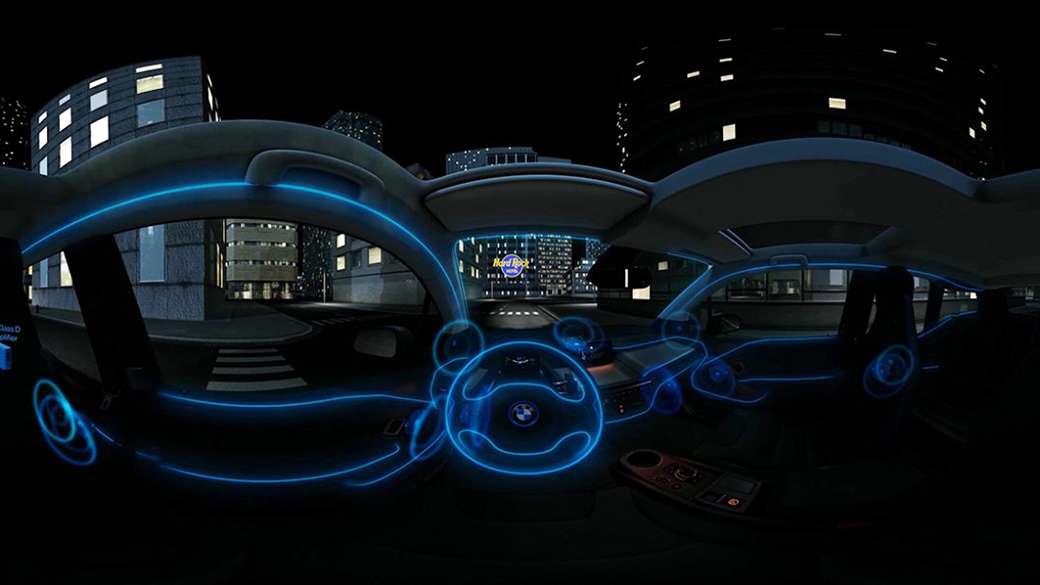
Harman/Kardon BMW at CES Las Vegas (Audio Showroom in VR)
A premium sound system is hard to sell at a trade fair. You can talk about it, show speakers, hand out data sheets. You can only really hear it when you sit in the car, and the car isn’t on every stand.
For Harman/Kardon and BMW I built the sound for a virtual showroom that solves exactly this problem. Visitors at CES in Las Vegas and IAA in Frankfurt put on a VR headset, suddenly sat inside a BMW i3 and could hear for themselves what the premium audio system does compared with ordinary stereo playback.
Why a listening comparison is both the problem and the solution
The core of the application was a direct comparison. On one side the stereo playback of a standard system, on the other a 5.1 surround mix as it plays through the car’s premium system. Visitors could switch between the two modes.
That sounds simple and has a catch I run into on almost every 3D audio project. Spatial sound is unfamiliar to many people. Someone who has listened to stereo for years doesn’t automatically perceive sound around them as better, but first of all as different. A comparison with stereo isn’t always what you want, because it points listeners to the differences before they have settled into the experience.
On the other hand, this very comparison is the strongest tool for showing what 3D sound actually does. Without it, spatial sound remains a claim. With it, everyone immediately hears that the music no longer only comes from the front but fills the cabin. For a trade fair stand where people have two minutes, that is hard to beat.
How a CGI car became a space to listen in
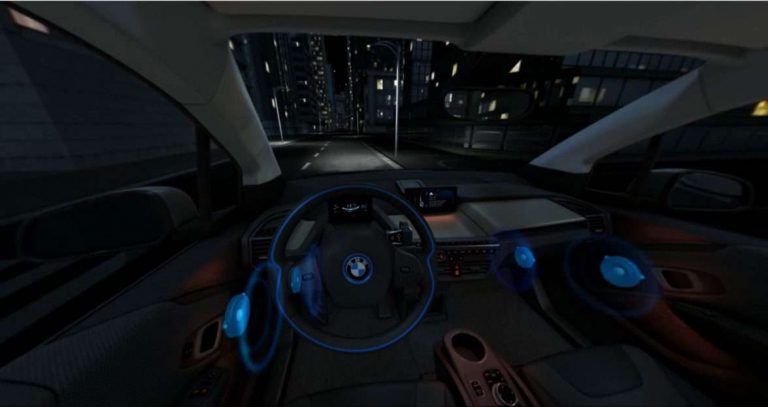
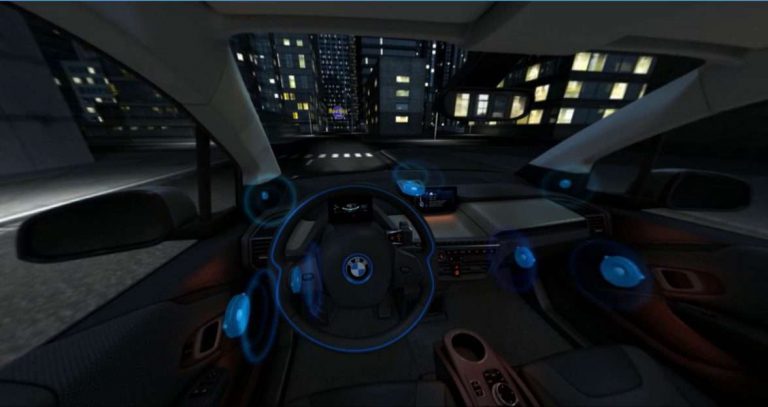
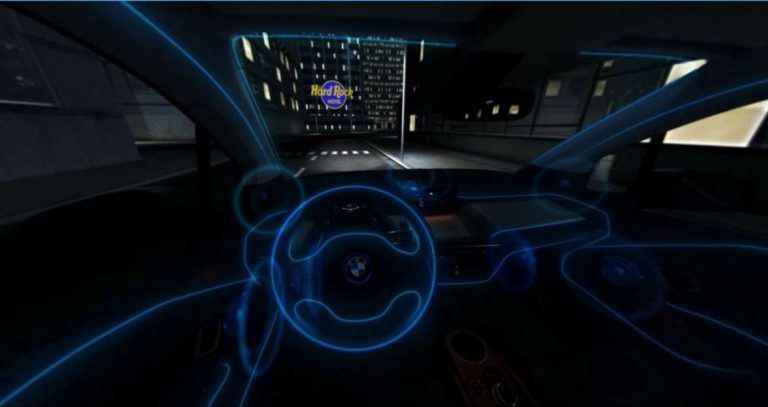
The whole thing was built as a stereoscopic 360° video based on a fully computer-generated interior of the BMW i3. A dedicated app was programmed for the Samsung Gear VR that played picture and sound together. It ran reliably, with no failures at the fair. The project was later developed further for the Oculus Rift.
Technically, the sound ran with live head tracking. When visitors turn their head, the sound turns with it, and the speakers stay in their positions in the car instead of moving with the head. It was rendered as binaural sound over headphones and built in Higher Order Ambisonics. Only that creates the feeling of really sitting in the car rather than in front of a video.
The Rift version added a step that connects the virtual and the real world: the audio output was extended to the BMW’s twelve-speaker hi-fi system. The 5.1 mix then played directly through the speakers in the car.
Where the real work was
The hard part wasn’t the technology but the fine-tuning. On one side, the mix couldn’t stray too far from the original song. Anyone who knows a track and hears it in the car notices immediately when it has been bent, and then they stop believing the sound system too. On the other side, visitors were supposed to come out of the headset after two minutes at a fair with an impressive result.
The answer lay somewhere in between, in a slightly heightened hyperreality. As realistic as possible so it stays credible, and just enough more to create a wow effect. It took some back and forth until that was right. That is normal for this kind of tuning, and it is exactly where experience helps: knowing at which point a mix impresses and when it starts to sound artificial.
What came of it
The result was an application that ran at two of the most important fairs for automotive and consumer electronics, CES in Las Vegas and IAA in Frankfurt. Visually the virtual i3 was impressive, and that is exactly why the sound had to keep up. When picture and sound work together, a showroom like this works. When they don’t, visitors notice they are looking into a headset.
For me that is the core of every virtual showroom for audio: the product is the sound, so the sound has to play the lead. The picture puts visitors in the car, the sound convinces them. A related project on in-car entertainment is the Samsung x BMW immersive car audio case.
Frequently asked questions about virtual showrooms for audio
How do you present a sound system at a trade fair without a car? With a virtual showroom. Visitors sit in the cabin via VR headset, the sound plays with head tracking over headphones, and the speakers stay in their positions in the car. For Harman/Kardon and BMW this ran at CES and IAA.
Does a stereo versus 3D sound comparison make sense? Usually yes, with care. Spatial sound is unfamiliar and at first sounds different in a direct comparison. At the same time, nothing shows faster what 3D sound actually does than putting the two side by side.
How much can a showroom mix be exaggerated? Only slightly. If it strays too far from the original, listeners stop believing the system. If it stays too close, the effect is missing. The goal is a hyperreality: credible, but a touch more impressive than reality.
Does a virtual showroom also work with real speakers? Yes. In the later version, the 5.1 mix played directly through the BMW’s twelve-speaker hi-fi system, with the VR headset providing the picture.
Planning a showroom or trade fair stand where sound is the product?
Concept, mixing and tuning from one source.
Get in touch