
Sound Haptics: Feel Immersive Tactile Audio Feedback
Content
Sound haptics turn an audio signal into vibration, so the thing you hear is also something you feel. On a phone that means a light tap under your finger as you type. In a production it can mean a vest that shakes with the low end of a 3D mix. This article covers both, and where the marketing around it stops being accurate.
Disclaimer: the first draft of this article came out of an AI and it was mediocre. I rewrote it against my own productions. Every claim below is either something I have built or something with a source.
What are sound haptics?
Sound haptics are vibrations generated from an audio signal rather than triggered as a fixed buzz. The device or the wearable follows the waveform, so a keystroke feels like a short tap and an explosion feels like a heavy pulse. The difference to a plain vibration motor is that the pattern carries information instead of just announcing that something happened.

Where do I find Sounds & Haptics on iPhone?
On iOS the menu is Settings › Sounds & Haptics. That screen holds the ringer and alert volume, the ringtone and text tone, and the switches for keyboard feedback and system haptics. Per-contact vibration patterns live one level deeper, under the individual contact in the Contacts app.
Apple drives this through the Taptic Engine, a linear resonant actuator rather than the older rotating-mass motor. An LRA starts and stops far faster, which is why an iPhone can render a short crisp tap where an older phone could only produce a smear.
What are haptics on the phone?
Haptics on a phone are the tactile responses the device gives to your input: the tap when you press a key, the click of a picker wheel, the double pulse of a notification. On Android the equivalent settings sit under Settings › Sounds and Vibration › Vibration Intensity, with per-contact patterns again set inside the contact entry.
Sound haptics in gaming and VR
Game controllers were the first place most people met a real waveform-driven haptic. The PlayStation 5 DualSense uses voice coil actuators plus adaptive triggers, so resistance and vibration both change with what is happening on screen. Meta ships Meta Haptics Studio and a Haptics SDK for Unity, which lets developers author haptic tracks the same way they author audio.
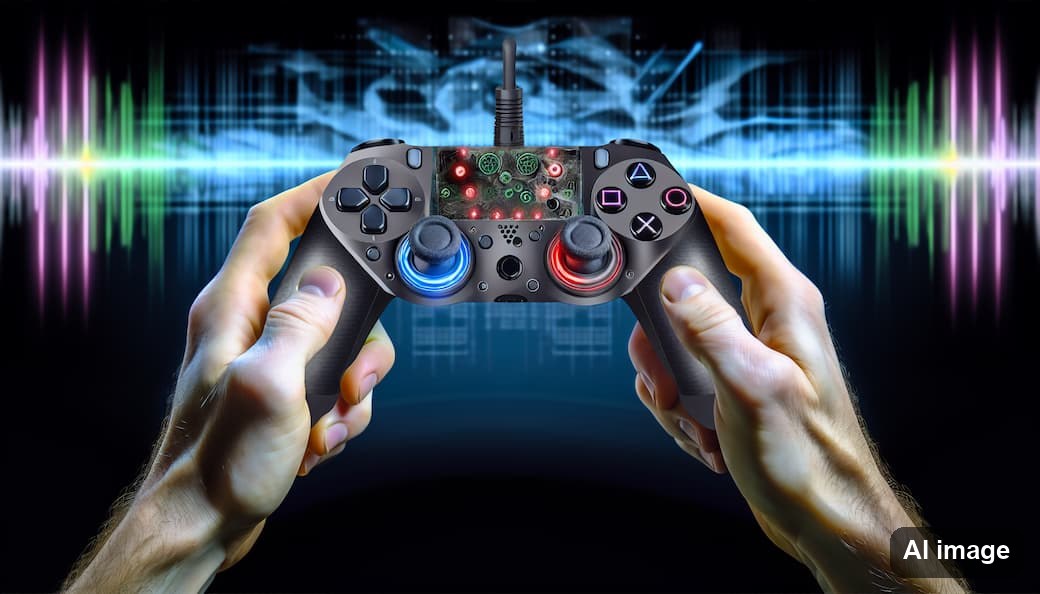
This is the part of the field I work in, and my honest read is that haptics is the cheapest large gain in immersion available right now. Vision and hearing are handled well by current headsets. Touch is not, and adding even a coarse tactile layer does more for presence than another increment of audio resolution. On what the audio side alone contributes, see the benefits of VR sound.
How I use sound haptics in productions
For DKMS I built Destiny's Ride, a 3D audio experience in a shipping container that toured festivals. To make the emotional arc land physically, visitors wore vibration vests. I describe them as strap-on subwoofers: they convert the audio to haptics in real time and stay in sync with the 3D audio content, so people did not only hear the piece, they felt it. At the premiere at the surf festival on Fehmarn, close to 500 people registered as bone marrow donors.
That is the useful version of sound haptics. It is not an effect layered on afterwards. The low end of the mix drives the vest directly, which means the haptic track is a mixing decision, not a post-production add-on.
Automotive: what the fourth D actually is
Mercedes markets the Burmester 4D system with a spec sheet: 31 speakers, six of them 3D speakers radiating from above, four near-ear speakers in the front seats, an 18.5 litre subwoofer, eight transducers at two per seat, two amplifiers, 1750 watts.
None of that is the fourth dimension. The extra D is the exciter that turns sound into vibration you can feel through the seat.
Here I will defend the label, which is unusual for me. I spend a lot of time arguing that 8D audio is a made-up number, because rotating a signal inside the same two channels does not add a dimension. A vibration you feel in your body is a genuinely different sense. If a system reaches a new sensory channel and users report the effect, calling it a fourth dimension is fair. My complaint about the Mercedes launch was never the technology, it was that the PR department appeared not to have asked the engineering department what the word meant.
Read more on Automotive Audio
What still gets in the way
Three things, in the order they bite. Latency first: audio and vibration have to arrive together, and a few milliseconds of drift reads as a broken effect rather than a late one. Power second, because a wearable that shakes for an hour is a battery problem. Hardware third, because most actuators still cannot render a wide bandwidth, so anything above the low mids has to be translated rather than reproduced.
Frequently asked questions
What is sound haptics for?
It carries information through touch that would otherwise have to be seen or heard. On a phone that means confirming an input without looking. In an immersive production it means the body registers an event before the conscious mind processes the sound.
What are haptics on an iPhone?
Tactile feedback produced by the Taptic Engine when you interact with the interface: keyboard taps, picker clicks, Haptic Touch, notification patterns. They are configured under Settings › Sounds & Haptics.
Should system haptics be on or off on iPhone?
Personal preference. There is one practical argument for leaving them on: with the ringer silenced, haptics are the only channel left that tells you an input registered.
What does play haptics in silent mode mean?
It keeps tactile feedback active while sound is muted, so taps and notifications are still felt. The switch is in Settings › Sounds & Haptics.
Is sound haptics the same as a subwoofer?
No, though they overlap at the bottom. A subwoofer moves air and you feel it because the room is loud. A haptic actuator drives your skin directly and can stay silent, which is why it works in a headphone-only setup where a subwoofer would not.
Back to the BlogLet’s talk about your project
Planning an installation where people should feel the sound and not only hear it?
Get in touch →Related Articles
VRTonung learning - THE spatial audio course for immersive media
Martin Rieger (VRTonung) - Interview VDT-Magazin
MPEG-H Audio vs. "Dolby Atmos" - there is a winner!
The Great 3D Audio Content Overview: inspiring demo examples
Automotive Audio: Why 3D Sound in Cars Needs Content, Not Speakers