
Destiny’s Ride – Blood Cancer (3D Audio Experience)
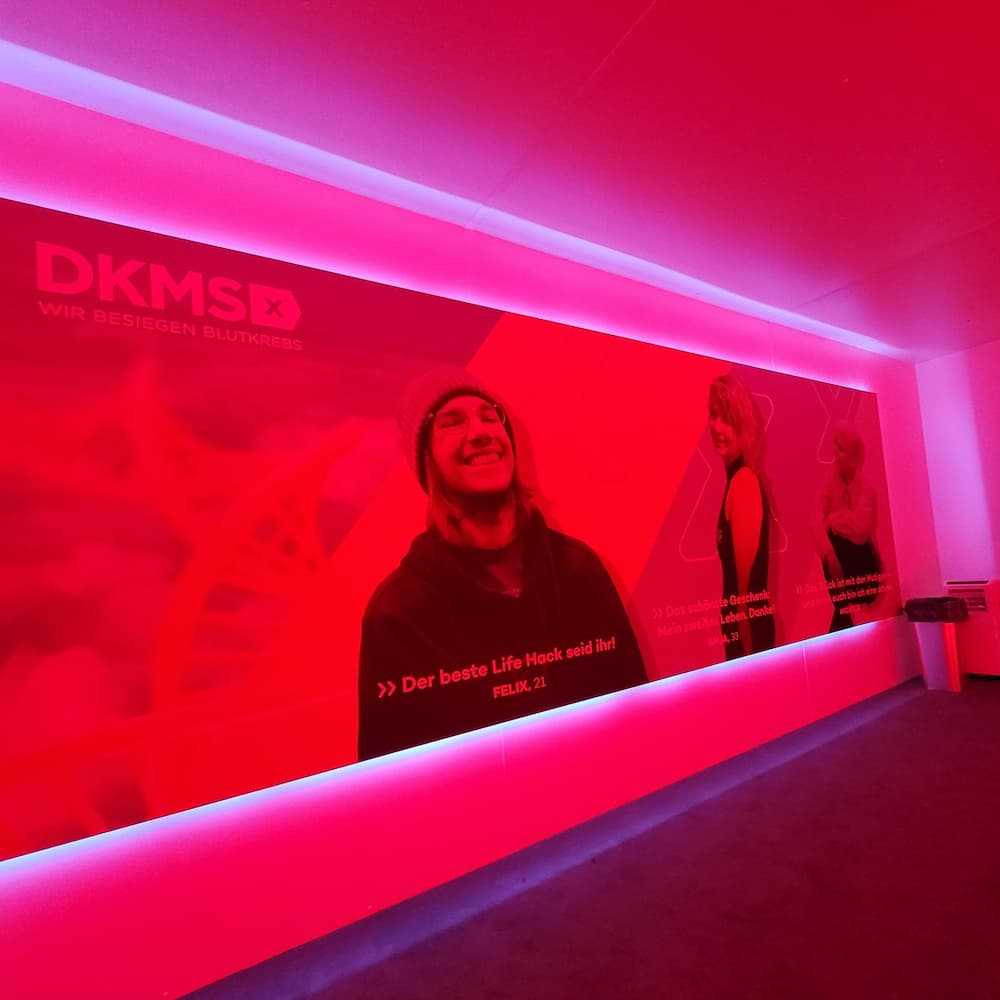
For most people, blood cancer feels far away. You read about it, maybe you donate once, but the feeling that it could affect you rarely sets in. “Destiny’s Ride” was meant to change that: a container at festivals that you walk into, put on headphones and for five minutes experience the story of someone who survived blood cancer because a stranger donated stem cells.
DKMS wanted to reach young people in particular and motivate them to register as stem cell donors. The concept was developed in 2022 by JOKE Event AG, which is also how the job came to me. I conducted the interviews with the patients, developed the stories with the writing team and did the recording and post-production in 3D audio. 3D audio can be more than marketing hype; here it solved a real problem.

Why a story about blood cancer only works through the ears
The question at the start was: how do you tell a story that grips people without them walking out with a bad feeling? People were meant to develop empathy, understand why blood cancer concerns all of us, and in the end want to do something themselves.
The challenge was to convey these emotions not through pictures but purely through sound. With 3D audio, the person whose story you hear seems to be standing right next to you. In stereo it would not have worked, because the voice stays inside your head instead of in the room.
The interviews already showed that this would carry. The patients spoke surprisingly openly about their illness, and listening gave you goosebumps at times, because you immediately ask yourself: this could happen to me too. That is exactly where we wanted to go with the stories.

How interviews became three stories for three festivals
From the interviews we built three stories, one per target group: Anja, the windsurfer, for the surf festival on Fehmarn, Felix, the gamer, for Gamescom, and Mickela, the singer, for music festivals like Wacken. Each story plays in its own world, some in a car, some outdoors, one in a gaming world. They are told with different means: sound collages that slowly get listeners used to spatial sound, flashbacks in the patients’ first-person perspective and scenes in which you are there as an observer.
In the film it sounds like this: a keen windsurfer is still on her board one day, shortly afterwards she has to go to hospital immediately. The diagnosis is blood cancer, a fifty-fifty chance, weeks of tests, therapy and transfusions, and Covid on top. Then the call that a donor has been found. A stranger saved her life without knowing her.
The biggest challenge was length. The container held a maximum of four people, and each could choose one of the three stories. So that everyone came out at the same time, each story could only be five minutes long, and all of them had to be exactly the same length and dramaturgically comparable. With such different worlds and sounds you can’t plan that to the second. We still managed it.
So that you don’t just hear the story but feel it, visitors wore vibration vests. These wearable subwoofers turned the sound into haptics in real time and ran in sync with the 3D audio, fitting the theme of an emotional rollercoaster.
What came of it
The best moment was always the exit. People went into the container, chose their story and came out with the feeling: this concerns me too, and I can make a difference. Right outside the door they could register straight away.
At the premiere at the surf festival on Fehmarn, according to DKMS, almost 500 people registered as stem cell donors.
For me the project shows what 3D audio can do in event marketing when it isn’t used as an effect but as closeness. A voice standing next to you reaches people where a poster can’t.
Frequently asked questions about 3D audio experiences at events
Why 3D audio instead of video for an emotional topic? Because sound can come very close. With 3D audio the narrator seems to stand next to you; in stereo they stay inside your head.
How long should a listening experience at an event be? Short enough for the flow to work. For Destiny’s Ride it was five minutes per story, all exactly the same length, so that up to four visitors could start and come out together.
What do vibration vests add to the sound? They make the sound physically tangible. The vests turn the audio signal into vibration in real time and run in sync with the 3D audio.
Can a listening experience be adapted to different target groups? Yes, with several stories. Destiny’s Ride had three stories for three festivals, from a surf festival to Gamescom.
Planning an event experience that should get under the skin?
Story, interviews, recording and 3D mix from one source.
Get in touch