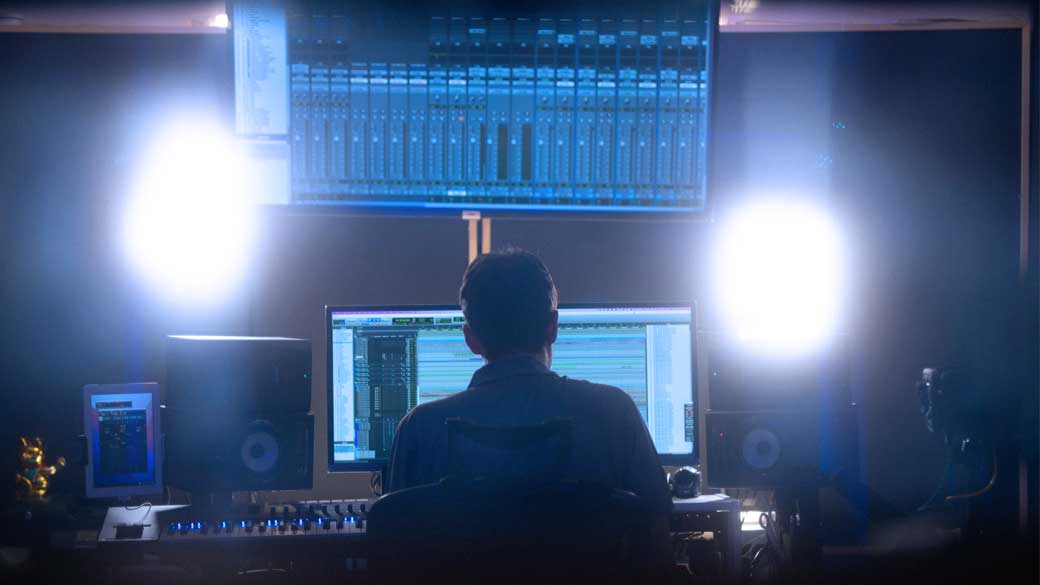
Dolby Atmos studio: Why produce here spatial audio now?
Content
A Dolby Atmos studio is a room certified to monitor object-based audio, usually on a 7.1.4 speaker layout with a renderer and a monitor engine in the signal path. Whether your project needs one is a separate question, and for a lot of immersive work the answer is no. This article explains what such a studio actually does, when it is the right spend, and how to pick the person rather than the room.
Disclaimer: the first draft of this article came out of an AI and described a facility rather than a person. I have rewritten it in the first person. I work as a spatial audio sound designer in Munich, with colleagues and partner studios when a project needs a room.
What is the state of Dolby Atmos studios today?
Immersive audio stopped being a trend some time ago, and the reason is headphones. Nearly everyone owns a pair, and every pair is a two-channel spatial playback system. That has quietly made spatial audio the default distribution case rather than the exception.
The studio infrastructure caught up in parallel. Facilities that already had surround rooms extended them upward, and the renderer moved from a specialist box to software you can run on a laptop. Both things are now true at once: there are more Atmos rooms than ever, and you need one less often than you used to.

What a Dolby Atmos studio is actually for The term itself is worth a second look: immersive sound is more than 3D music.
Three things, and only three.
Monitoring on speakers. Hearing what the renderer produces on an actual array, not just what the binaural fold-down suggests it produces.
Downmix verification. Checking that the same master survives 7.1, 5.1 and stereo, because most of your audience will hear one of those rather than the full layout.
Soloing paths. Listening to only the front height speakers, for example, to know what is really running up there. This is why the monitor engine matters more in an immersive room than in a stereo one: you need to set downmixes, hear the binaural version, hear 5.1 and 7.1, and isolate individual paths.
Everything else in the room is a normal studio.
Which speaker setup?
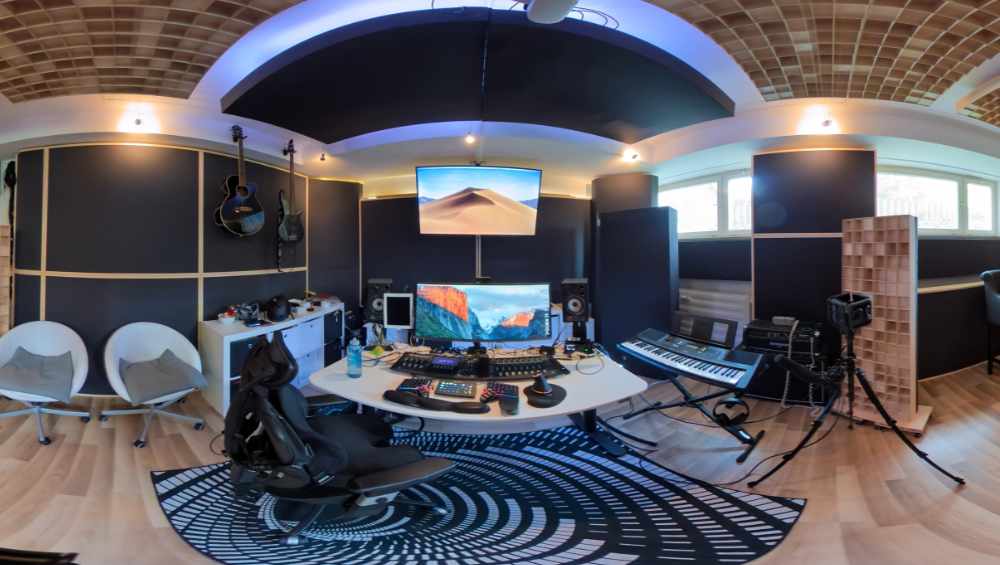
7.1.4 is the common recommendation, because 7.1, 5.1, stereo and 9.1 are all contained within it. For a dome or a planetarium it does not give you a real dome, but you do get X, Y and Z axes with homogeneous speaker distribution, which is enough to work.
Do you need a Dolby Atmos studio for your project?
Ask what you are delivering.
| Deliverable | Studio needed? |
|---|---|
| Atmos music master for streaming | Helpful, not mandatory. The Production Suite renders binaurally |
| Film or trailer in Atmos | Yes, at the mix stage. The speaker render has to be verified |
| VR, AR or a headset experience | No. The target is headphones and the renderer is the game engine |
| Installation with a speaker array | No, but you need access to the actual array |
| 360° or 180° video | No. Ambisonics delivered to a player, checked on headphones |
Most of the work I am asked about sits in the lower three rows. An event installation, a VR piece, a 360° film: none of those are delivered as an Atmos master, so none of them need Atmos certification. Paying for a room you do not use is the most common way immersive audio budgets get spent on the wrong thing.
Dolby Atmos is one slice, not the whole field
Most discussions about 3D audio only talk about Dolby Atmos, and Atmos is a small section of the whole spatial audio universe. It is a shame how rarely anyone talks about the rest, because there are use cases that add far more value to an experience than simply being immersive.
Two examples of what falls outside Atmos entirely. Ambisonics, which is what a 360° video needs, because the sound field has to rotate with the picture. And game-engine audio, where nothing is mixed in advance at all and the renderer builds the scene at runtime from the player’s position. See immersive audio formats for how these relate.
If you want the format itself explained first, start with What is Dolby Atmos.
Is 3D audio the same as Dolby Atmos?
No, and the confusion costs people money. Dolby Atmos is a brand for an immersive experience delivered over several different codecs. 3D audio is the whole category of techniques for placing sound in space, of which Atmos is one commercial implementation.
The practical consequence: a device carrying a Dolby Atmos logo tells you nothing about whether the content is spatial or whether the playback is any good. You can enjoy 3D sound without the need for special speaker arrangements, and you can also have an Atmos badge on something that does nothing at all.
How to choose who does the work
Judge the person, not the room. Concretely:
Ask what they have delivered in your format. An Atmos music mixer and a VR sound designer share a vocabulary and almost no workflow.
Ask how they handle the headphone case. If the answer involves pressing a binauralize button at the end, keep looking. The binaural render is a design decision made per object, not an export setting.
Ask what they would leave in stereo. Anyone who says everything gets spatialized has not thought about bass, and your low end will suffer for it.
Ask to hear something on your own headphones. Not in their room, on their system, at their level. Spatial processing usually gets louder as well as wider, and louder always reads as better.
How I work: my own focus is the design and production side of spatial audio for events, film, VR and installations. For Dolby Atmos music mixing I bring in a mixing engineer who does it full time, and for anything needing a certified room I work with partner studios. You get one point of contact and the right person on the desk, and I tell you which is which before we start rather than after the invoice.
So if you are looking for Dolby Atmos, ask. Either it is a fit or I will tell you who is a better one, and that conversation costs nothing.
What the format actually gives you creatively
Sound big, and sound enveloping, are not the same goal. Atmos is very good at the cinema feeling: reverb, height, a room around you. It is less good at pressure, and a lot of Atmos music arrives sounding roomier and weaker than the stereo it came from.
Where spatial audio earns its keep is where position carries meaning. A voice that comes from where the character is. An event where the audience is immersed in the action rather than facing a stage. A haptic layer that makes the low end something you feel. Those are decisions about storytelling, and the format is downstream of them.
More on the range of applications in 3D audio content and immersive sound.
Frequently asked questions
What is a Dolby Atmos studio?
A room set up to monitor and verify object-based mixes, typically on 7.1.4, with a renderer and a monitor engine that can produce and check the downmixes.
Can I mix Dolby Atmos without a studio?
Yes. The Dolby Atmos Production Suite includes binaural monitoring, which is enough to produce a valid master. A room buys certainty about the speaker render, which is a different thing from a good mix.
What does a Dolby Atmos mix cost?
It depends almost entirely on the number of stems and how much of the material has to be rebuilt rather than placed. Ask for a quote against your actual session, not against a track count.
Do I need Dolby Atmos for VR?
No. VR audio is rendered at runtime by the game engine from the listener’s position, which is a different architecture from a pre-rendered Atmos master.
Is a Dolby Atmos studio needed for 360° video?
No. 360° video wants Ambisonics, because the sound field has to rotate with the viewer’s head, and that is checked on headphones.

Let’s talk about your project
Not sure whether your project needs an Atmos room or something else entirely? That is usually a ten-minute conversation.
Contact me now!