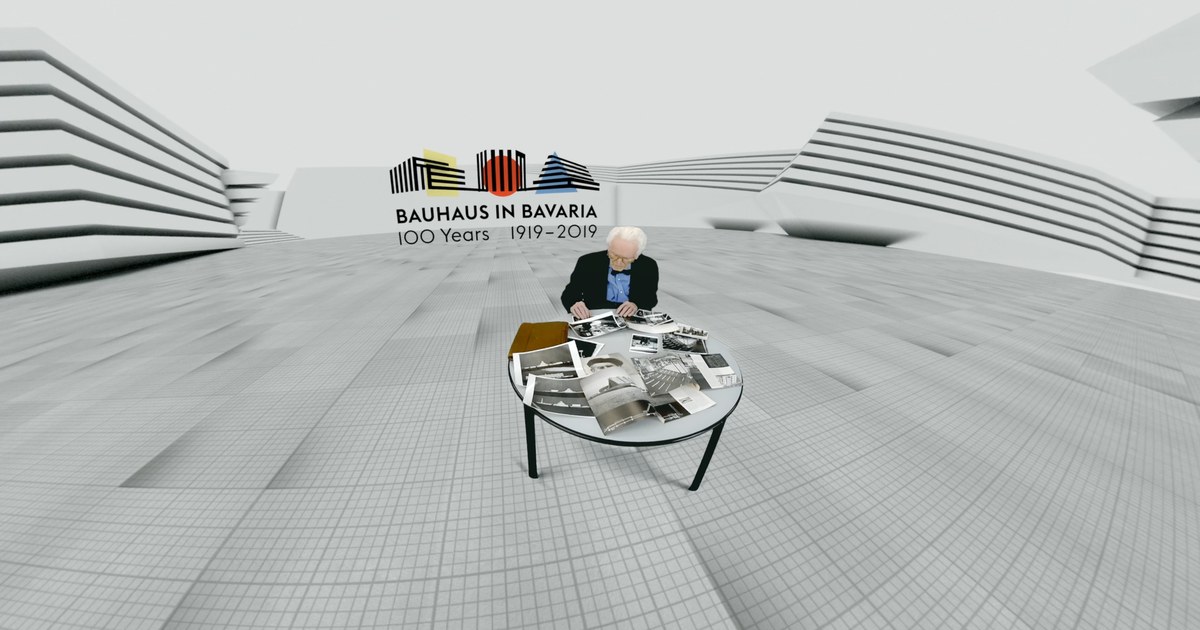
Bauhaus in Bavaria – 360° VR Documentary with 3D Audio from Headset to Dome
When the Bauhaus turned 100 in 2019, the world looked at Weimar and Dessau. Hardly anyone knew that Walter Gropius left two of his most striking industrial buildings in Bavaria: the Glass Cathedral in Amberg and the Rosenthal factory am Rotbühl in Selb. The 360° film “Bauhaus in Bavaria” set out to close that gap, an immersive trace of the late friendship between architect Walter Gropius and entrepreneur Philip Rosenthal.
The film was produced by Munich-based Schwarzbild Medienproduktion, with Kevin Müller of Visual Vitamin as 360° supervisor and director of photography. I joined the crew as 360 Sound and was responsible for the entire audio side: location recording at the original sites, sound design, music integration, and the final mixes for VR headsets, YouTube, and eventually a walk-in projection dome.
Why a story without archive footage needs sound as its narrator
Almost no moving images exist from Gropius’ years in Bavaria. The story is therefore told as an essay built on the memories of Alex Cvijanovic, Gropius’ long-time collaborator, which also took the crew to Boston. The encounters between Gropius and Philip Rosenthal, the construction of the buildings, factory life in the 1960s, even the flamingos the two brought to Selb: the production had to rebuild all of it from unpublished archive photos, animated sketches, and newly shot 360° material. This is where sound becomes the strongest storytelling tool. Where the picture can only show a still photograph, the sound design keeps the scene alive: paper rustles, a factory hall breathes, a kiln glows audibly behind the viewer’s back.
A 360° film adds a second constraint: nobody controls where the audience looks. Spatial audio therefore does the directing. It pulls attention to where the story happens. The score uses this principle quite literally. Both protagonists received their own musical motifs that always play from their position in the scene. If you hear Gropius, you know where Gropius is.
On top of that, “Bauhaus in Bavaria” was conceived not only as a linear film but as a virtual reality experience that lets the viewer step into Gropius’ mind. An experience like this does not forgive a flat audio track. The moment sound stops reacting to head movement, the illusion collapses.
Even the Bauhaus design vocabulary itself became a sound concept. The circle rotates around the viewer’s head, triangle and square received their own rhythmic figures. The abstract intro of the film is carried by this listening logic derived from Bauhaus teaching.
How a running porcelain factory became a walkable soundscape
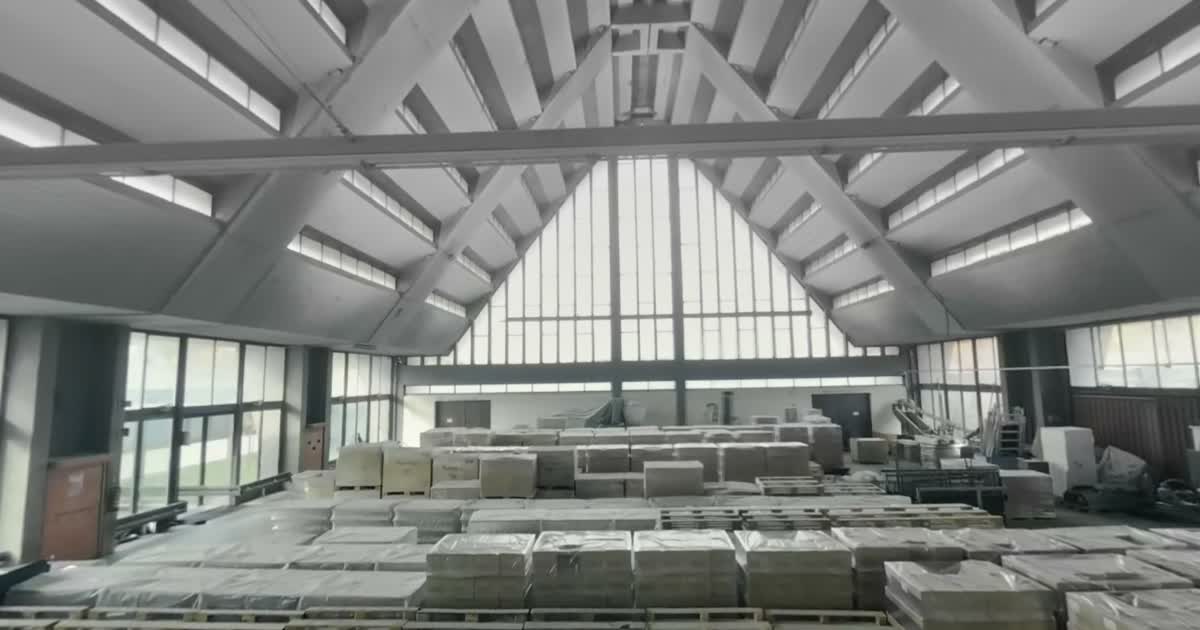
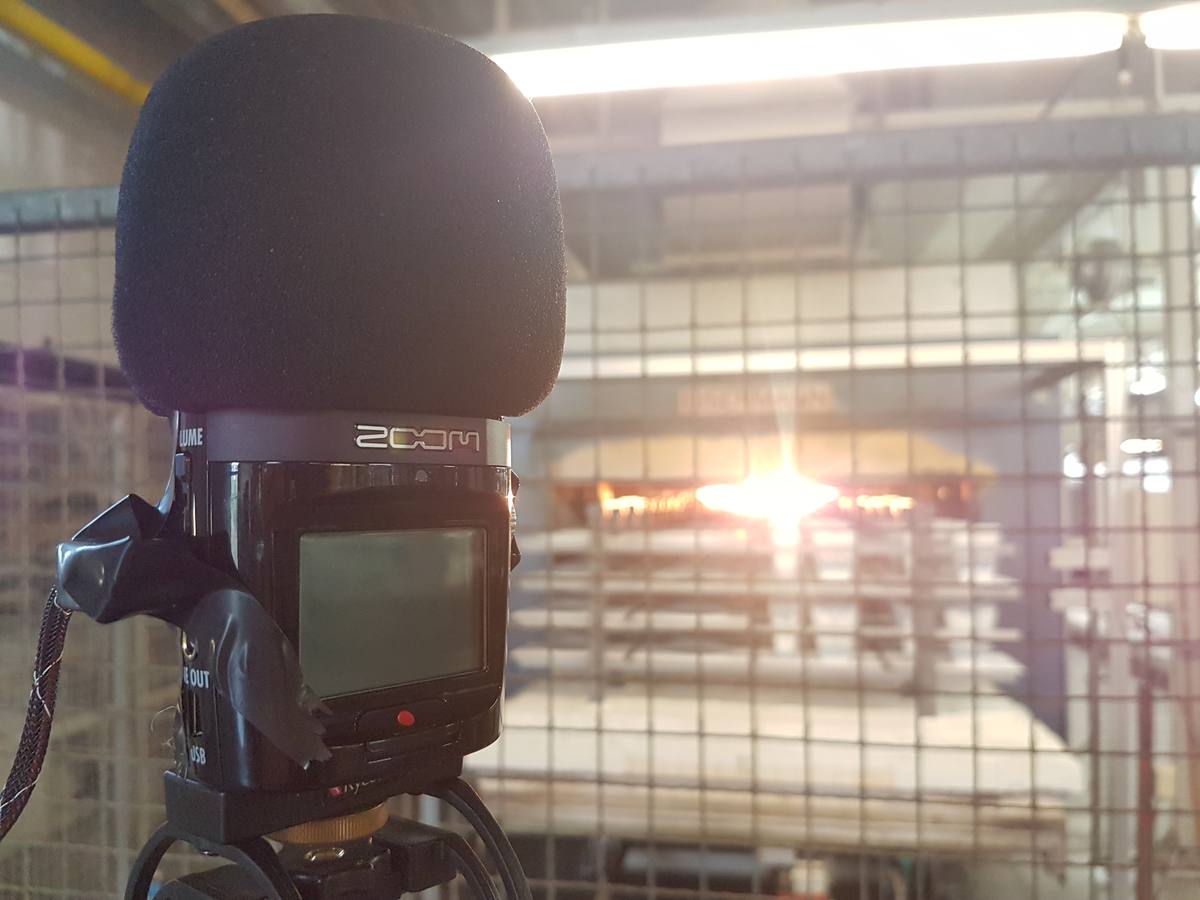
We shot in September 2018 in the middle of ongoing production at the Rosenthal factory in Selb, followed by the Glass Cathedral in Amberg. For me that meant collecting original sound where it is made: room tones recorded directly at the machines, from the porcelain roller kilns to the glass production line where glowing drops fall into moulds every few seconds.
Industrial locations teach you a lesson about sound: a kiln is a constant drone that buries everything else. Sources like that have to be recorded separately, labelled, and rebalanced in the mix so the hall sounds like work instead of noise. I complemented the location recordings with foley in the studio: photo paper being leafed through, sketching strokes, porcelain set down on wood. Small gestures that create a surprising amount of intimacy in VR.

The drone flights over the Gropius buildings were a challenge of their own. A drone delivers no usable sound, only rotor noise. So the aerials received a fully designed soundscape of high-altitude wind and distant town atmosphere that makes the height feel real without drowning the narration. That is a pattern across most 360° productions: the more spectacular the shot, the more of its sound has to be designed after the fact.
The score was composed by Andrej Melita. What mattered most was that he handed me the stems rather than a finished stereo mix: that let me place the music in the room instead of laying it across the scene as one block. In a 360° mix, that is the difference between music that carries a scene and music that competes with voices and effects for the same spot in your head. In the mix, I treated music, voice-over, and sound design as one head-tracked 3D audio scene: turn your head and the world stays put while your perspective moves. The voice-over was produced in German and English and used sparingly, so the spaces themselves get to tell the story.
What came out of it: one spatial mix that scales from headset to dome
The project ended with several deliverables from the same spatial mix: the roughly eleven-minute VR experience with head-tracked 3D audio, a linear cut that premiered at the BAU 2019 trade fair in Munich, a 360° video with ambisonic audio for YouTube, plus 5.1 and stereo mixes in German and English for screenings without headsets. Internationally, the experience was selected for FIVARS 2019, the Festival of International Virtual and Augmented Reality Stories. The production was supported by FilmFernsehFonds Bayern and the Deutsche Stiftung Denkmalschutz, Germany’s foundation for monument protection.
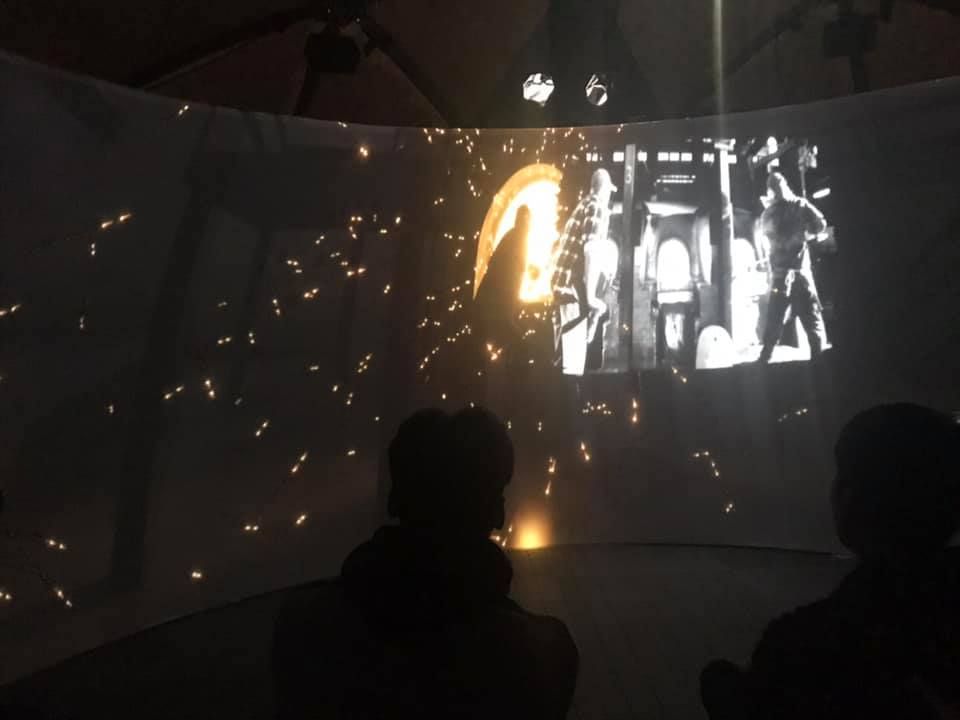
The most exciting stop came last. At Sheffield Doc/Fest 2019, the film ran in the Alternate Realities exhibition inside an Igloo projection cylinder, a walk-in 360° space where a whole audience stands inside the picture together, no headsets involved. Because the mix had been built as a spatial scene from day one rather than a stereo track, it could be re-rendered for the dome’s loudspeaker layout. The flamingos from the Rosenthal grounds suddenly strutted along the curved screen at life size, and the sparks of the glass production flew over the audience’s heads. How well domes and spatial sound go together also shows in my fulldome production Emergence in Nature at the Deutsches Museum.
That is why I push for object- and scene-based mixing early in every immersive production: think spatially once, and the same audio works in a headset, on YouTube, in a cinema, and in a dome. Teams that treat spatial sound as an afterthought end up producing every version twice.
A few years on, that pays off in a way nobody planned for. One of the original deliverables was TBE, the format by Two Big Ears that Facebook bought and later discontinued. The format is dead, the mix is not: it exists as a spatial scene rather than a finished render, so it can be pushed into whatever format comes next.
Planning a 360°, VR, or dome production? Let’s talk.
Whether it is a VR headset, a projection dome, or a trade fair installation: sound decides whether your audience truly feels transported. Let’s talk about the right audio strategy before the shoot.
Get in touch