8D Audio on Spotify and YouTube: What Works in Real Time
Content
Some nerd on the internet put music inside a spatializer, let it circle around the head, and people loved it. It reached a gazillion views, way more than Dolby Atmos Music has reached and probably will reach in the near future. The audio industry’s answer was that this is dumb and we know better. I find it far more interesting to ask why people love it, and then to ask the obvious follow-up: can you get that on your own music, on Spotify or YouTube, without downloading a converted file first?
Can you listen to Spotify or YouTube in 8D?
Yes, but not the way you probably want to. Neither service has an 8D mode. What you find are tracks that other people ran through a spatializer and uploaded, often without holding the rights to them. Search for a song plus “8D” and you will hit a few of those. They play back on any ordinary pair of headphones, because the processing is already inside the file. Making one yourself is a separate route, and I have covered it in my guide to 8D audio converters.
Two things are missing, and they are the reason this stays a novelty. The song you actually want to hear probably has no 8D version, because someone has to make one first. And you get no control at all: you cannot slow the rotation down, you cannot stop it where you like it, and you cannot decide how much reverb sits on top or which room it is meant to be. You get one person’s fixed choice, or nothing.
That gap is what real-time processing solves, and it is why the tools below exist.
What actually exists today
This is the honest state of play as of September 2026, and it is worth knowing before you spend money on anything.
| Tool | Where it runs | Users |
|---|---|---|
| 8D Audio Experience | Chrome extension, works with YouTube, Spotify Web and SoundCloud | 1,000, rated 5.0 from 22 reviews |
| 8Dfy / Audio Spatializer | Chrome, real-time, with HRTF, presets and binaural beats | 255, rated 5.0 from 7 reviews |
| YouStage 8D | Chrome, Korean interface, three spatial modes | rated 5.0 |
| Orbit 8D Audio | Chrome, any tab, with volume boost | 18 |
Two things stand out. The tools rate well, judging by their reviews. And almost nobody uses them: the largest one sits at a thousand installs, the newest at eighteen. That gap is the actual story here. The technology is not missing, the distribution is. Figures checked in the Chrome Web Store on 8 September 2026.
There is no 8D hardware to buy either. What you find under that keyword are ordinary headphones with 8D in the title, added because people search for it.
Why 8D works in the first place
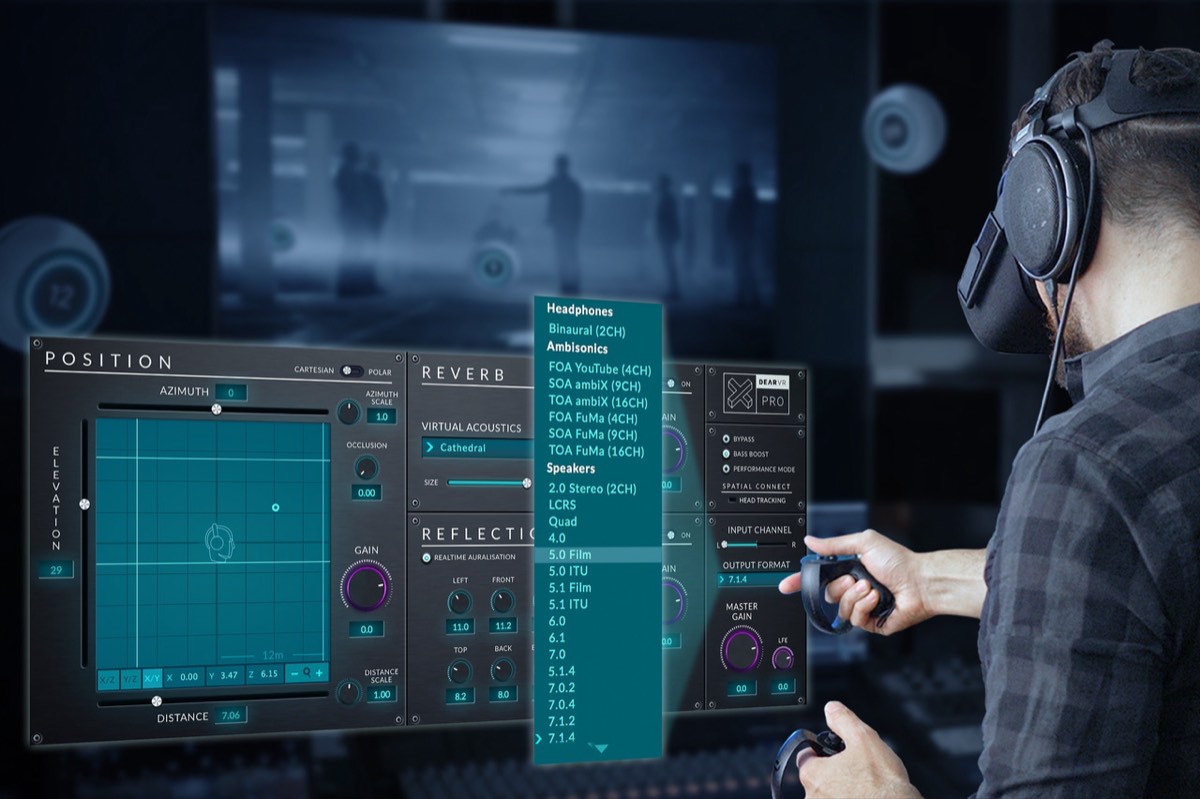
From an engineering point of view this should not impress anyone. Someone takes a finished stereo track, runs it through a spatializer, and lets it rotate around your head in a stupid, constant circle. Two things make it land anyway.
The reverb is the first. That same sense of space is why many people use 8D to concentrate, which I have looked at in 8D music and ADHD. The processing places the sound in an artificial room, and a room is what your ears need to hear something as being outside your head rather than between your ears.
The rotation is the second, and it is the one people underestimate. Because it keeps moving, your brain has a continuous chance to follow the sound and put it into context. Static spatial audio gives you one snapshot to judge; a moving source gives you a stream of cues. That is why the effect survives even on cheap earbuds.
Ignore 5D, 12D and 1000D
To sound more special, people simply changed the number. There are 5D, 12D and 16D videos that are all basically 8D, and 4D audio trends on TikTok. My criterion is simple: if the sound rotates around your head the whole time, it is the same thing no matter how many D are printed on it. It is still two audio channels with some spatiality applied.
Ignore everything beyond 3D, because it does not make sense from any engineering perspective. What is next, calling it a supersonic experience?
Do you need special headphones?
No. With a converted 8D file the processing is already rendered in, and any stereo headphone plays it back. With a real-time extension the same is true, because the calculation happens on your computer. The one hard requirement is that you use headphones at all, since the effect collapses over loudspeakers where both ears hear both sides. I have written up the details in my 8D audio overview.
Would you use a real-time version you can control?
The tools above prove two things at once: the demand is real, and the reach is tiny. What none of them gives you is control. The rotation runs at whatever speed the developer picked, the reverb is whatever they chose, and you cannot match either to the track you are listening to.
That is the version I am weighing up. Rotation speed you set yourself, a room that makes acoustic sense instead of a generic reverb, and the option to stop the movement where it sits best. Before I build anything, I want to know whether people would actually use it.
Why a viral gimmick is worth taking seriously
I take this seriously because it has produced paid work. ASMR channels reach millions of people with ordinary dummy head microphones, and that is something to learn from rather than to sneer at. It happened to me directly: clients came asking whether we could do something like that for their product, whether they could use it for marketing. Two commissions for Audi in two consecutive years came out of that, an 8D production and an ASMR production the year after.
A format that reaches millions of listeners is a signal, even when the engineering behind it is crude. The interesting question is never whether the audio scene approves. It is what people are responding to, and how to do that properly.