
What Is Dolby Atmos on My Phone? Why the Logo Proves Nothing
Content
What Is Spatial Audio?
Spatial audio places sound sources in three dimensions around the listener instead of on a left-right line. It adds height and depth, and with head tracking the sound field stays fixed while you turn your head. The result is a scene you can locate, not just a wider stereo image.
Two words for one idea: English-speaking markets say “spatial audio”, German ones say “3D Audio”. They point at the same physics, but not at the same thinking — depending on the use case, the sound has to be conceived differently. Since Apple pushed the term, interest has grown sharply, and everyone acts as if the meaning were settled.

What Does Dolby Atmos Actually Do on Your Phone?
The label describes a delivery format, not what is inside the file — and what your phone does with it varies wildly by manufacturer.
Apple documents the mechanics most clearly. For stereo material, say Spotify on an iPhone, there are three states: off — you hear plain stereo, nobody is forced to listen in 3D; Spatialize Stereo — the stereo gets artificially reverbed, the same trick 8D audio uses, but without head tracking, and honestly it does not add much when the source is only stereo to begin with; and with head tracking — the stereo image gets locked in front of you, where speakers would sit, and stays there as you turn your head. For multichannel material the menu suddenly reads “Dolby Atmos” instead of “Stereo”, and the choice narrows to two options: binaural, with or without head tracking. You still need the off switch — walk around the house with a vacuum cleaner and you will quickly find out how annoying a constantly readjusting sound scene can get.
One misunderstanding I run into a lot: with head tracking, the phone is only the reference point, not the sound source. It calibrates the sound scene so that something meant to come from your left actually does — the sound itself still comes from the headphones, not from wherever the phone happens to be lying.
Android is less consistent, and my own Galaxy S10 shows why: it carried a Dolby Atmos option in the settings, and all it did was turn the volume up. No spatialization, no head tracking, none of what Apple’s third mode delivers — just louder stereo with a prestigious name attached.
The same gap showed up with headphones, and I paid for it myself: the Galaxy Buds Pro, marketed as “360-degree sound”. I assumed that meant head tracking and Dolby Atmos. What it actually did was what Samsung calls Spatialized Stereo — a stereo signal shifted around until it seems to come from one direction, the same trick as 8D audio, but no real envelopment. My reaction at the time was basically: what is the point of this, it adds nothing — so I switched it back off. Only the Galaxy Buds2 Pro brought real multichannel audio, with Direct Multi-Channel for 5.1, 7.1 and Dolby Atmos.
| Claim on the box | What it usually means | What to check |
|---|---|---|
| “Dolby Atmos” on a phone | An EQ or loudness preset | Is the source file multichannel? |
| “Spatial Audio” on earbuds | One signal panned around your head | Does the scene stay fixed when you turn? |
| “8D Audio” on a track | Stereo with an automated pan | Is there any height information? |
| Real object-based audio | Sources placed in 3D space | Head tracking holds the scene in place |
Where 3D Audio Is a Nice Extra — And Where It Is Mandatory
In a cinema, surround is a pleasant add-on. Audiences pay for it, but a stereo mix still works. In VR the calculation flips: the environment is rendered spherically rather than as a framed excerpt, so a stereo mix is heard as a broken sound field and destroys the immersion the picture is building.
That is the practical dividing line. For a dialogue-heavy drama, the full object-based chain is rarely worth the budget. For anything where the viewer can turn their head, it is not a feature — it is the difference between a scene that holds and one that falls apart.

Case: 360° ASMR With NanouASMR
ASMR is enormously popular and the formats resemble each other. Together with the influencer NanouASMR we looked for a format where spatial sound carries the experience instead of decorating it — and where it still works across devices, from YouTube on a desktop to a smart TV.
The solution was a double perspective that only exists in 360°: Nanou appears twice in the video, once in front of the viewer and once behind them. Move your head and the sound follows the direction you are looking through head tracking — you hear the difference as you explore the space, not just see it. The TikTok clips from the production were viewed millions of times within a few months, and Nanou and I have since produced ASMR audio for brands like Audi as well.
How Do You Show Head Tracking Without a VR Headset?
Upload the mix as a 360° video — it is the cheapest way to let someone hear what stays in place when they look away. What goes into the container is ambisonics (AmbiX), not the Atmos mix itself; that has to be rendered onto an ambisonics bed first. The route is not reliable at the moment, though: YouTube’s head tracking for 360° does not run in the desktop browser at all right now, and in the YouTube app on the Quest 3 only as long as you look straight ahead. If you have to demo it today, use VLC 3.0.x with the binaural renderer switched on, or Vimeo in Firefox. I keep the current state in my overview of spatial audio support in 360° players.
What This Means for Your Project
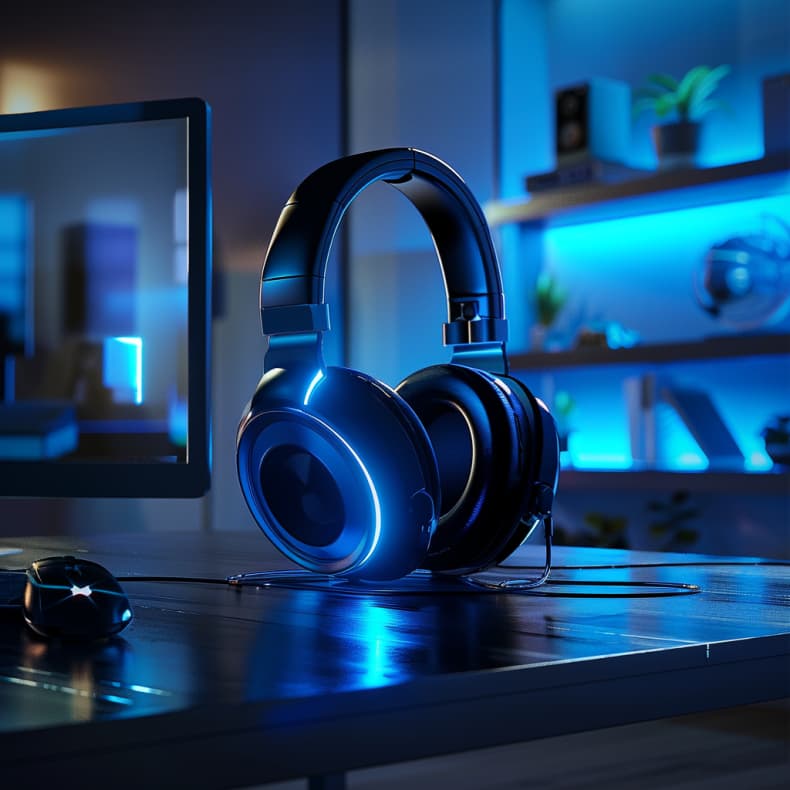
My buying rule for headphones, learned the expensive way: if it says 3D audio on the box, that does not mean 3D audio is actually inside. Ask whether it supports real multichannel audio — if it does not, walk away, because artificially reverbed stereo buys you very little. How confusing this gets even for people in the industry hit home at a trade show once, where the marketing person at the booth could not tell me what his own headphones actually did.
That is also why I favor headphones over speakers. With speakers in a room, the sound always comes from outside — your brain never believes it is inside your head. Headphones can do both: the sense of sound coming from outside, and sound inside your head. For your project, that means the label on the box is not what decides whether the effort is worth it. Your audience’s ability to turn their head, your source material, and the device people actually listen on are what decide.
Back to the BlogLet’s talk about your project
Want to use 3D audio in a real project, not just understand it in theory?
Get in touch →