RAUM+KLANG 2026: Biggest Fan, Harshest Critic of Immersive Audio
On 23 and 24 September 2026, ZiMMT Leipzig hosts RAUM+KLANG 2026, the Spatial Audio Network Conference. Martin Rieger is on the speaker list with a talk about where immersive audio earns its budget and where it does not.
Two days of expert talks, listening sessions, deep dives and workshops, built around a question the spatial audio field rarely asks out loud: what does 3D sound actually do for a project once it leaves the demo room. The conference language is English.
What is RAUM+KLANG
RAUM+KLANG is the spatial audio conference developed by ZiMMT, the Centre for Immersive Media Art, Music and Technology in Leipzig, in partnership with the Spatial Audio Network Europe (SANE). It puts artistic research and industry in the same room: composers, sound designers, developers, researchers and producers working across music, film, games, XR and media art.
The 2026 edition has a strong focus on real-world use cases and practical application, while keeping an eye on the research shaping the field. Expert talks meet hands-on workshops and deep dives into current tools and production methods. Breakout discussions open the floor for focused conversations between artists, developers and industry partners, and live performances demonstrate spatial audio in the room it was built for. Listening sessions run across both days, with archive material from ZiMMT, 4DSOUND, spæs and Amoenus.
What the Programme Covers
- Ambisonics without the myths: Daniel Rudrich takes a critical look at the technical and practical misconceptions around Ambisonics, including where it is simply the wrong tool for the job
- Object-based metadata: Mathieu Delquignies on ADM-OSC, the industry initiative standardising object audio data between studio, broadcast and live environments
- Real-time binaural rendering: Konstantin Fontaine on the psychoacoustic foundations, current rendering methods and the practical obstacles behind them
- Spatial audio for live and club: Banu Sahin on 3D audio from the studio to the stage, and Felix Deufel on Spatial Clubbing, a system that adds a spatial dimension to existing DJ setups
- Tools and engines in practice: 4DSOUND, HOLOPHONIX, LEMM3D, Grapes 3D Audio Control, the Dome Tools for planetarium content and Apple’s PHASE engine inside Sonic Moves
- Publishing and rooms: Christian Duka on running a spatial audio label, and Sebastian Oeynhausen on room enhancement systems from concert halls to museum installations
The Speakers
Opened by Jakob Gruhl and Felix Deufel, initiators of the Spatial Audio Network Germany and Europe, with speakers from research, artistic practice and the tool side of the industry:
- Alejandro Cabrera – founder of Audio Brewers, higher-order Ambisonics plugins and workflows
- Dr. Angela McArthur – director of the MA in Spatial Sound (Art/Science) at University College London
- Matthias Kronlachner – audio engineer behind the ambiX and mcfx plugin suites
- Paul Hauptmeier and Martin Recker – artist duo Hauptmeier|Recker, co-founders of ZiMMT
- Adrien Zanni – CTO at HOLOPHONIX, sound engineer and researcher
- Poul Holleman – 4DSOUND, playing the space as an instrument
- Sebastian Oeynhausen – Product Manager at Pan Acoustics
- Enrico Dorigatti – sound and digital artist, co-organiser of the Spatial Audio Gathering
- Marc André Weibezahn – developer of Sonic Moves, built on AudioKit and Apple’s PHASE engine
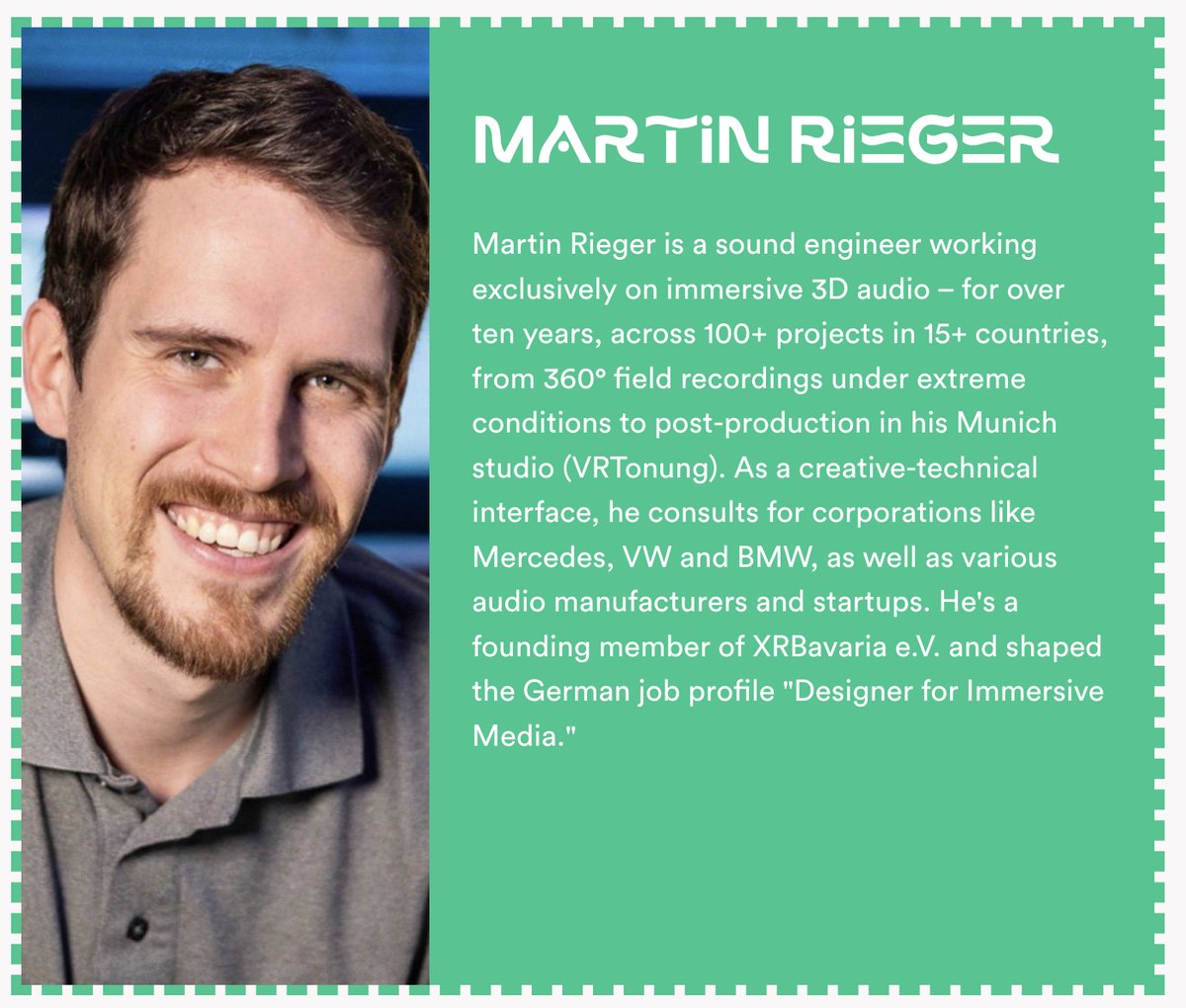
- Martin Rieger – sound engineer for immersive 3D audio, founder of VRTonung
Single-day and two-day passes are available, and seats are limited. Get your ticket for RAUM+KLANG 2026 and join two days of spatial audio in Leipzig.
RAUM+KLANG Special: Biggest Fan, Harshest Critic
Which stories actually need 3D audio, and which are better served by plain stereo?
Martin works format-independent and argues that immersive audio is not automatically the better choice. Drawing on real projects, he shows where spatial sound unlocks something stereo never could, especially for VR and immersive storytelling with head-tracking, and where it is just expensive overhead.
The talk stays honest about the failures too. Over ten years and more than 100 projects in 15+ countries, from 360° field recordings under extreme conditions to post-production in the Munich studio, the pattern that keeps repeating is a mismatch between the format a project was sold on and the format the story actually needed. Head-tracked binaural on headphones carries a scene that stereo cannot hold. A talking-head interview does not get better because it was rendered in Ambisonics.
Expect real life examples with a focus on headphone projects, and a clear set of questions to ask before committing a budget to immersive audio. For producers, directors and agencies planning their next immersive format, this is the conversation that usually happens too late.
 More articles on my blog