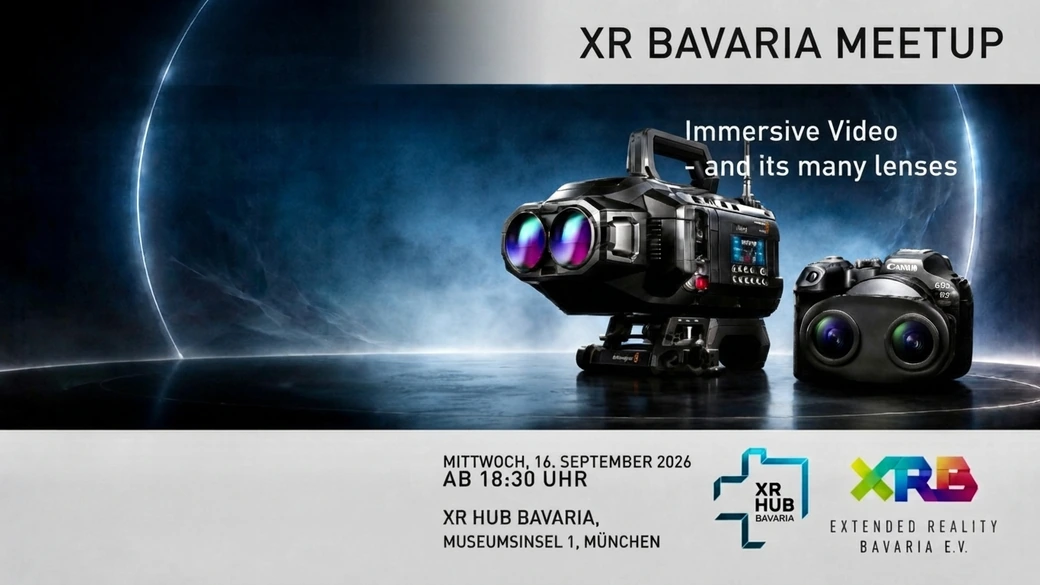
Immersive Video and its many lenses: XR Bavaria Meetup Munich
On 16 September 2026 the XR Bavaria Meetup puts three immersive video formats next to each other at the XR HUB Bavaria in Munich. Martin Rieger takes the part that usually gets pushed into the edit: the sound. Doors 18:30 CET.
One term, many lenses. Immersive video means something different depending on who says it: stereoscopic, 180 degrees, 360 degrees, and then for a headset or for a dome. The formats share a name and behave nothing alike, in production and in playback. Whether a scene actually feels immersive is not decided by putting a special camera on a tripod.
What the XR Bavaria Meetup is
The VR, AR and 360° Video Meetup Munich has been running since October 2015 and has grown to more than 1,400 members. It is organised by XR Bavaria e.V. and takes place at the XR HUB Bavaria on the Museumsinsel, the Bavarian hub for extended reality.
This edition does not stop at hardware you can pick up and look through. It goes into what people tell with it, and how, drawn from work the speakers have actually shipped.
What the Evening Covers
- Stereoscopy with Canon: cameras and lenses are in the room. How stereoscopic video is produced today: capture, settings, the usual traps, and how much of it survives into the headset
- Apple Immersive Video: the current workflow for the Vision Pro, from the URSA Cine Immersive camera through to delivery
- 360 degrees: the format that has been around the longest and is shifting again right now
- And the sound: all three formats ask the same question, how an audience perceives space. Why a spatial image only works with spatial sound, and what that has to be planned for on the shoot and afterwards
The Speakers
- Marcel Heß – Canon
- Joshua Park – Awesome Pixels
- Martin Rieger – sound engineer for immersive 3D audio, founder of VRTonung
The evening is built for filmmakers, producers, XR developers and agencies standing in front of the question which immersive format fits their next project. Afterwards there is time to try the gear, talk to the people who built it, and have a drink.
Seats are limited. Reserve your spot at the XR Bavaria Meetup and join us on the Museumsinsel.
Meetup Special: Why a Spatial Image Needs Spatial Sound
A camera that captures 360 degrees hands the audience the decision where to look. Sound is what makes that decision.
Martin measures this rather than arguing it. Most recently in 2025 with Edinburgh Napier University: 21 listeners heard the same clips once in 360° and once flat in 2D. 58 percent chose the 360° versions against 38 percent for 2D, and 76 percent named precisely placed sound sources as the reason. Presented at Audio Mostly 2025 in Coimbra.
The effect has been on record for longer. In 2018 he showed, together with Sylvia Rothe of LMU Munich, two groups the same 360° documentary episode, one with head-tracked spatial audio, one with a flat binaural downmix that sounded identical when you looked straight ahead. The gaze data from the headsets was turned into heatmaps. The spatial group produced 99 viewing hotspots against 149 in the flat group, which means their attention settled instead of wandering. The flat version already carried room information, so the measured gap is a lower bound, not a best case.
The second effect is one every 360° producer has run into. Without spatial rendering a voice cannot be located. The audience cannot tell whether someone is speaking inside the scene or over it, and people who have no visual presence at all turn into ghosts in the mix. That is a storytelling problem long before it is a technical one.
None of this gets expensive if it is planned. When Martin is in the conversation before the shoot, immersive sound does not cost significantly more than a flat production. Expensive is the version where it is fixed afterwards, because by then crews are standing around waiting.
More articles on my blog