Smart Glasses Audio: How It Actually Works – and Which Models Get It Right
Content
Every discussion about smart glasses right now is about the eyes: the display, the camera, the AI that reads what you’re looking at. Almost nobody is talking about the ears, and that’s backwards. For every model actually shipping and selling today, the audio is doing more of the real work than the optics.
I do spatial audio consulting for a living: headphones, XR, immersive sound. People keep asking me whether the smart glasses trend is finally the moment 3D audio goes mainstream. Short answer: not the way most coverage frames it. A handful of companies are trying to fit a listening device onto a face, in open air, without touching the ear canal, and that constraint shapes everything about how these things sound, wearables and hearables both.
This article is about the audio side specifically. How it works, what it can and can’t do, which current models handle it well, and what’s actually worth buying today, since two of the most-recommended products in “best smart glasses” roundups don’t exist anymore.
What are audio glasses and audio sunglasses? A quick overview of smart audio glasses
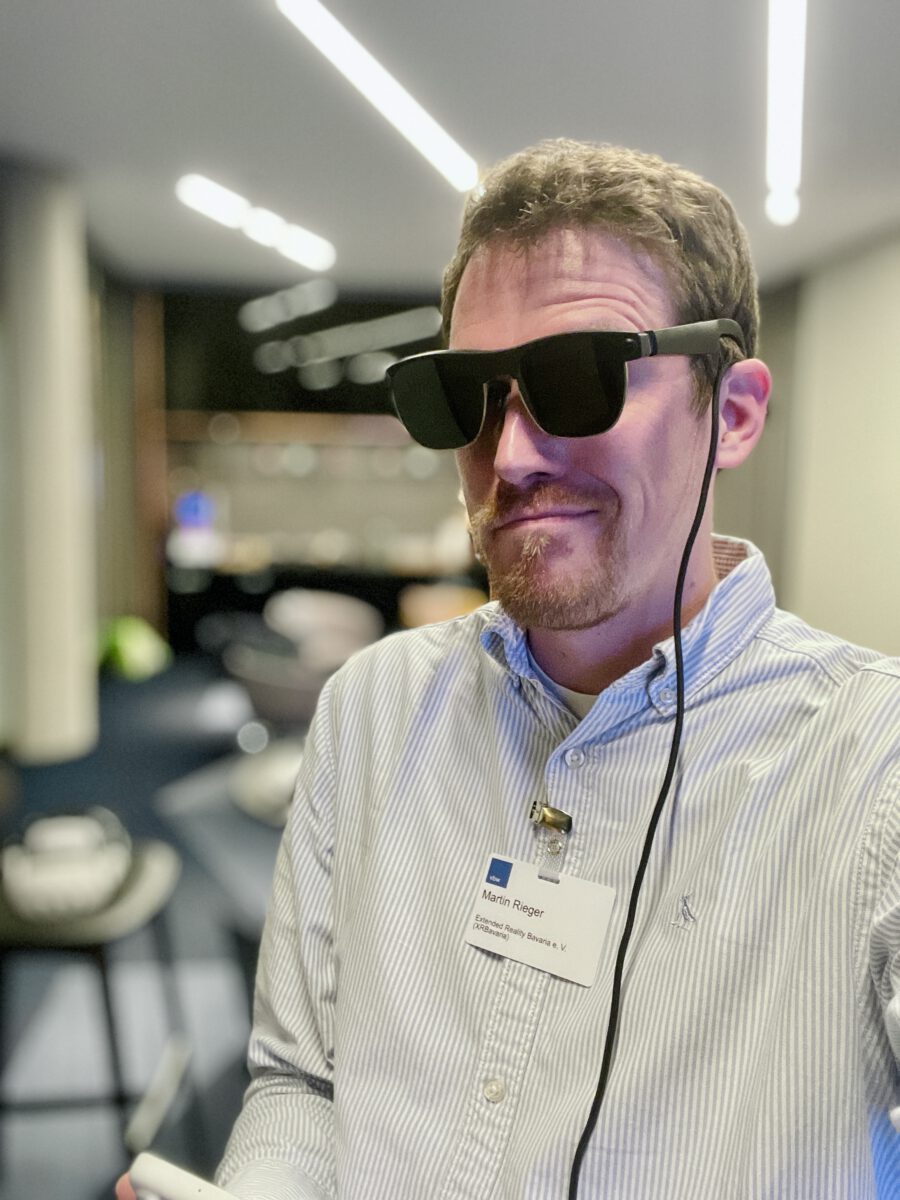
Audio glasses (also called smart audio glasses, Bluetooth glasses, or audio sunglasses, depending on which corner of the internet you’re in) are eyewear with a small speaker built into each temple, firing sound down and forward toward your ear canal without sealing it. Add a Bluetooth chip, a microphone array for calls and voice assistants, and usually a touch panel on the temple, and that’s the category. It’s the same wearables logic behind hearables: take an established product, in this case glasses, and quietly turn it into a computer.
Where it gets confusing is the display question, because the category actually splits three ways, not two.
Most current models have no display at all. Bose Frames, Echo Frames, Razer Anzu, Soundcore Frames, the base Ray-Ban Meta: pure audio, nothing projected into your field of view. A second tier adds a small heads-up display, like the Meta Ray-Ban Display, which launched at 799 USD with a 600×600 pixel panel in one lens and a 20-degree field of view. That’s built for a quick glance at a notification, not for looking through, and reviewers note you end up angling your eye toward the corner of the lens to actually read it. Neither tier is real AR in the ARKit or ARCore sense, the kind of room-scanning a phone can already do, because almost none of them track head or room position. You’re not looking into a space. You’re glancing at a small fixed overlay.
The one real exception, historically, is Bose. Bose Frames launched in 2018 as part of a platform called Bose AR, with actual head-tracking built in and a 50 million dollar developer fund behind it. No display, but the audio content shifted as you turned your head, years before most of the industry took head-tracking on wearables seriously. Bose shut the platform down in 2020 after roughly 32 apps got built on it and adoption never caught up with the ambition. Worth remembering when a company claims to have just invented head-tracked audio on glasses: Bose had it running, and pulled the plug, half a decade earlier.
True spatial tracking, the kind that scans the room in real time from multiple cameras the way AR/XR headsets like Apple Vision Pro do, is a different order of hardware entirely. Nothing wearing the shape of ordinary glasses does that today. It’s a plausible direction for the category, just not where it is now. Ray-Ban Meta added a camera to the formula and confused things further, but strip that away and you’re left with the same open-ear speaker problem every audio glasses maker is solving, display or no display.
How smart audio glasses work, and why the frame is the problem
Here’s the part that gets skipped in most reviews: the frame moves.
Convincing spatial or even just consistently good audio depends on a stable, known geometry between the driver and your eardrum. In-ear and over-ear devices give you that. The transducer sits in a fixed relationship to your ear canal every time you put them on. Glasses don’t. They sit differently on every face, they slide down your nose over the course of a day, and a few millimetres of movement measurably changes the frequency response arriving at your ear. Manufacturers compensate with beamforming, angling the speaker output and using multiple microphones to focus pickup, but that’s compensating for a moving target, not solving it.
Leakage is the second problem, and it’s physics, not an engineering oversight. Once sound radiates into open air instead of a sealed canal, anyone near you hears a thin version of what you’re hearing, and the real room adds its own reflections on top of whatever the device is trying to render. No firmware update fixes that. It’s the tradeoff you make for keeping your ear canal open.
I’ve written before about what starting with spatial audio for XR actually requires, and the same head-to-ear geometry problem shows up there too. That tradeoff is also the entire value proposition. An open ear means you hear traffic, your kids, your colleague talking to you. For anything where situational awareness matters more than critical listening (walking directions, notifications, a podcast on a commute, a phone call while you’re doing something else), that’s a feature, not a bug. It’s also why I wouldn’t build a genuinely spatial audio product on this form factor today. HRTF-based rendering assumes a stable head-to-ear geometry that glasses can’t guarantee, and open-ear leakage layers a real room on top of a simulated one.
Audio quality: what actually matters in practice
Every audio glasses review reaches for the same handful of criteria, and they’re the right ones. I’d just weight them differently than most buying guides do.
Bass response. Here’s the honest bad news, and it applies to the entire category: open-ear drivers small enough to fit in a temple arm cannot move enough air to produce real low end. Every product in this comparison, Bose Frames in their day, Ray-Ban Meta, Echo Frames, Razer Anzu, Soundcore Frames, gets described by reviewers as thin, tinny, or bass-light. If bass matters to you, no smart glasses model on the market right now will satisfy you. For that, sealed 3D audio earbuds are still the only form factor that delivers. That’s not a knock on any single product. It’s the physics of the form factor.
Leakage at volume. Every model leaks more as you turn it up, because “up” means pushing more air out of an open port. They all leak. The differentiator between products is at what volume it becomes obviously audible to the person sitting next to you.
Microphone performance for calls. This is where the category has genuinely improved, and where the real engineering budget goes now. Beamforming arrays (Ray-Ban Meta’s 5-mic array, Echo Frames’ 4-mic setup) are built to isolate your voice from wind and background noise, specifically because calls, not music, are the actual daily use case for most owners.
Battery life. Around 5 hours for Razer Anzu and Soundcore Frames, 6 to 8 hours of continuous use for Echo Frames and Ray-Ban Meta. These are built for intermittent use across a day, not for a long-haul flight.
Bose Frames, Ray-Ban Meta, Echo Frames and the rest, compared
Before the comparison: two of the models that still show up constantly in “best audio sunglasses” roundups are no longer for sale. Worth knowing which, because a lot of the content ranking for this topic hasn’t caught up. If you want the wider picture beyond glasses specifically, I’ve covered the whole hearables category, from earbuds to audio glasses separately.
Bose Frames: discontinued, but still the reference point
Bose ended the entire Frames line in late 2023. Tempo, Tenor, and Soprano are gone, and bose.com now simply says the product is no longer available. I’m including them anyway because they set the template the rest of the category still follows, and because the Bose AR head-tracking platform behind the original launch was ahead of what most of today’s models even attempt. Tempo used a 22 mm full-range driver per side and hit up to 8 hours of battery; Tenor and Soprano used two 16 mm drivers per temple and ran about 5.5 hours. Reviewers consistently described bass as “basically none” below 100 Hz, with clear leakage above roughly 80% volume, numbers that, unflatteringly, still describe most of what replaced them. Bose now points customers toward its Ultra Open Earbuds instead. That tells you where the company decided this problem is easier to solve: at the ear, not on a frame.
Ray-Ban Meta (Gen 2): the camera bundled in, audio along for the ride
The best-known audio sunglasses on the market are arguably not sold as audio sunglasses at all. Meta leads with the 12MP camera and Meta AI assistant. The audio side: open-ear speakers with beamforming aimed at reducing leakage, and a 5-microphone array powering “Conversation Focus,” a feature that boosts the voice of whoever you’re facing while suppressing background noise. Up to 8 hours of use, 379 USD to start. Reviews are split on sound quality: some testers find the Gen 2 speakers noticeably louder and clearer than the original Ray-Ban Stories, others still call the bass response poor. Both can be true at once. Better than its predecessor, still thin by any headphone standard.
Amazon Echo Frames (3rd Gen): audio-first, Alexa-first, no camera
Echo Frames skip the camera entirely and put the engineering budget into the listening experience: a custom-built open-ear driver Amazon claims doubles the volume and triples the bass of the previous generation, plus a 4-microphone beamforming array that mutes with a double-tap. Six hours of continuous media and calls, up to 14 with lighter use, 269.99 USD at launch and frequently discounted since. If you want smart glasses for phone calls and Alexa without a camera raising eyebrows in every room you walk into, this is the more honest audio-first option in the lineup.
Razer Anzu: built for screen time, not the street
Razer’s angle is blue light filtering for desk work first, audio second: 16 mm drivers per temple, a single omnidirectional mic with no beamforming array, roughly 5 hours of battery, 199.99 USD. Reviewers describe the sound as clear enough for calls and podcasts at moderate volume but “tinny” once you push it toward music. It’s the cheapest glasses in this comparison, and it sounds like it, which is fine if screen-time comfort, not audio fidelity, is what you’re actually buying.
Soundcore Frames: interchangeable frames, audio in the temples
Anker’s twist: the temples carry all the electronics (four drivers total, two per side, one firing toward the ear from front and back for a stereo effect, plus dual microphones and the battery), while the front frame is a purely mechanical piece you can swap for one of ten styles. Base kit with one frame runs 199.99 USD; extra frames are 49.99 USD each. 5.5 hours of playback, fast enough to add 1.5 hours of use from a 10-minute charge. Reviewers call the sound “perfectly acceptable” without audiophile pretensions: reasonable for a quiet office, prone to leakage, and mic quality reviewers compare to budget true wireless earbuds.
XREAL: audio riding along with an AR display
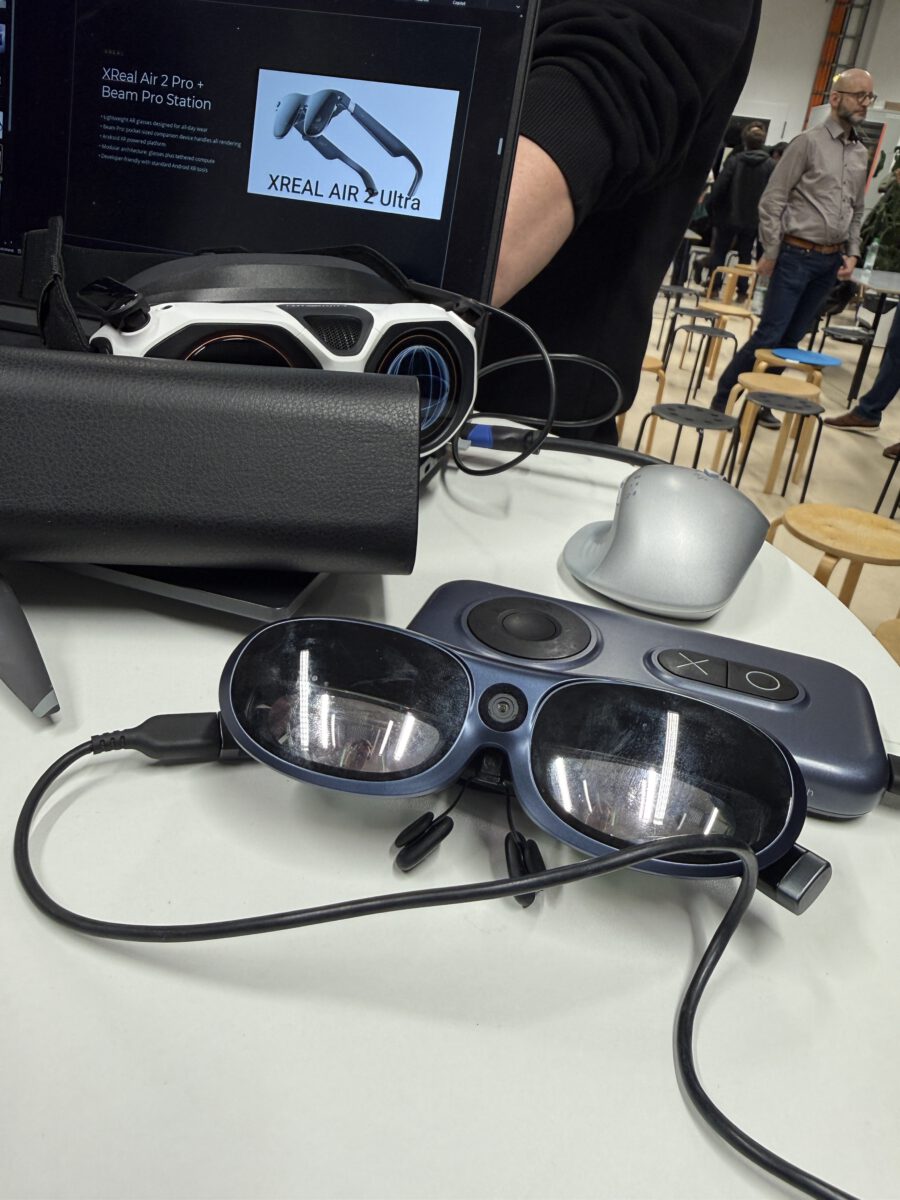
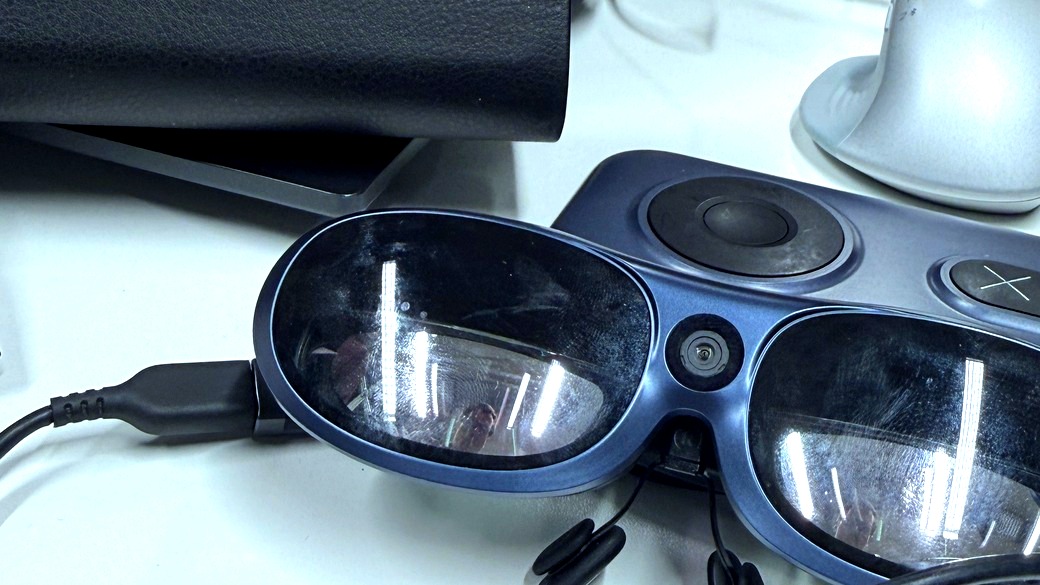
XREAL’s Air 2 Ultra, the model I’ve personally tested, is discontinued as of mid-2026, replaced by the XREAL One and One Pro. XREAL leads with the display, a real AR headset packed into a glasses form factor, but the temple speakers are Bose-tuned (audio tuning, not Bose hardware, according to Bose’s own SVP) and worth mentioning because they prove the point of this whole article: even a company with a display to sell still has to solve the same open-ear, leaking-sound problem as everyone else. Reviewers of the One Pro call the Bose-tuned speakers clear with “reasonable bass for the form factor,” but note the same leakage and lack of low-end punch as the audio-first competition. If your primary reason for smart glasses is the screen, XREAL is a different conversation. If it’s audio, it performs in the same range as everything else here. Not better just because Bose is in the marketing copy.
Chamelo Music Shield: the outlier
Chamelo’s core product isn’t audio at all. It’s electrochromic lenses that tint on demand, aimed at sport. The Music Shield (299 USD, Gen 2) bolts open-ear directional speakers and a microphone onto that base. To Chamelo’s credit, this is one of the few products in the category not primarily selling audio, which makes the “acceptable but not bass-heavy, occasionally described as slightly tinny” reviews land closer to expectations than products marketed on sound quality that deliver the same result. One caveat for anyone comparing spec sheets: Chamelo doesn’t publish driver type or microphone count, unusual even by this category’s already-thin disclosure standards.
Best smart glasses by use case: phone calls, sport, and everyday wear
Phone calls are the strongest use case across the entire category. Beamforming microphone arrays exist specifically for this, and every model here, Ray-Ban Meta’s 5-mic array, Echo Frames’ 4-mic array, Bose’s old dual-beamforming setup, was engineered around isolating your voice, not around music playback. If calls are your primary reason to buy, any current model will serve you reasonably well.
Sport and outdoor use favors Razer Anzu’s blue-light-filtering angle for screen breaks, or Chamelo’s tint-on-demand lenses if you’re moving between sun and shade. Neither is chasing serious audio fidelity, and for a run or a bike commute, the open-ear situational awareness matters more than bass anyway.
Everyday wear with occasional music is where Soundcore’s interchangeable frames earn their keep. You’re not locked into one look, and the audio is “acceptable” across the board rather than a highlight in any one direction.
Music as the primary purpose: I’ll say this plainly, none of these are the right tool. Sealed in-ear or over-ear headphones remain the only form factor that delivers real bass and any sense of a sound sitting convincingly around you. Smart glasses are built for speech, notifications, and situational awareness. Buying them expecting a music experience is the single most common source of disappointed reviews in this entire category.
Best lenses and prescription options
Most of the models above are available with prescription lens options. Ray-Ban Meta and Echo Frames both offer prescription-ready frames through their standard retail channels, and Razer Anzu ships with swappable lens options including blue light filtering. If you wear prescription glasses daily, check lens compatibility before the audio specs. It narrows the field faster than sound quality does, since not every audio glasses maker supports every prescription range or coating.
Building a smart glasses product? What this means for you
If you’re on a product team evaluating whether to add audio to a glasses form factor, or trying to figure out why your prototype sounds worse than the marketing deck promised, the pattern above should look familiar. Every company in this space is solving the same three problems: a driver small enough to hide in a temple arm, a frame that moves and breaks any assumption of stable geometry, and leakage that no amount of DSP fully removes.
Where teams actually lose time is treating this as a hardware spec problem when it’s just as much an acoustic and content problem. Driver placement and mic array design decisions only show up as complaints once real users are wearing the thing outdoors, in wind, mid-conversation. This sits inside a bigger shift toward spatial computing and what I’ve called the future of immersive digital experience. Glasses are just the form factor currently getting the attention.
I consult on exactly this: evaluating driver and mic placement before a form factor is locked in, and setting realistic expectations for what “spatial audio on glasses” can and can’t deliver given the geometry you’re working with.
Talk to me about your projectFrequently asked questions
Do audio glasses really work? For their actual use case, yes: calls, notifications, navigation prompts, casual background listening. For music or anything requiring real bass or spatial precision, no current model delivers that convincingly.
What are the downsides of audio glasses? Thin bass, audible leakage once you push the volume up, and a frame that shifts on your face throughout the day, which affects both fit and consistent sound quality.
Can you listen to music on smart glasses? Technically yes, every model plays music over Bluetooth. Realistically, expect thin, bass-light sound closer to a phone speaker than headphones.
Do smart glasses have sound? Most audio-focused smart glasses do, through open-ear speakers in the temples. Display-first AR headsets like XREAL include speakers too, tuned by Bose in that specific case, but audio is a secondary feature there.
What can Bluetooth glasses do? Take calls, play music and podcasts, relay voice assistant responses, and in some models (Ray-Ban Meta) trigger a camera, all without putting anything in or over your ears.
What are glasses with speakers called? Audio glasses, smart audio glasses, Bluetooth glasses, and audio sunglasses are all used interchangeably for the same category. There’s no settled industry term yet.
Are there Bluetooth glasses that don’t have a camera? Yes. Bose Frames while they were sold, Echo Frames, Razer Anzu, and Soundcore Frames are all camera-free, audio-only designs. Ray-Ban Meta and XREAL are the camera and display exceptions in this comparison.
Can you put a prescription in Bluetooth glasses? Yes, for most current models. Ray-Ban Meta and Echo Frames both support prescription lenses through standard channels.
How much do Bluetooth glasses cost? Roughly 200 to 380 USD for the current lineup covered here, before prescription lens upgrades.
What are smart audio glasses? Eyewear with built-in open-ear speakers and a microphone, connected via Bluetooth. Functionally the same category as “audio glasses” and “Bluetooth glasses,” just a different name for it depending on the source.