
BKW Engineering Digital Event – 3D sound experience in livestream
In 2021, the BKW Engineering event was supposed to be a classic company gathering: talks, networking, an evening together. Then came Covid, and the hall turned into a livestream for 2,200 people, each sitting alone in front of a screen. The Swiss agency Habegger was asked to turn that into something that wasn’t worse than the original, but better.
Habegger already had the idea of using 3D audio for it. I was brought in to turn that idea into a concept, produce the spatial audio pieces and be there live during the show. You can hear the audio sample in the video above.

Why a virtual event needs more than a good stream
Virtual events have a reputation, and it isn’t a good one. You see something, you hear something, but it feels like nothing. Stereo from laptop speakers, one slide after another, and after twenty minutes attention is gone. Death by PowerPoint, just at home this time.
There is more to it than boredom. Bad sound causes stress subconsciously, even when nobody consciously notices it. Listen to thin, flat audio for an hour and you end up tired without quite knowing why.
For BKW Engineering, that was exactly the problem. A company event lives on people feeling part of something. How do you create that feeling when twenty-two hundred people are only connected by a stream and nobody can see anyone else?
The obvious answer would have been to film the real event as well as possible. I think that is the most common mistake with digital formats. Virtual events copy the real thing instead of using what only works virtually. And one thing works better virtually than in any hall: everyone sits alone in a quiet room with headphones on. For 3D audio, those are perfect conditions.

How a technology idea became a story
In the first conversation I didn’t talk about microphones. I wanted to know first: why do you want this at all? And where do you want to go with it? 3D audio is not an end in itself. Once it’s clear what the audience should feel at the end, the technology almost follows by itself.
The answer was clear. BKW Engineering’s core values, entrepreneurial, forward-looking and collaborative, were to become tangible, along with the idea of the network and the charm of the DACH region. The Habegger team was open from the start. Among the engineers at BKW, many initially couldn’t picture what we were planning with a sound experience at all. So I played them examples so everyone could hear which direction this could go. After that, there were no sceptics left.
In a virtual workshop on Miro we collected ideas together and developed the storyline from them. The result was a light-hearted audio drama with several stations. Because I had already been introduced as a character in an interview beforehand, I became the guide through my own experience. I can’t act, so I simply led listeners through the stations the way I am. I was joined by Richard Putzinger from Austria and Claudia Trachsler from Switzerland, and Tobias Schmutzler took on the role of the radio presenter.
In one scene you stand next to a farmer raving about the mountains, the fresh grass and the scent of flowers, and his voice audibly moves around your head, from right to left and right up close. The instruction to viewers was simple: headphones on, eyes closed, lean back. Items from the goody bag sent out in advance tied into it.
Everything was recorded binaurally, with two microphones in the ears. The brain does the rest. That sounds simple but has a catch: a binaural recording can’t be edited together afterwards like a voice-over in the studio. If one word is wrong, the whole scene has to be recorded again, with every movement in the space, in places like an underground car park that you can’t book again and again. That’s why we had the scripts signed off twice before a single microphone was switched on. Going back out over one or two words would have been expensive.

The night the connection had to hold
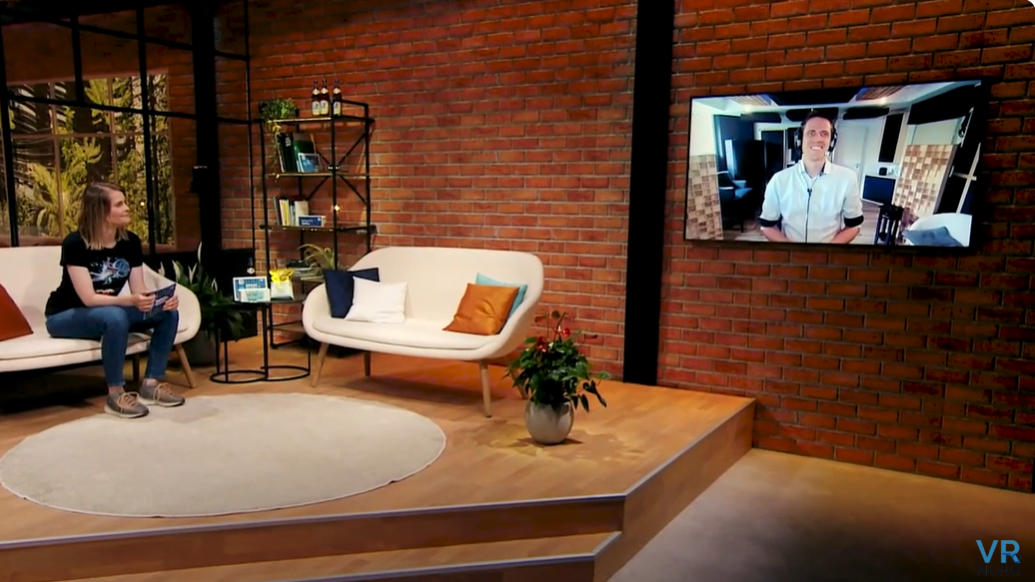
The show itself came from a purpose-built 200-square-metre TV studio. Comedian Hazel Brugger hosted it as a late-night show and welcomed guests including BKW Engineering CEO Michael Schüepp and Oliver Kahn. Teaser videos in advance and the goody bags had built up anticipation.
I was connected live via Zoom. Anyone who has done this knows the feeling: the whole time, the worry sits at the back of your mind whether the internet connection will hold. In a livestream there is no second chance. It held, and the audio pieces played exactly as intended.
And then something happened that wasn’t planned. Because the engineers had become so enthusiastic about the technology, Hazel Brugger spontaneously interviewed me live. We talked about why spatial sound feels more natural, why spatial hearing matters so much to people and why good sound is so often underrated. Hazel mostly wanted to know why we don’t record everything in 3D already.

What came of it
The team thanked us in the call right after the show. A few months later came recognition from outside: the BKW Engineering Digital Event 2021 won silver in the Best Corporate Event category at the XAVER Award 2022.
For me, the evening was proof that 3D audio can create closeness across distance. Not because the technology is so impressive, but because it uses the one advantage a digital event has over any hall: everyone listens entirely on their own, and yet everyone hears the same thing.
The client was Habegger AG, with support from Samuel Röthlisberger, Marion Häring and Aline Piazza. How sound has to land to the second at an on-site event is shown in the Lufthansa Dreamliner roll-in case.
Frequently asked questions about 3D audio at virtual events
Does 3D audio work in a livestream? Yes, with ordinary headphones. Binaurally recorded pieces are streamed like any other audio, and the spatial effect happens while listening. At BKW Engineering, 2,200 participants experienced the pieces this way in the stream.
Do viewers need special headphones? No. Any headphones work, as long as they are headphones and not laptop speakers. What matters is telling viewers beforehand, for example in the invitation or with a note in the goody bag.
How do you make a virtual company event more emotional? By not trying to rebuild the real event, and using what only works digitally instead. Everyone sits alone with headphones, which is ideal for spatial sound. An audio piece with eyes closed then hits harder than any stage in a hall.
What takes the most time in a binaural production? Preparation. Because binaural recordings can hardly be edited afterwards, the script has to be final before recording. At BKW Engineering, the scripts were signed off twice for that reason.
Planning a digital or hybrid event that should be more than a stream?
Concept, recording and live support from one source.
Get in touch