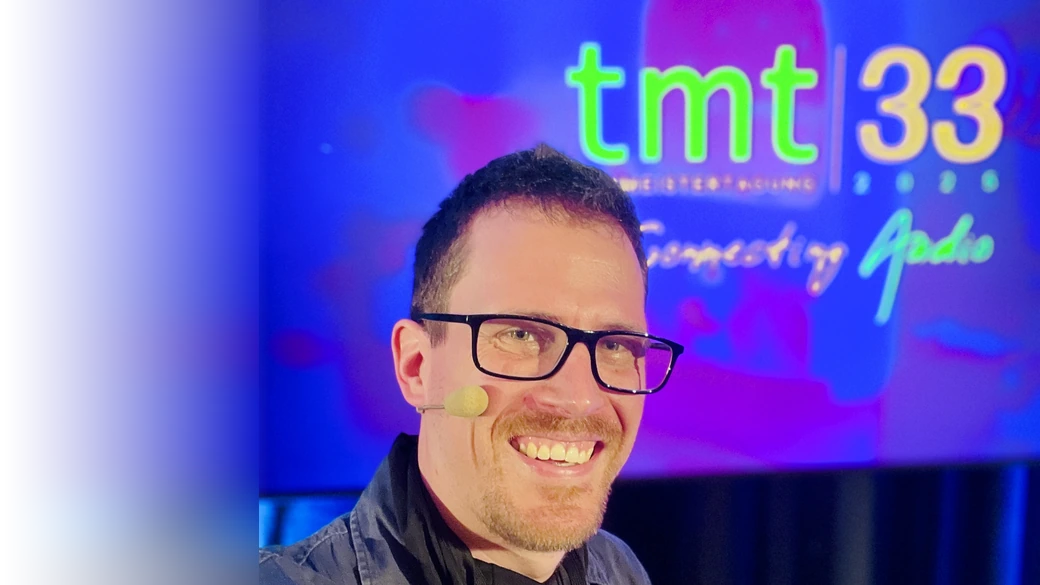
The 33rd Tonmeistertagung: 3D Audio Beyond Music
From 12 to 15 November 2025 the 33rd Tonmeistertagung took place at the CCD in Düsseldorf, Europe’s leading congress for audio professionals. I was there with a talk on the part of 3D audio that has nothing to do with music.
Four days of lectures, workshops and an exhibition floor, organised by the VDT. The Tonmeistertagung runs every two years and is the place where the German-speaking audio industry compares notes on what actually works.
My talk: Extreme and practical
The title was “Extrem und praktisch: Wo 3D-Audio echten Mehrwert bietet, über Musik hinaus”. Most of what gets shown at audio conferences is music. Immersive mixes, height channels, a new renderer. That is the comfortable part of the field, and it is also the part where the benefit is hardest to prove.
So I took two projects where the sound is not decoration. In both of them the audio is the interface, and if it fails, the whole thing fails.
Audio game “Ajo”
A game with no picture, built around the question of how well a person can locate something using an echo. The full case is in my portfolio: the audio-only escape room Ajo.
The test setup was a small escape room in a game engine, seen from above. Several sources in the space: footsteps, running water, a bird’s nest, a fuse box, shelves. The player steers by phone and turns in fixed steps, first 90 degrees, later 45. A sonar trigger sends out a ping, and the system answers with sound depending on direction and distance. The task is to find the way out by listening alone.
“SmartAIs”: navigation for blind people
The project is documented here: SmartAIs, acoustic hazard detection for blind users. A Munich startup asked me what the biggest obstacle is for blind people in everyday life. My spontaneous answer was the kerb or uneven paving. Wrong. The white cane reads the ground surprisingly well. The real problem sits higher up: e-scooters parked across the pavement, at hip height, where no cane finds them.
The app uses the iPhone lidar scanner, worn on the chest, and reports what is in the way. The decision that took the longest was not technical. A guide dog leads, a cane warns, and those are two different kinds of responsibility. We ended up with three directions, left, right and straight ahead. Anyone walking forward barely needs information from behind.
Why these two
Both projects answer the question I get asked most often, which is what 3D audio is actually good for once you leave music behind. In a game without a picture and in an app for blind users, sound is not an effect on top. It carries the information. That is the case I wanted to make in Düsseldorf, and it is the same one I make in every project: sound for immersive productions.
More articles on my blog