Olympic Vertigo – Sound for a VR Installation in the Olympiapark
The Olympiapark in Munich is a place with two memories that cannot be separated. There are the Games, the concerts, the summer evenings by the lake. And there is 1972, the attack, the rupture. Both of them lie on the same lawn.
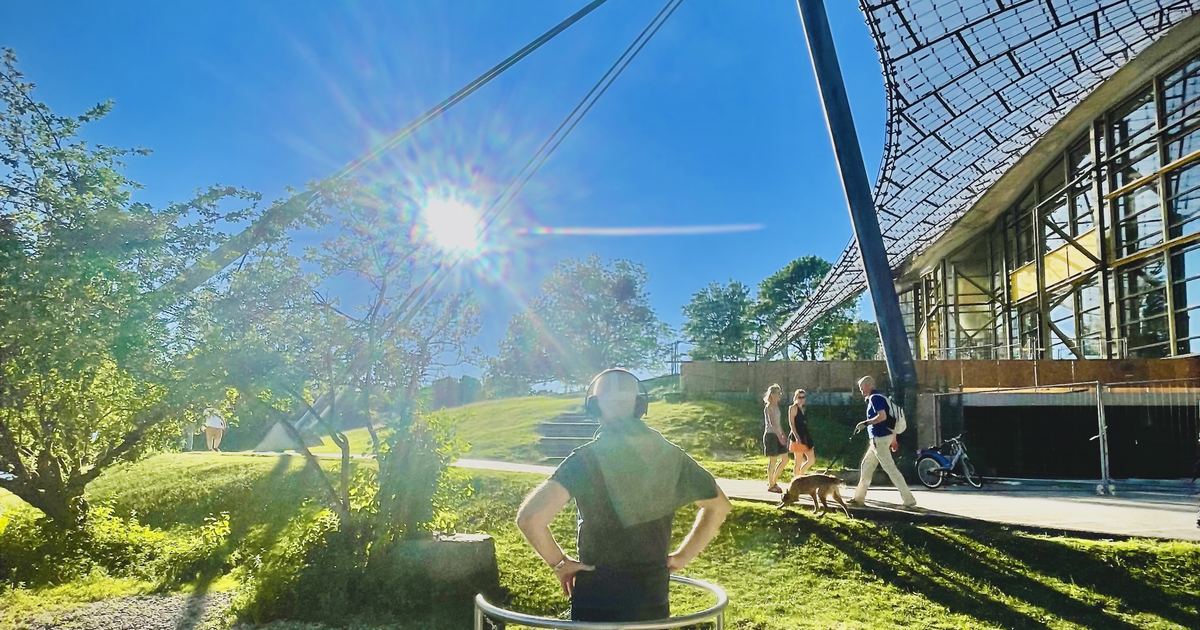
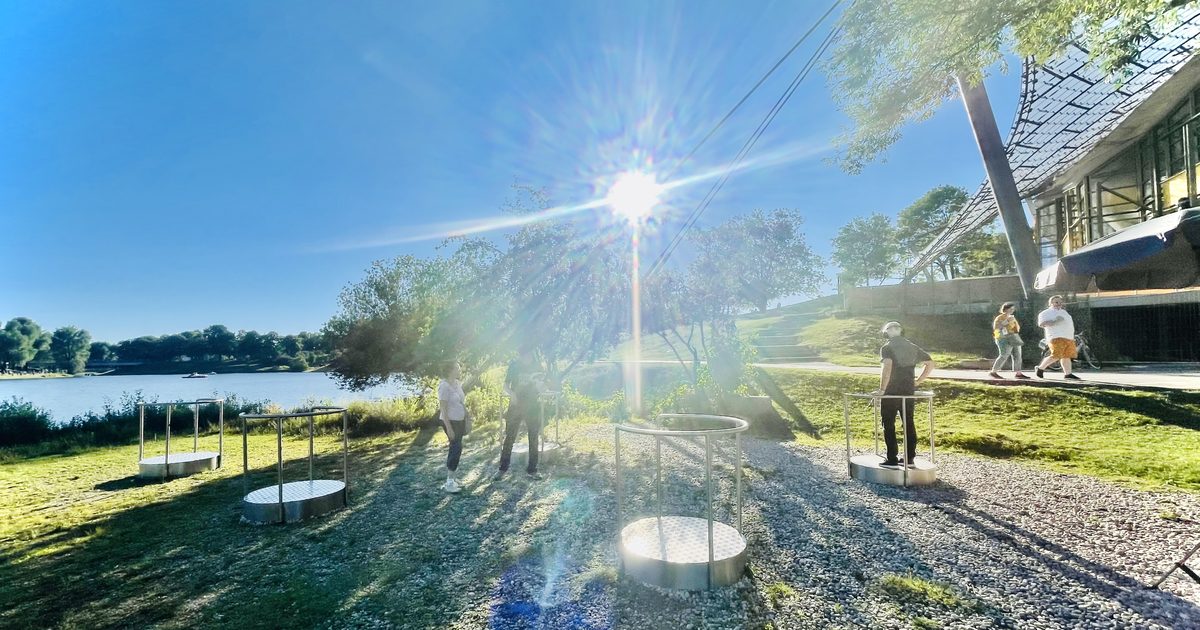
For the fiftieth anniversary of the Games the artist duo M+M built a VR installation for exactly this place, and I did the sound for it. “Olympic Vertigo” stood from 2 to 9 July 2022 on the gravel area by the Olympiasee, below the Olympia swimming hall. You stepped onto a round platform, put on a headset, and afterwards stood in the same spot, only not quite.
Why the music here could not be background
What you see inside the headset is the rebuilt park, and human-sized praying mantises move through it in time with the beat. After a while the Olympic tower collapses, the creatures disappear, the dust settles, the tower stands again, and everything starts over.
The core of the work, though, was not in that event but in the music. The artists’ idea was to lay the decades of the park around the viewer as sectors. Five slices of a pie, each with its own version of the same music, same tempo, same beat, different instrumentation. Turn your head and you travel through time without the music ever starting again.
That sounds like a simple rule and is not one to build. When five versions run at once and you only emphasise the direction of view, you easily hear a mush of everything. Switch hard between them instead and you hear the switching rather than the music. The way in between runs through a focus parameter that lifts one direction and lowers the others without taking them away entirely. The environment stays complete, the attention gets a direction.
How an art project became a question about headphones
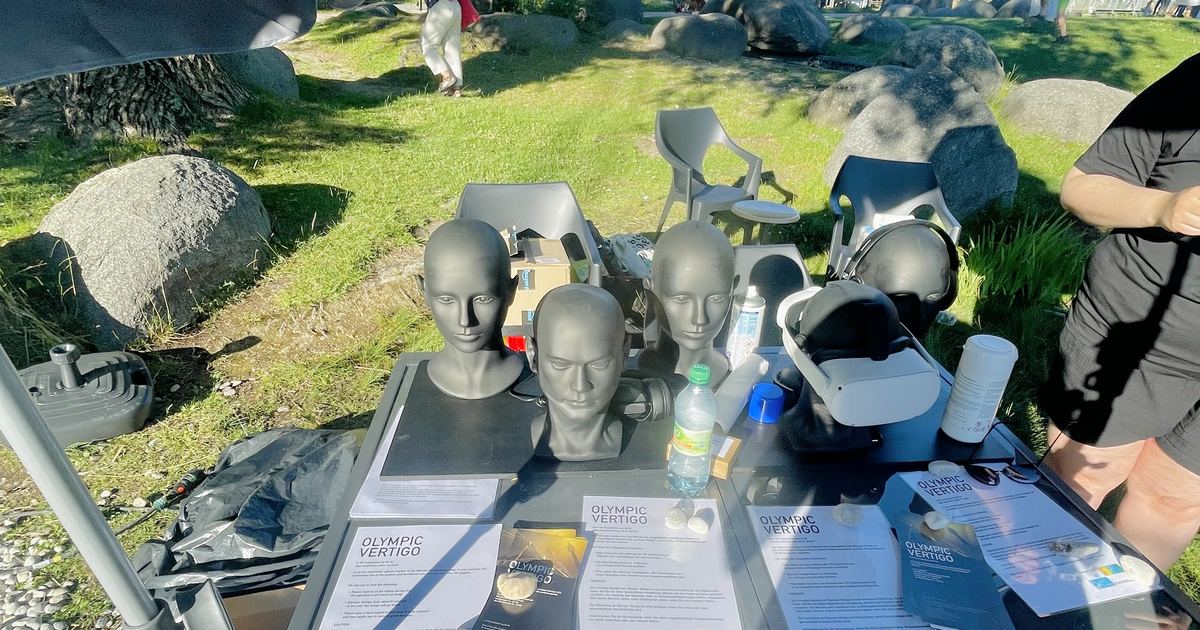
There is a part of a production like this that concepts rarely mention and that decides the result. The installation ran on several standalone headsets at the same time, outdoors, in the park, in daylight and with ambient noise. What works in a studio is a long way from working there.
Bass was the biggest issue. Music that lives on its pulse needs substance down low, and that is exactly what mobile headphones on a headset deliver worst. On top of that comes the environment: a park in July is not quiet. So we tested and chose clip-on headphones, meaning ones that sit firmly on the headset and do not get lost when the next visitor arrives. On an installation that runs for days with nobody permanently attending it, that is not a side matter.
The collapsing tower was the second task where mobile devices take their revenge. A collapse normally lives from the bottom up, from frequencies you feel rather than hear, and those are precisely what is missing on clip-on headphones in the open air. So the force had to come from ranges that survive small playback: from the grinding and tearing in the mids, from the music suddenly dropping away, and from the silence afterwards while the dust settles. An event does not feel big because it is loud, but because what came before and after was different.
A second point came from experience with film. Anything that sounds too clearly human takes the realism out of a scene like this, because the brain immediately looks for the person who is not there. The mantises therefore had to stay audibly animal and were not allowed to start feeling like people in costumes. The site itself is defined as a gravel area, which is convenient for sound: gravel makes a noise at every movement, and an animal walking towards you across gravel needs no explanation.
There is also a peculiarity of installations you never get in film. The piece runs in a loop, and some visitors stand on the platform for two passes while the staff beside them stand there eight hours a day. What is striking on first hearing can be unbearable the fourth time, especially a conspicuous noise in always the same place. That is a reason to pull effects back rather than push them.
What came out of it
The result was an installation that ran daily for a week, from two in the afternoon until ten at night on weekdays and from noon at weekends, on several headsets at once, in the middle of the park and free of charge.
Concept and artistic realisation were by M+M, that is Marc Weis and Martin De Mattia. The technical realisation was by Jörg Liebold, the project coordination by Tanja Schmitt-Fumian, both from Macromedia University in Munich, which took part as a partner. The music is by Polly Lapkovskaja and Mikko Gaestel, the metalwork of the platforms by Michael Ganser. I was responsible for the sound. I am not allowed to publish the sound itself, that was the clients’ wish, and I keep to it.
What this project shows well is a rule that holds for any installation, not only for art. Sound there is not what you lay over the top at the end, it is the mechanism that steers the experience in the first place. Take the directional dependency of the music out of “Olympic Vertigo” and a pretty picture with techno on it remains. The same question comes up with any application running on a headset, for instance the VR prototype about the Dornier Do X flying boat. Leave it in and the visitor turns by themselves, noticing on the way that the place holds several times at once. Something similar happens in What Lies Beyond the Woods, where the position in the room carries the narration.
Planning an installation with VR or headsets on site?
What works in the studio rarely works unchanged outdoors. Let’s talk early about playback, headphones and daily operation, rather than at build-up.
Get in touch