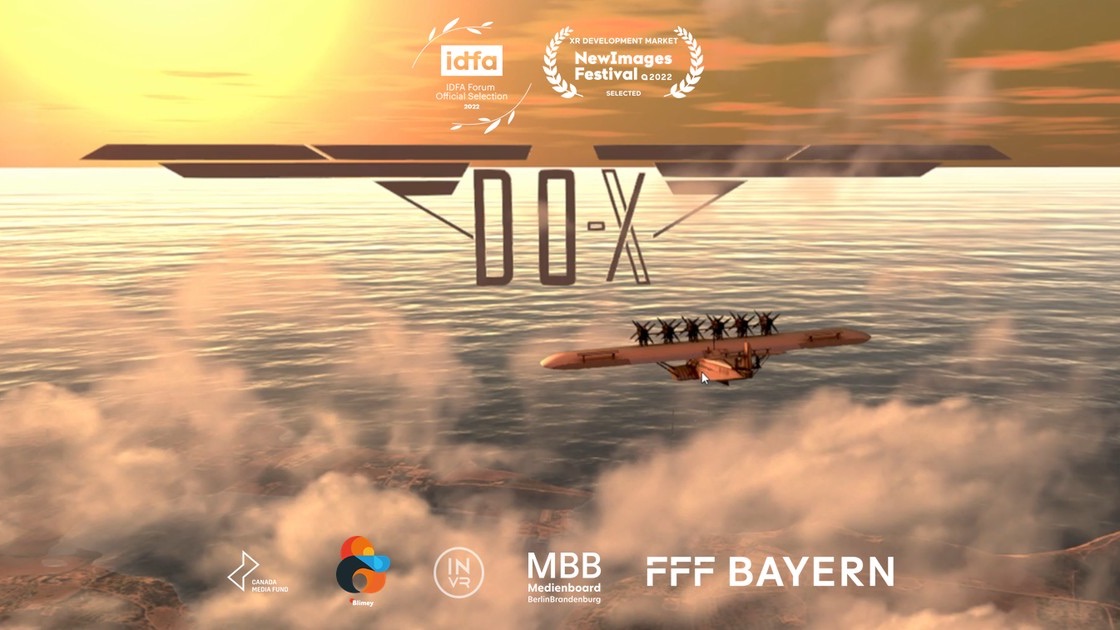
Dornier DO-X – VR Sound Design Flying Boat Multiplayer Experience
The Dornier Do X had twelve engines. Six pulled, six pushed, mounted in nacelles above the wing. In 1929, at forty metres long with a wingspan of almost forty-eight, it was the largest flying boat in the world and carried up to a hundred passengers. Its Atlantic crossing ended up taking nearly ten months, because something kept breaking along the way: in Lisbon a tarpaulin touched a hot exhaust pipe and burned half the left wing, which alone cost six weeks of repairs.
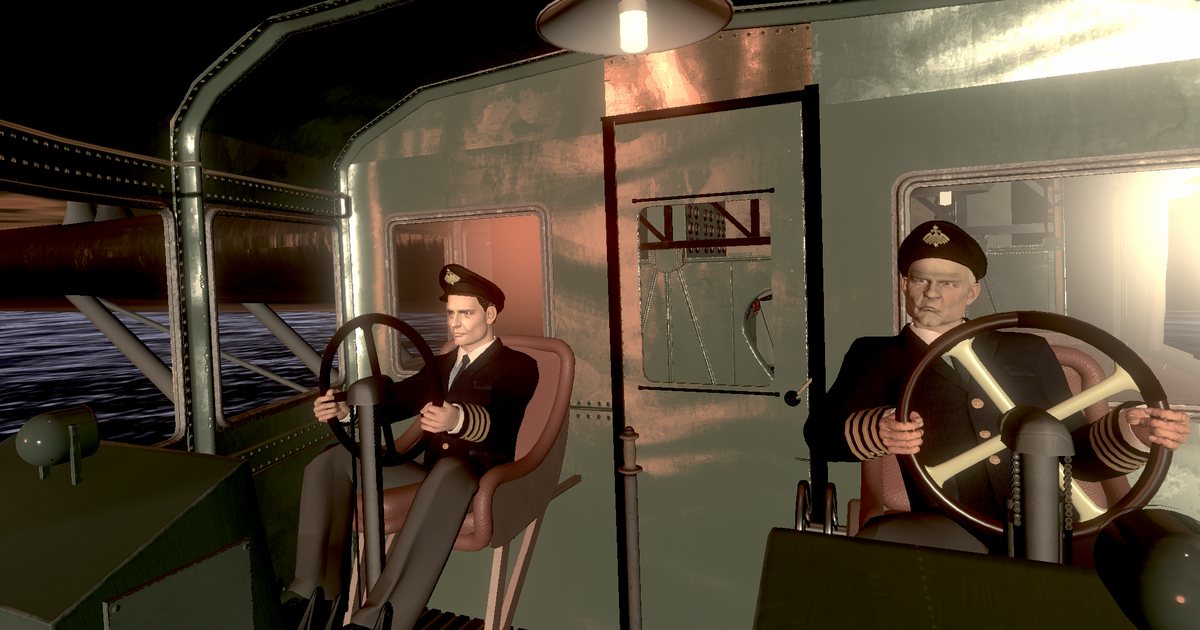
I was brought in in 2021 to do the sound for a VR prototype that puts you inside that flight. You sit in the cockpit between two commanders who disagree, and you have to decide how it continues.
Why twelve engines are a sound problem, not a picture problem
The conflict is quickly told. Friedrich Christiansen, around fifty, flies the machine on instinct and stubbornness and pushes it past its limits. Cramer von Clausbruch, a good twenty years younger, is the voice of caution with the passengers in mind. The user sits between them and decides.
In a film you would build that conflict through cutting and camera work. In VR you have neither. There is no cut to a face, no close-up of a trembling needle, no music that tells you things are getting serious without sounding ridiculous. What is left is the sound.
The whole scene hung on exactly that. The first feedback on the mix was clear: it sounded too relaxed, it had to feel like a crisis beginning, and an engine failure had to be audible over the roar of the remaining engines. That is not a question of level. With twelve engines running, a single failing one has to be identifiable as a position, otherwise nobody notices what is happening.
How an engine room turned threatening
I did not treat the engines as one wall of sound but placed each one as its own source in the room. The failure therefore happens in one spot, does not follow your head, and fades again when you turn away. Sit in the cockpit, hear the stutter behind you on the right, and you turn towards it. That is the directing you still have in VR.
There was one requirement I liked, because it takes the space seriously: when you put your head out of the window, the sound should flip completely. Inside, the muffled drone through metal and glass; outside, the full airstream and the engines with no filter. Transitions like that decide whether a VR scene works as a room or as a backdrop.
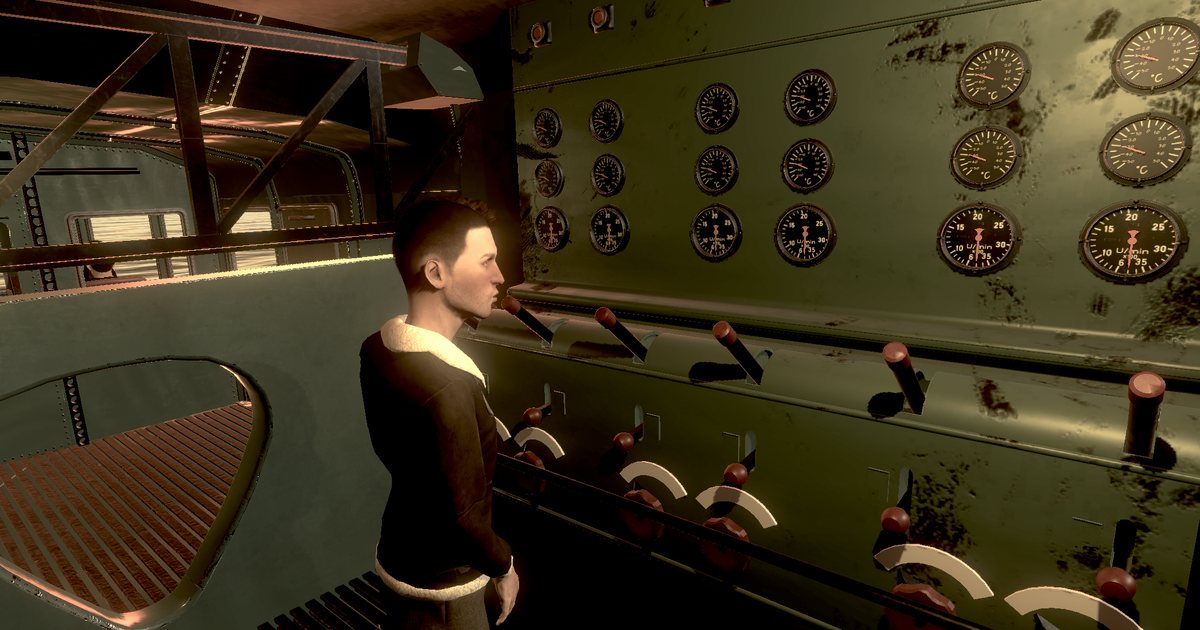
The engine room got its own layer. You stand in front of a wall of round gauges and levers, and every action had to be audible: levers locking in, the groan when you pull, the click of the dials. I built the interactive sounds as separate elements, because in an engine any of them can be triggered at any moment and nothing sits fixed in an edit beforehand. How a VR game differs in that respect from a 360° video, where the sound sits pre-mixed, I took apart in a separate article on spatial audio in VR games.
One note from the review shows how fine these distinctions get. One voice recording was treated as a PA announcement, with the typical sound of an onboard speaker. In context that was wrong, because at that point the character is not announcing anything, he is sitting next to you. So the effect came out. A voice in the room and a voice from a loudspeaker are two different things, and in VR you notice immediately, because you turn your head and find nobody there.
On the voices we deliberately decided against synthetic speakers. The idea of generating the dialogue with AI voices was on the table, which was just emerging in 2021. In the end real actors recorded it, in German and English, the English with a slight German accent. A good actor with an accent carries a scene; flawless English without attitude does not.
The music ran as its own tension curve, built from strings that slowly tighten. It was not meant to tell you about the threat, the engines do that. It was meant to stretch the time in which you have not yet decided.
What came out of it
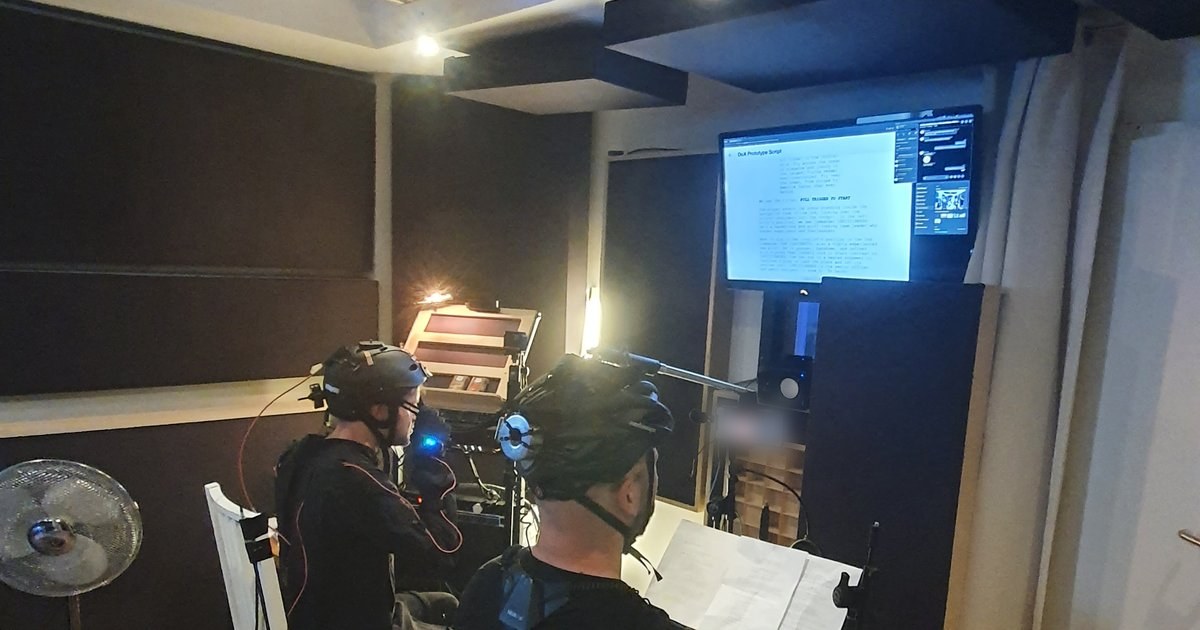
We recorded the dialogue in August 2021 at my own studio, with actors from the Munich scene, after a casting that was less about perfect pronunciation than about two voices you tell apart instantly: one hard, one measured. In a scene that lives on two men arguing, casting is half the mix. The actors wore head rigs for the facial capture, so voice and expression came out of the same take. For the sound that means the recording is tied to the performance: you cannot quietly redo one line later without the face no longer matching it.
The result is a playable prototype for the Quest, a vertical slice: a short but complete scene that demonstrates how the full project would work. Prototypes like this are the currency you approach funding bodies and festival markets with, and in this case something came of it. The project is now called “DO-X: Soar Into the Future” and is co-produced by BLIMEY and INVR.SPACE, with Nimrod Shanit as director and producer and Sönke Kirchhof as producer. In 2022 it was an Official Selection at the IDFA Forum and was picked for the XR Development Market of the NewImages Festival. It is funded by the Canada Media Fund, Medienboard Berlin-Brandenburg and the FilmFernsehFonds Bayern. The story has shifted along the way: today you command the flying boat across the Atlantic as its first woman pilot, rather than sitting between two commanders having an argument. The technical realisation of the 2021 prototype came from Design4Real.
For sound that carries a specific demand. A prototype has to convince on the first run, with people who do not know the project and may be putting on a headset for the second time in their life. There is no second chance and no explanation up front. If the engine failure does not register as a threat immediately, the scene is lost for that viewer.
This is the difference between linear and interactive work that became clearest to me on this project. On a film I mix a sequence. In an engine I build a system that responds to decisions I cannot know in advance. It was much the same on the German version of Emperor, where every voice file had to fit the timeline exactly as its own asset. That this way of thinking is travelling back from game audio into film, I wrote up in how game audio influences film sound design.
Planning an interactive VR production?
Whether it is a prototype for a submission or a finished application: in an engine, sound decides whether a scene feels threatening, calm, or merely loud. Let’s talk early about which elements need to sit separately.
Get in touch