Audi e-tron GT: Binaural 8D Location Recording for “The Sensation of Sound”
An electric car has no engine that sounds like anything on its own. Everything the Audi e-tron GT emits, outside and inside, is a decision: made by two sound designers in Ingolstadt, held in 32 audio tracks, refined over more than a hundred iterations. The brand film “The Sensation of Sound” is about exactly that work. Which gives it a problem most commercials never face. It is a film about sound. In ordinary stereo it shows the work, but you never get to experience it.
So the decision was made to produce the whole film binaurally, as an 8D audio movie for headphones. I worked on the shoot as the 3D and 8D audio engineer: consulting before production, then all of the location sound, recorded binaurally. Dummy head, ORTF main pair, spot microphones on the car, interior perspectives, and a sound-only pass after every setup.
Why a film about sound cannot sound like a normal film
One of the sound designers explains it in the film: the sound of a car does not work like a piece of music. It has no beginning, no middle part and no end. It runs as long as the car is moving, and it reacts to speed, torque, drive mode and recuperation.
That idea cannot be shown in pictures. You can film faders and screens, but the point only lands when you hear the difference. In an 8D audio movie the sound is the layer that carries the subject in the first place: sound objects that move outside your head, that come closer and move away, that walk in from behind you.
I am no evangelist about 8D. From an audio engineering point of view it makes no sense at all to keep a sound circling somebody’s head. It works anyway, remarkably well, and it teaches the right lesson along the way: you do not need special headphones for spatial sound, because you only have two ears to begin with. For a film about sound, that is exactly the door an audience walks through.
8D audio uses the principles of binaural recording. Two signals matching what actually arrives at the left and the right ear, including the timing, level and colouration the head and the outer ear impose. The brain then localises outside the headphones instead of between them.
The most common mistake is not placement, it is missing room information. Most people just pan their sources around in 3D space and give them no reverb. The brain then concludes that the source must be very close to the head. In reality you never hear a sound only from the upper left; you also hear its reflections from behind and a little from the right. Even when a car is standing to your right, something still arrives at your left ear. We have spent a lifetime learning that, and without it the brain does not believe the space.
On a real shoot this is considerably less comfortable than it looks in music production. Three things had to be settled before day one, because none of them can be fixed once you are on set.
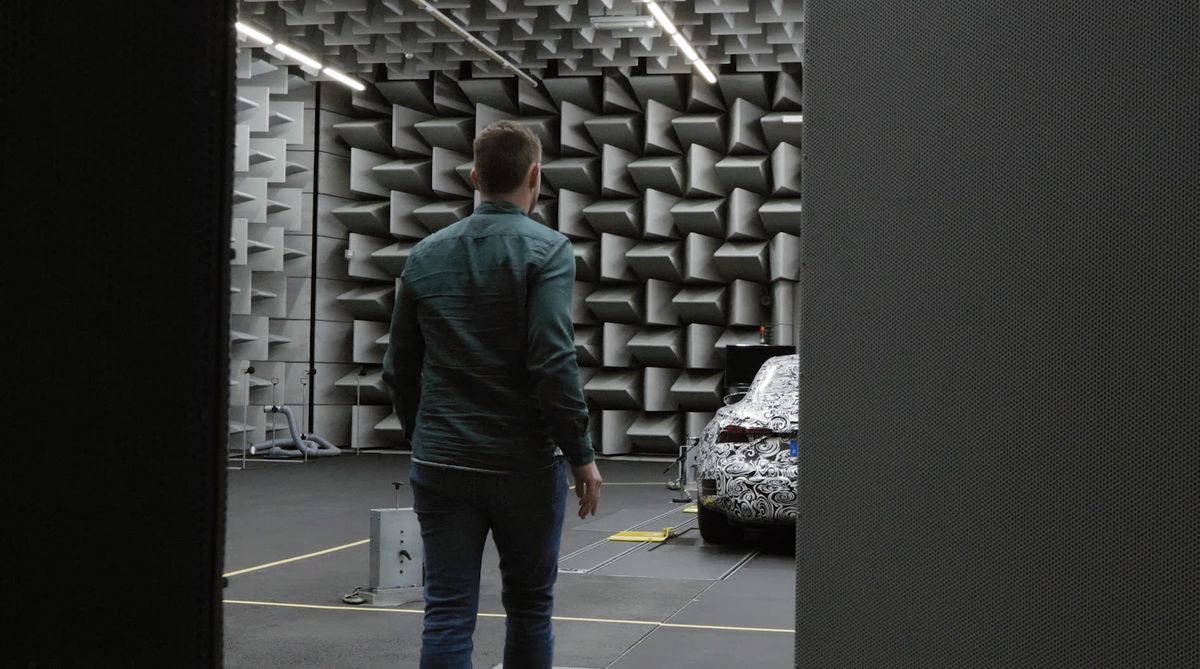
First, space and movement are the precondition. A sound is only localised outside the head when it brings reflections with it and when it moves. The central location was the sound lab, an anechoic room, acoustically the hardest place you could pick for 8D. There, movement in frame and sound-only takes matter twice as much, because the sense of space cannot come from the room.
Second, only one or two streams work at a time. Hearing cannot place an arbitrary number of moving sound objects in parallel, least of all against a picture that is competing for attention as well. A densely populated sound bed destroys the very effect it is meant to create.
Third, music works against you. A continuous score spreads across the scene and takes away the space the moving objects need. The film therefore relies on sound design rather than music for most of its running time.
There is also a trick I normally keep for talks, and it made it into the concept here: at one point the sound field collapses to mono for a moment. People get used to spatial sound very quickly, because it matches how they hear anyway, and after a minute they stop noticing what is special about it. The moment it drops to mono, they notice.
How a wind tunnel, a pipe and a model helicopter become a car sound
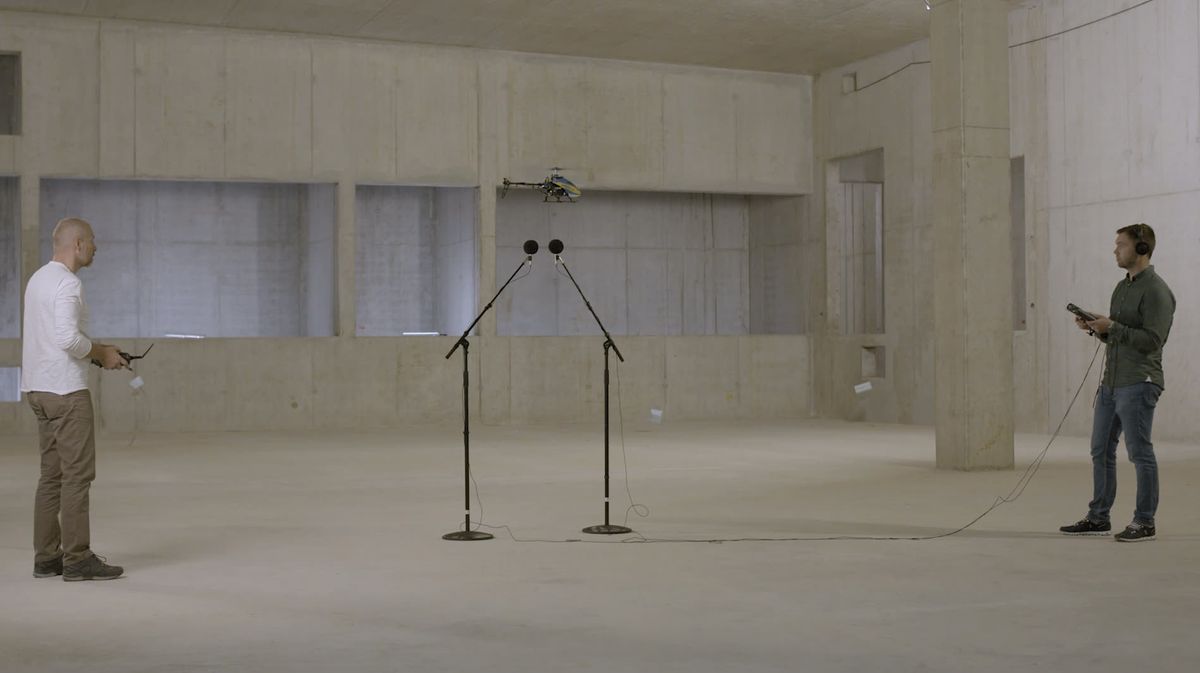
The sound of the e-tron GT does not come from a synthesiser preset. It comes from things that stand around the factory and make noise. A sound designer walks past a pipe and hears something that could be turned into a tone with no beginning and no end. A model helicopter delivers a rotor movement that loops. The wind tunnel, a ventilation shaft, the car loading bay at the freight yard: raw material.
Audi documented that process themselves. The making-of shows how the e-tron sound was built at the desk, in the sound lab and in the moving car, before any of it reached the film.
Those recordings become short, loopable fragments, with no audible repetition and no interference. They are imported into the software Audi developed in-house and assigned to individual tracks, one of 32. Each track is then coupled to vehicle data: what happens to that pipe tone when speed increases, when the driver recuperates, when the drive mode goes from efficiency to dynamic. Tested at the workstation, then in the car in the lab, then on the road. More than a hundred iterations before the final result.
For the film’s sound track that means the locations are also the sound sources. A pipe visible in frame has to be audible too. So at every location I recorded with several systems in parallel alongside the interview sound. Dummy head for everything that had to travel around the listener’s head later, mono shotgun for the objects that had to stay freely placeable in post. A dummy head stares in one fixed direction, which is its limitation, so mine carries several pairs of ears and the orientation of a recording can still be turned afterwards. Wherever possible, a sound-only pass followed the picture: same movement, same distance, but without a camera crew in the room.
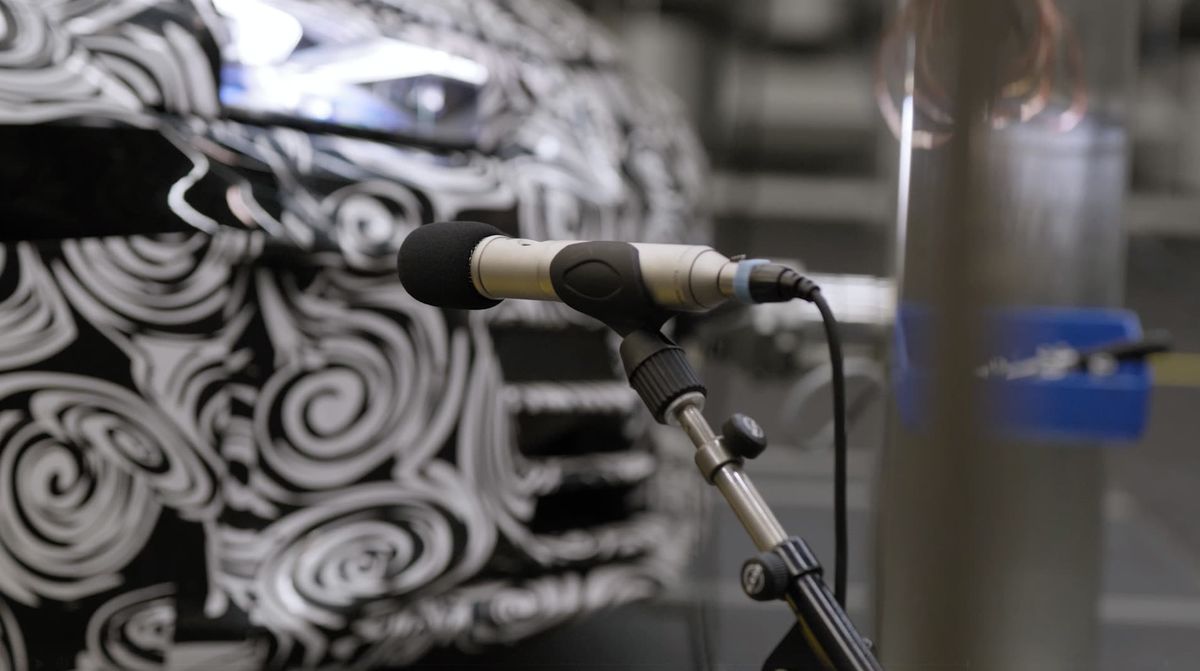
The car itself took the most effort. Acoustically the e-tron GT radiates across its whole surface. It sounds different at the front than at the side, and different inside than outside, and that difference is the point of the scene. So spot microphones outside, main pair at the front, interior perspectives, plus walk-arounds so the mix could follow how the sound changes as you move.
What came out of it
Two films came out of the shoot: the emotional film “The Sensation of Sound” and an explainer that walks through the software workflow step by step. The emotional film is the 8D one, mixed for headphones and carrying the movement laid out in the concept. The explainer stays deliberately more sober, because there the explanation is the job.
The embedded video is Audi’s public making-of about the e-sound. It shows the work, but only part of it: the 8D film itself is not on YouTube, and it only works on headphones anyway.
According to the production, the emotional film is the most successful festival film in Audi communications:
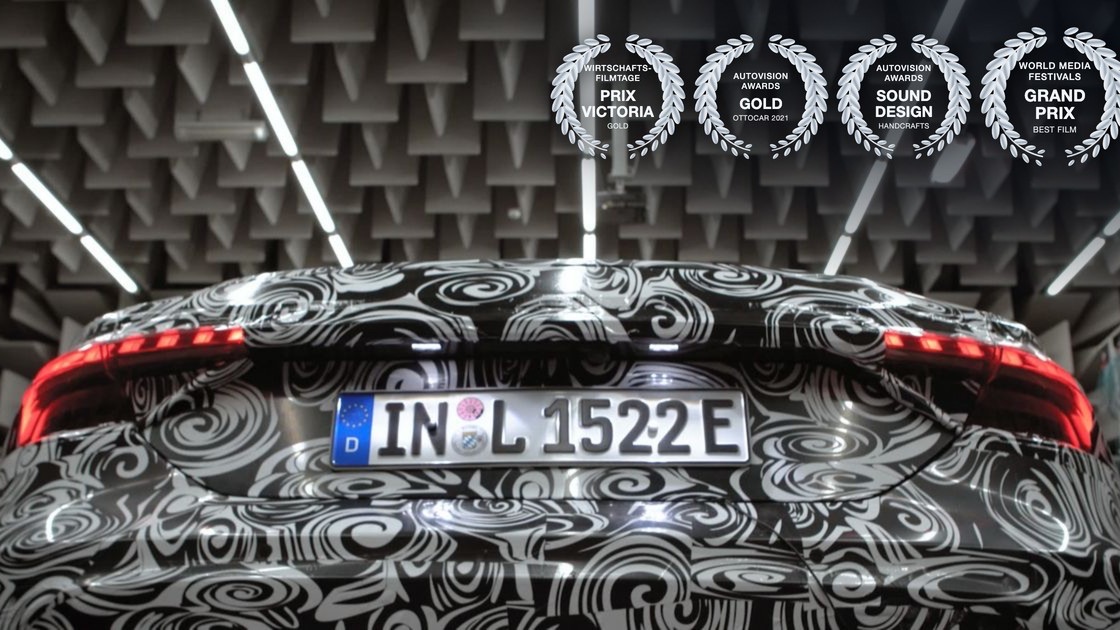
- WorldMediaFestival: intermedia-globe in silver and in gold, the Grand Award, and the Grand Prix as best film of the entire competition, picked from more than 800 entries
- AutoVision Awards 2021: golden Ottocar in the category for trade fair, show, event and visitor films, and the Handcrafts Award in black for the best sound design in the competition
- 30th Internationale Wirtschaftsfilmtage: Prix Victoria in gold in the category Technology, Research & Development
- Further awards at international festivals, among them the Cannes Corporate Media & TV Awards
The Grand Prix is the biggest of these. About the sound work, the sound design award says the most, because it judges precisely the layer the film was produced binaurally for.
My part in it was “only” the location sound. The mix and the sound design were done by Christian Hartmann and Dimitrios Karras, the e-sound of the car by the Audi sound designers Rudolf Halbmeir and Dr. Stephan Gsell. Quite a lot came out of those recordings all the same: without binaural material from the shoot, the film could not have been mixed spatially in post. What is not captured on set, nobody gets back later.
For me this was the first production in which I used 8D audio this way for a brand film. It is also a good example of how an internet phenomenon turns into a commission: 8D was not invented in a recording studio, it was invented online. Whoever can translate it gets the enquiries. The following year brought the next Audi production, this time ASMR in 8D for the R8 GT, shot in over 30 degrees of heat in Guadix. The approach behind it stayed the same: making spatial audio audible rather than illustrating it.
Planning a film where sound plays the lead?
Vehicle sound, product acoustics, or a subject you can explain but would rather have people hear: I consult before the shoot and record on set so the spatial information is still there when post-production starts.
Get in touch