
Fulldome Sound: Music and Sound Design for Emergence in Nature
A dome has no front. That single fact changes everything about how sound has to be built for it. In a cinema everyone faces the same direction and the mix is allowed to assume a stage. Under a dome the audience lies on the floor looking up, and the image surrounds them in every direction. Put stereo, or even 5.1, into that room and the sound stays flat while the picture is everywhere.
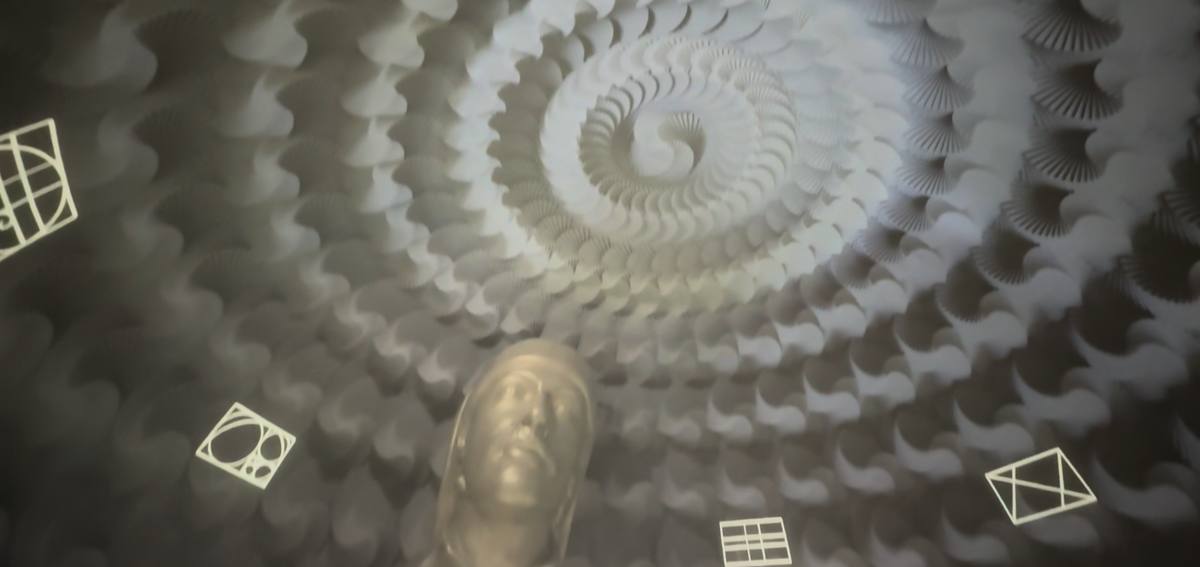
For Emergence in Nature, a 40-minute fulldome projection at the Deutsches Museum in Munich by WE ARE VIDEO and Nicole Popst, I composed the music, built the sound design and mixed the entire piece in 9.1.4 in Spat Revolution.
Why a dome needs its own mix and not a converted one
The piece follows the mathematics behind natural forms: from atoms and crystals through DNA and cell structures to fractal networks and spiral growth. One chapter is built entirely on the Fibonacci sequence and the golden angle of 137.5 degrees, the invisible rule behind the spirals of a sunflower, a pine cone, a seashell.
The subject sets the task. These are structures that grow outward from a centre in all directions at once. A soundtrack arriving from the front contradicts the image on the ceiling. If a spiral opens above the audience and the sound stays on a horizontal plane, the two halves of the experience disagree, and the viewer feels that as an unspecific flatness without being able to name it.
There is a second reason the mix cannot simply be converted. In a dome the audience is lying down. Heads point at the zenith, which means the height channels are not a decorative layer above the action, they are the action. Everything a normal room treats as “overhead” is the main direction of attention here.
How the piece was built in 9.1.4 with Spat Revolution
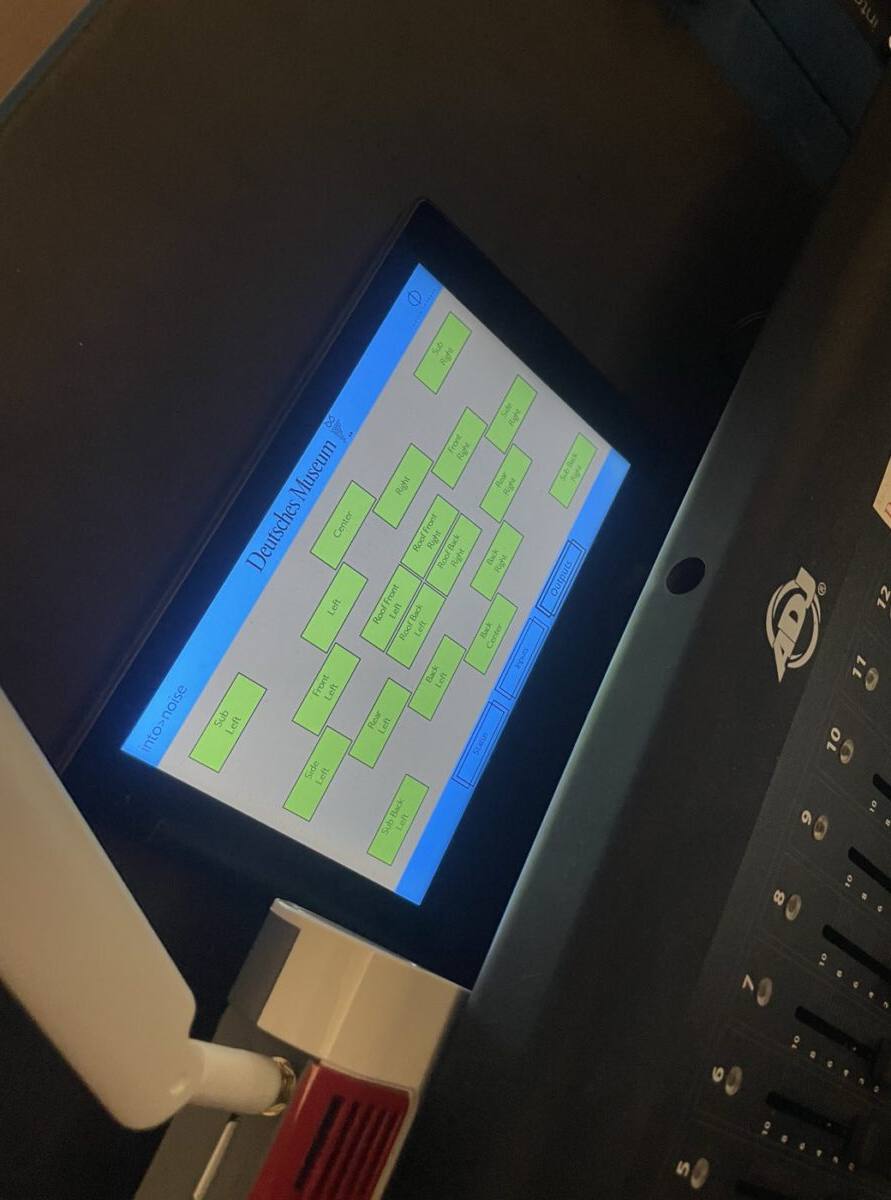
Nine channels around, four above, one below. The dome runs a 9.1.4 layout: front, side, rear and back positions around the audience, four roof channels above, plus subs. The routing has to be exactly right, because in a dome a channel that sits ten degrees off is not a small error but a sound coming from the wrong part of the sky.
Object-based, not channel-based. The mix was done in Spat Revolution, where sounds are placed as objects in space and rendered onto the actual speaker layout rather than mixed straight to channels. That is the only sensible route here, because the geometry of a dome is not the geometry any channel format was designed for. You put a sound where it belongs in the room and the renderer solves the rest.
Music and sound design from one hand. I composed the music and built the sound design, and with this subject that counts for more than usual. When score and effects come from two directions you hear the seam: the music sits in a wide stereo image while the effects move, or the effects fight the harmonic content. Here both were built together, so a spiral opening above you can be carried by the music instead of being decorated by an effect on top.
Movement that follows the growth, not the effect. The temptation in a dome is to keep everything flying around permanently, because the room allows it. The subject argues against that. Emergence is about simple rules producing complex order, and the sound follows the same logic: things start small and centred, and the space opens as the structure opens. Movement earns its place when the image grows, not because the speakers are there.

What came out of it
The audience lies on the floor and the piece happens above and around them. When a structure unfolds overhead, the sound unfolds with it, from the same direction, at the same pace.
For an exhibition context that delivers three things a conventional projection does not:
The room disappears. People stop registering that they are sitting in a hall in a museum with speakers on the wall. That is the point where a scientific subject stops being explained and starts being experienced.
Attention gets a direction. In a 360-degree image the audience can look anywhere, which also means they can miss the moment. Sound says where to look, without a caption and without a narrator.
The abstract becomes physical. Fibonacci is a number sequence. A number sequence is hard to feel. A spiral opening above your head while the sound opens with it is very much something you can feel, and that is the difference between understanding a principle and retaining it.
The same logic applies to any dome, whether a planetarium, a science center, a fulldome festival or a temporary mobile projection: once the image runs all the way around, sound decides whether the room disappears or whether the audience hears the speakers.
The project was funded by FilmFernsehFonds Bayern and was shown at the European Patent Office during the Long Night of Munich Museums, among other places.
More on how spatial audio works in installations is at audio spatialization, and on the formats behind it at what is spatial audio.
Planning a dome or installation project?
If you are working on a fulldome show, a planetarium programme or a spatial installation and the sound has to hold the room together, that is the part I do.
Get in touch