
Understanding the VR AR Difference Through Sound
Content
In today’s tech-driven world, the VR AR difference is becoming more significant as both technologies shape how we interact with digital content.
Virtual reality (VR) and augmented reality (AR) are two transformative technologies under the umbrella of extended reality (XR), but they offer distinct experiences.
Virtual reality immerses users completely in a virtual environment, where everything from the sights to the sounds is part of a fully computer-generated simulation.
In contrast to a VR environment, augmented reality overlays virtual elements onto the physical to simulate real world situations, enhancing real-life interactions by adding digital information to real world objects.
Both technologies rely heavily on sound to create convincing and engaging experiences, but the way they integrate sound is different.
While visuals often grab the most attention in VR and AR, sound is an integral part of creating immersive experiences.
Immersive audio is estimated to account for up to 50% of the immersive experience in virtual environments.
While VR headsets like the Meta Quest Pro aim to isolate users within a virtual world, AR technology—often accessed via mobile devices or augmented reality glasses—blends both virtual environments and physical soundscapes, requiring audio to harmonize with the user’s real environment.
This guide will explore the key differences between VR and AR in terms of sound design and audio immersion.
Whether you’re exploring fully immersive virtual reality experiences or integrating augmented- reality technologies into real world scenarios, understanding how sound operates in these two technologies is essential for creating effective, immersive applications.
We’ll also touch on the advantages of each technology, the challenges they face, and the future outlook for AR and VR headset markets, including how the audio industry is driving the development of immersive audio formats for VR and AR.
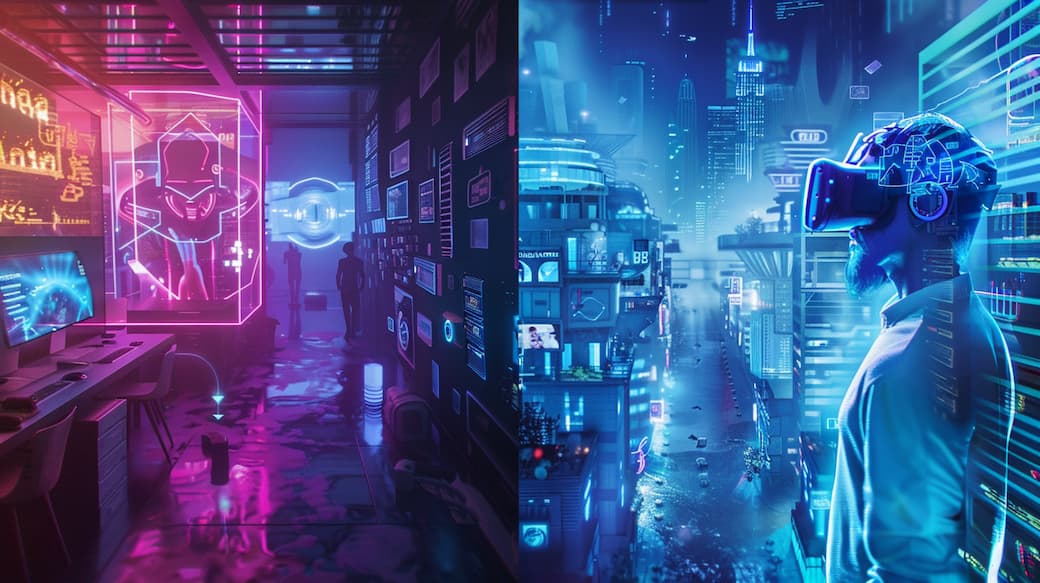
What is Virtual Reality (VR)?
Virtual Reality (VR) is an immersive technology that completely replaces the real world with a computer-generated simulation.
Through VR headsets, such as the Meta Quest Pro, virtual reality creates a digital world where users interact with a fully isolated virtual environment.
The user is entirely cut off from the physical world and immersed in a full virtual reality work to walk through a space where everything—sounds, sights, and interactions—are digitally created.
Immersive audio systems are designed to surround the listener in a three-dimensional space, with precise sound placement enhancing the sense of presence.
VR is best known for its use in video gaming, virtual tourism, and simulated environments for training.
However, it’s not limited to entertainment; VR technology is also used in virtual and augmented reality work, for virtual meetings or design processes.
What virtual and mixed reality really is not, however, is an overlay of virtual elements onto real world objects—that’s the domain of augmented reality (AR).
In addition, object-based audio is a key technology in immersive audio for VR and AR. Unlike traditional channel-based systems that rely on fixed channels, object-based audio allows individual sounds to be positioned and moved freely within the sound field.
Immersive audio treats each sound as a distinct object placed at specific coordinates within a three-dimensional space, offering greater flexibility in sound placement and movement. This approach enables a more dynamic and realistic audio experience for the listener.
In essence, VR replaces the physical reality with an entirely virtual reality replaces a new, virtual world, offering users a chance to interact within a completely fictional, virtual reality itself.
The immersive experience VR provides is highly dependent on hardware such as VR headsets, which are required to create a convincing simulated environment.
What is VR Sound?
In VR, sound is a key component for creating a believable, immersive experience.
Immersive audio formats such as Ambisonics, binaural audio, and object-based systems like Dolby Atmos and DTS:X are essential for creating realistic and dynamic soundscapes in VR, enabling three-dimensional and interactive audio environments.
3D spatial audio simulates the way we hear in a real life environment, making it seem as though sounds are coming from specific directions, such as behind, above, or beside the user.
Spatial audio encompasses techniques like head-related transfer functions (HRTFs) and ambisonics to create a sense of space and depth in audio experiences.
Binaural audio and binaural recording use HRTFs to simulate how sound is heard by the human ear, providing a personalized and immersive experience, especially with headphones.
However, the effectiveness of immersive audio technologies can be diminished if the HRTF does not match an individual’s unique ear shape and size.
Ambisonics captures a full sphere of sound from a single point in space, allowing for real-time rotation and re-orientation to match the listener’s head movement.
Object-based audio treats each sound source as an independent sound object, allowing for dynamic placement and movement within the sound field.
Dolby Atmos and DTS:X are object-based audio formats that support various speaker configurations and create immersive, three-dimensional sound experiences.
VR headsets like the Meta Quest Pro use advanced audio rendering technologies to ensure that sounds change dynamically based on the user’s position and movement.
This contributes significantly to the feeling of presence, where users believe they are in a new, digital world.
Immersive audio systems are designed to engage the listener’s brain, creating realistic and emotionally compelling experiences by simulating sound in three dimensions.
The evolution from traditional stereo and surround sound to advanced immersive audio formats highlights the limitations of stereo and the advantages of object-based and spatial audio in creating realistic, environment-aware sound experiences.

What is Augmented Reality?
Augmented Reality (AR), on the other hand, is a technology that enhances the physical world by adding digital elements.
Instead of immersing the user in a virtual environment, AR systems overlay digital information, such as images, text, or sound, onto real world scenarios.
This is commonly done through mobile devices, such as a mobile phone, computer vision or smart glasses.
Unlike virtual reality, AR technology does not isolate users from the real environment; instead, it enriches the experience by blending both virtual environments and physical worlds.
Environmental sounds play a crucial role in making virtual objects feel physically present, significantly enhancing the user feel and experience feel in AR applications.
Sound placement in immersive audio for VR AR is especially important in retail AR applications, where it is used to enhance virtual try-on experiences and make digital objects feel more realistic.
Environmental sounds in immersive audio also provide contextual cues that help users feel part of both virtual reality environments and augmented reality experiences.
A good example of AR technology in action is the use of AR apps that utilize the phone’s camera to overlay digital information onto physical objects.
AR experiences are widely used in applications like navigation, and AR displays, gaming, and digital training devices.
Augmented reality is also becoming increasingly popular in industries such as healthcare and education, where it’s used to create interactive and educational real world situations by placing virtual objects within the real world environment.
Augmented Reality is not intended to replace the real world but to enhance it, offering its augmented and virtual reality advantages and a different approach than VR.
It brings together the physical world and digital world in a more practical, real-time way.
What is AR Sound?
In AR, sound must coexist with real-world audio, creating an augmented soundscape.
AR audio integrates virtual sounds with physical-world noises, requiring precise placement so that the augmented sounds feel natural.
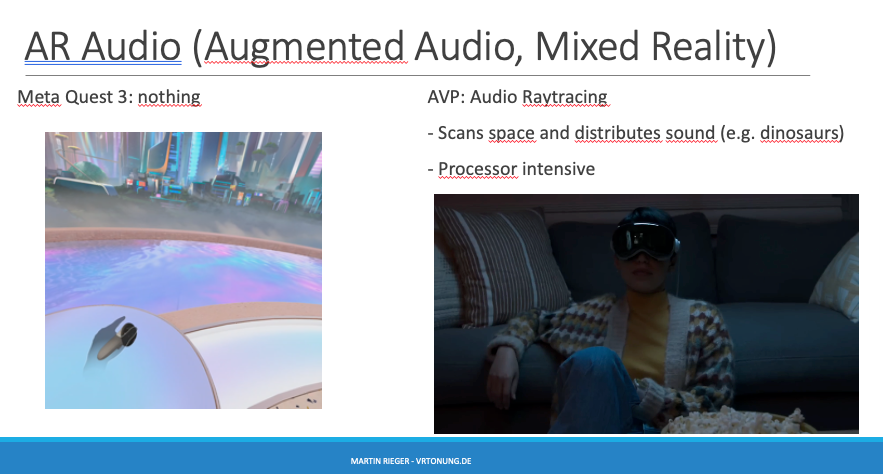
For example, with Apple’s Audio-R-Tracing in the Vision Pro, virtual sounds are anchored to specific locations in the user’s real-world environment, meaning if a sound is meant to come from a particular spot, it remains consistent, even as the user moves.
Google Resonance Audio is a cross-platform SDK that supports spatialization using HRTFs and ambisonic playback for AR applications.
Steam Audio integrates with game engines like Unity and Unreal, providing real-time acoustic modeling based on the virtual environment.
The integration of immersive audio with augmented reality will require advanced systems to analyze the acoustic properties of the user’s environment.
Haptic integration, where immersive audio is combined with haptic feedback, can create a multisensory experience by allowing users to feel sound as well as hear it.
The combination of sound and visuals in VR and AR creates a multisensory experience that enhances immersion.
Feedback loops, created by integrating audio and tactile sensations, further enhance immersion and realism in AR experiences by providing immediate, sensory-based responses to user actions.
This allows AR to blend digital audio seamlessly with real-world experiences.

Key Differences Between VR and AR Sound
Main Differences Between AR and VR
The VR AR difference lies in how each technology interacts with the real world and its approach to creating an experience.
Virtual VR augmented reality completely removes users from the physical environment, placing them in a fully virtual world, while augmented reality overlays virtual elements onto the real environment.
While visuals are a key component in both VR and AR, the combination of visuals and immersive audio—including surround sound and advanced spatial techniques—creates a multisensory experience that significantly enhances immersion and the sense of presence.
Surround sound was an important step in the evolution of immersive audio, providing horizontal sound distribution, but modern immersive audio systems go beyond surround to create fully enveloping, multidimensional soundscapes that work alongside visuals for greater realism and engagement.
VR Technology creates a complete virtual reality environment, isolating the user with a VR headset for a fully immersive experience.
AR Technology enhances the real world with digital elements, typically accessed through mobile devices or augmented reality glasses.
Shared Elements in AR and VR
Despite these significant differences, both AR and VR are part of the broader category of extended reality (XR), which covers all immersive technologies that blend real and virtual worlds.
Both technologies aim to create immersive experiences, whether through full simulation (VR) or the augmentation of the virtual and physical worlds through augmented reality and virtual one (AR).
In both, sound plays a crucial role in enhancing these immersive experiences, although the application of sound varies significantly between the two.
Immersive audio for VR and AR can greatly enhance music experiences, such as virtual reality music videos or interactive music classes, making them more engaging and emotionally resonant for users.
Actively listening to spatial audio cues helps users feel more connected to virtual environments, as immersive audio helps to build emotional connections between users and virtual experiences.
Shared Goals in AR and VR Audio
Both AR and VR rely on audio to create immersive experiences, but the way sound is used in each differs significantly.
VR audio enhances the illusion of being in a completely new virtual world, while AR audio enhances augmented reality adds the user’s interaction with the physical environment by adding relevant digital information to real life environments.
Object-based audio treats each sound source as a sound object with its own spatial characteristics, allowing for precise placement and movement within the 3D soundscape.
This enables accurate sound localization, so users can pinpoint the exact origin of sounds—an essential feature for navigation and interaction in both virtual and augmented reality environments.
Virtual world Sound: Creating Immersion
3D spatial audio enables users to hear sounds from all directions, greatly enhancing the realism and immersion of virtual environments.
Spatial Audio and Realism
In VR, the goal is to create a fully immersive sound experience where every sound is carefully positioned in 3D space.
Advanced spatial audio systems combine precise hardware and software components—such as head-tracking, calibration, and object-based audio—to generate a three-dimensional sound field.
This sound field allows users to perceive sounds from all around them, simulating a realistic auditory environment.
Spatial audio creates a more realistic experience by allowing users to hear sounds from different directions, making it feel as though they are physically present in the virtual world.
When users turn their heads or move within the environment, the sounds adjust accordingly, as the system dynamically manipulates the sound field, further enhancing the sense of presence.
Use Cases for VR Sound
VR audio is crucial in fields such entertainment applications or gaming, where realistic audio cues are essential for player interaction and immersion.
Training simulations in VR also rely on accurate soundscapes to mimic real-world scenarios, whether it’s in flight training or medical procedures. Developers use immersive audio to provide crucial audio cues, helping users develop situational awareness in training scenarios.
AR technology Sound: Enhancing Reality
Augmented Soundscapes
In AR, sound enhances the real world by adding layers of audio that provide context or information.
For example, in a navigation app, AR audio can guide users through voice directions while keeping them aware of their surroundings.
Precise sound placement within the three-dimensional sound field is essential for creating engaging and interactive AR experiences, as it allows virtual sounds to be perceived as originating from specific locations in the environment.
The Apple Vision Pro uses Audio-Ray-Tracing to ensure that virtual sounds are fixed in specific locations within the physical environment, providing a sense of spatial consistency between real and virtual augmented reality advantages of augmented sounds.
Additionally, immersive audio improves user engagement in virtual environments by providing feedback based on user actions, making experiences more dynamic and responsive.
Use Cases for AR Sound
AR audio is widely used in applications like mobile gaming (e.g., Pokémon Go) and business tools, where sound helps users interact with both digital and physical environments.
In maintenance or repair, audio cues in an AR headset can direct workers to specific actions or locations, adding a practical layer to real-world tasks.
Immersive audio enhances the user feel and experience feel by providing cues that guide actions and interactions in AR applications, making users feel more engaged and present within the environment.
Choosing the Right Sound Technology: VR vs. AR
VR Sound: Immersion Through Isolation
In VR, the goal is total immersion, which makes sound isolation essential. VR is primarily experienced through dedicated headsets, where external noises are distractions that can break the sense of presence.
This is why over-ear noise-cancelling headphones are often used.
These headphones completely block out environmental sounds, allowing the user to focus entirely on the 3D spatial audio within the virtual world.
High-quality headphones paired with immersive audio technologies enable precise and dynamic sound localization, further enhancing the sense of immersion in VR.
In gaming or training simulations, audio cues must be accurate and responsive, as they help users navigate and interact with the digital environment.
The role of spatial audio is to create a believable soundscape and virtual model that enhances the immersion by simulating sound sources from all around the user.
AR Sound: Blending Virtual and Real Worlds
In AR, the experience differs significantly because users still need to engage with the real world. AR overlays virtual objects and content onto the physical environment, meaning the audio needs to work harmoniously with real-world sounds.
Unlike VR, AR audio must allow ambient sounds to pass through, ensuring the user remains aware of their surroundings.
In-ear headphones, like the AirPods Pro, provide an ideal solution, as they feature both noise-cancelling and transparency modes. In noise-cancelling mode, they can function similarly to VR headphones by blocking out external sounds.
In transparency mode, they let ambient noise in, which is essential for AR applications like navigation or maintenance, where users need to be alert to their environment while interacting with digital content.
Challenges and Future Developments in AR and VR Audio
Overcoming Audio Challenges in AR
In AR, the primary challenge is balancing virtual sounds with real-world audio in real-time. As AR applications continue to grow on devices like smartphones and smart glasses, ensuring that digital sounds feel natural and blend seamlessly with physical surroundings will be critical.
This includes making sure that the user can easily switch between isolated audio for focused tasks and ambient-aware audio for situations that require attention to the real world.
AirPods Pro, for example, offer the kind of flexibility needed in AR environments, where users may need to quickly toggle between noise cancellation and noise awareness modes.
Advanced AR audio systems can dynamically switch between different channel configurations—such as stereo, surround, or object-based setups—to adapt to the user’s environment and needs, moving beyond fixed channels to enable more precise and immersive spatial audio experiences.
Enhancing Immersion in VR Audio
For VR, the challenge remains creating deeply immersive soundscapes that respond dynamically to user movements.
Noise-cancelling headphones are vital to maintaining this immersion, as they help isolate users from the outside world.
As VR headsets evolve, the development of even more advanced spatial audio technologies and headphones will improve how accurately sounds are positioned in 3D space.
Future VR experiences will benefit from hardware improvements in processing power and sound rendering, making the audio even more responsive and immersive.
Dynamic, object based audio systems will simulate how sound behaves in the real world, increasing the sense of presence and realism in virtual environments.

Conclusion: Understanding VR vs. AR Sound
Both VR and AR offer unique opportunities to enhance user experiences through sound. VR audio creates immersive, isolated environments, while AR audio enhances and complements the real world.
As the line between VR and AR continues to blur with Mixed Reality headsets, understanding the different audio technologies behind each headset device will be crucial in creating compelling, immersive experiences.
Need advice on integrating immersive audio into your AR or VR project? Contact me for expert guidance on how to make your Mixed Reality experiences sound as real as they feel.