Localise sound: Modern methods and technologies for precise sound source localisation
Content
Key insights
Acoustic cameras enable precise localisation of noise sources in real time by combining video technology with microphone arrays.
Beamforming methods visualise sound sources in colour and make noise analysis easier even for inexperienced users.
Modern sound cameras can detect problems up to ten times faster than conventional methods.
Areas of application range from industry and the automotive sector to building diagnostics.
A systematic approach with switching off interference sources and proper documentation leads to better localisation results.
What is noise localisation and why is it important?
The precise determination of the spatial position of sound sources has become an indispensable tool in modern industry. When a production plant makes unusual noises or a compressed air system wastes energy due to leaks, every minute spent searching for the source costs real money.
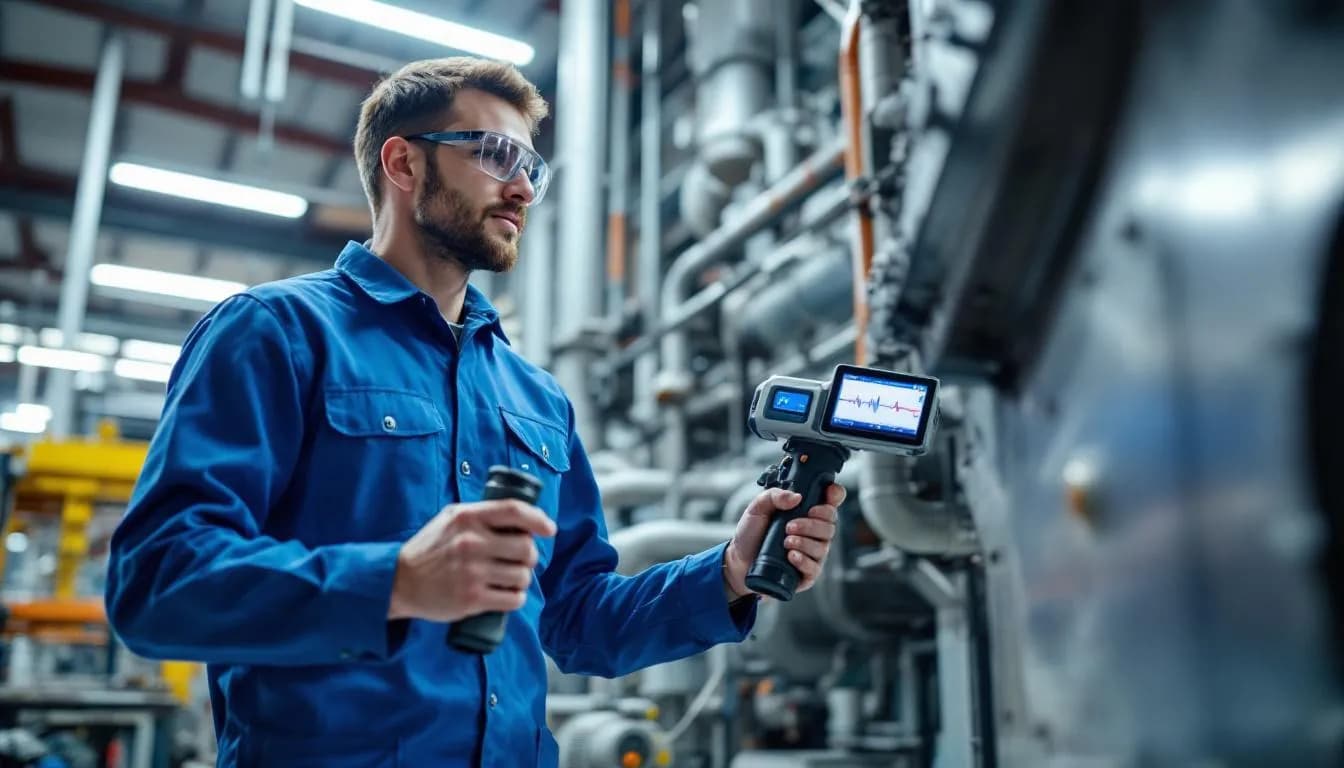
Localising noises means far more than just finding noise sources. It is a systematic approach to fault diagnosis that enables significant cost savings in various fields. In quality control, sound source localisation helps to detect production faults at an early stage before they lead to expensive complaints.
The importance for maintenance and servicing is particularly noteworthy: by detecting signs of wear or defects at an early stage, unplanned downtime can be avoided. A defective bearing in a production machine often announces itself through characteristic noises long before a complete failure threatens.
Modern technologies for noise localisation
Acoustic cameras and beamforming
The revolution in sound analysis came with the development of acoustic cameras, which enable a completely new approach to locating noise sources. These devices combine a conventional video camera with a precisely calibrated microphone array consisting of several dozen individual sensors.
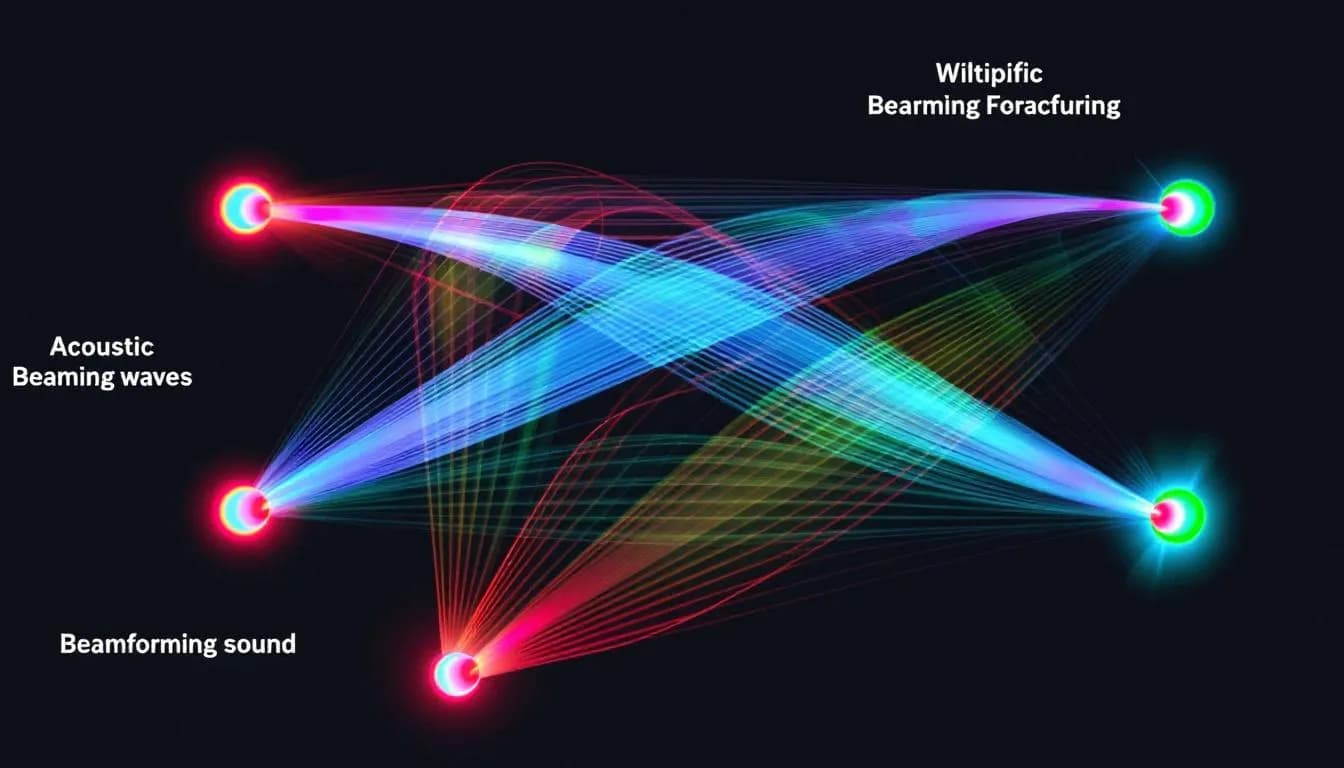
The heart of this technology is the beamforming process. All microphone signals are mathematically processed in such a way that the direction and intensity of sound waves can be determined precisely. The result is displayed as a coloured overlay on the video image – red areas indicate loud sources, blue areas quiet ones.
Modern systems work in real time and can capture both audible frequencies and ultrasound. The resolution is impressive: under optimal conditions, sound sources can be localised to within a few centimetres. Recording is done as video with synchronised audio, enabling detailed analysis and documentation.
Different measurement techniques
The choice of the right measurement technique depends heavily on the field of application. Near-field measurements are ideal for detailed analysis of individual components or machines, while far-field measurements can cover large areas.
Holography methods are used for particularly complex sound fields, for example when several sources are active at the same time and influence each other. These methods require more elaborate data processing but provide three-dimensional information about sound propagation.
Intensity measurements supplement pure localisation with quantitative data on sound power. They not only determine where a source is located, but also how much energy it emits. This information is particularly relevant for noise control measures and the assessment of limit values.
Main application areas of noise localisation
Industrial applications
In production environments, the practical benefits of noise localisation are particularly clear. Compressed air leaks in extensive piping systems can cause enormous energy losses. A sound camera can identify such leaks within minutes, while conventional searches with ultrasound detectors can take hours.
Partial discharges in high-voltage systems pose a significant safety risk. These electrical disturbances generate characteristic ultrasound signals that can be detected with special cameras even from a safe distance. Early detection can prevent power outages and costly repairs.
In machine diagnostics, the combination of visual and acoustic analysis enables precise assignment of noises to their causes. Wear parts, imbalance or assembly errors can thus be identified in a targeted manner. The measurement data provide a solid basis for planning maintenance activities.
Automotive industry
The automotive industry uses sound source localisation intensively to improve driving comfort. BSR noises – these are buzz, squeak and rattle noises – can significantly impair comfort. With acoustic cameras, these disturbing sounds in vehicle interiors can be localised precisely.
NVH analyses (Noise, Vibration, Harshness) are another important field of application. Both stationary vehicles and drive-by measurements are analysed. Modern test facilities can use several microphone arrays and different sensors at the same time to create a comprehensive picture of the acoustic properties.
Quality control in vehicle production benefits greatly from the ability to detect production faults through characteristic noises. Incorrectly assembled parts or defective components often reveal themselves through atypical sound patterns.
Building diagnostics
In building diagnostics, noise localisation opens up completely new possibilities. Leaks at windows and doors can be detected regardless of outside temperature – a major advantage over thermographic methods that depend on temperature differences.
House noises that disturb residents can be identified through a systematic approach. Disturbing sounds often come from heating pumps, fans or other technical systems located in hidden areas.
Testing the building structure for sound-conducting paths helps with noise control planning. Cracks in masonry or improperly laid pipes can form significant sound bridges that are difficult to detect using conventional methods.
Practical tips for effective noise localisation
Systematic approach in buildings
Successful noise localisation in buildings requires a methodical approach. The first step is to systematically switch off electrical devices. Fridge, heating pump, ventilation systems and other loads are switched off one after the other to eliminate interfering noises.
Keeping a room logbook has proven useful. All observations are documented in it: which noises occur at what times? How do noise patterns change with different settings? This information is extremely helpful for later analysis.
Opening windows can help distinguish between indoor and outdoor noises. Different sound sources often overlap, and only through targeted manipulation of the environment can the individual components be separated.
Examination of the building structure should include both visual and acoustic aspects. Cracks in plaster or loose cladding can transmit structure-borne sound and make distant noise sources audible in unexpected places.
Optimising the measurement technique
The positioning of the microphone array is crucial for the quality of measurement results. Ideally, the camera should be positioned so that as many potential sources as possible are within the capture area. Reflections from walls and other surfaces must be taken into account.
Ambient noise can greatly complicate analysis. Modern devices offer various filters to suppress constant background noise. For transient events – short noise events – a high frame rate is required to capture the events.
The combination of image, sound and video enables comprehensive documentation. Many systems allow exporting individual images or recording longer video sequences. These recordings are valuable for later analysis or as evidence for clients.
Selection criteria and investment costs
The choice of the right equipment depends on several factors. Entry-level devices are available from 990 euros including accessories and are suitable for basic applications such as leak detection or simple machine diagnostics.
For professional applications with higher accuracy requirements, costs increase accordingly. Systems with large microphone arrays and extended analysis functions can easily reach five-figure amounts. A problem analysis before the purchase decision is important: which types of noise sources are to be localised? In which environments will measurements be taken? What resolution is required?
Individual consultation by experts is usually indispensable. Many manufacturers offer test installations where the devices can be tried out under real conditions. This helps to assess whether a system meets the requirements.
Training of staff should be taken into account when planning the investment. While basic operation is often intuitive, professional applications require deeper knowledge of measurement technology and signal processing.
Frequently asked questions (FAQ)
How accurate is localisation with acoustic cameras?
Modern beamforming methods achieve a spatial resolution of a few centimetres under optimal conditions. However, accuracy depends on several factors: the frequency of the signal, the distance to the source and the ambient noise. Low-frequency signals below 500 Hz are fundamentally more difficult to localise than high-frequency ones because the wavelength is larger than the distance between the microphones.
Can acoustic cameras also be used during operation?
Yes, intelligent filtering allows background noise to be selectively suppressed. Special algorithms enable localisation even in noisy industrial environments. The system can distinguish between constant background noise and the sound sources under investigation. Measurements are therefore possible without interrupting operations, which is a significant advantage over other diagnostic methods.
Which frequency ranges can be captured with acoustic cameras?
Standard devices capture frequencies from around 200 Hz to 20 kHz, which corresponds to the audible range. Special ultrasound cameras can detect frequencies up to 100 kHz and above. The different microphone configurations are optimised for specific frequency ranges – large arrays with wider spacing for low frequencies, compact arrays for high frequencies and ultrasound.
How long does a typical noise localisation take?
Simple compressed air leaks can be localised within minutes once the device has been positioned and calibrated. Complex machine diagnostics, on the other hand, require 30–60 minutes depending on the scope of the investigation. Preparation – optimal positioning, adjusting settings, switching off interference sources – should be planned additionally and can easily take an hour in unknown environments.
Do you need special training to operate the devices?
Basic operation of modern devices is possible after a short introduction, as the user interfaces are designed to be intuitive. For professional applications with detailed analysis, however, 1–2 days of training are recommended. Manufacturers usually offer practical courses in which participants learn on real examples how to identify and analyse different types of sound sources.
Related Articles
New car sound technology with Automotive Audio and 3D speakers