#EUsavesLives Roadshow: Humanitarian Operations with Spatial Audio Workstation
The EU spends part of its budget helping people around the world, including far beyond Europe. Whoever pays for that wants to know what happens to the money. The European Commission, specifically its DG ECHO department (European Civil Protection and Humanitarian Aid Operations), therefore wanted to show how the EU helps in crisis situations, as a VR experience for a roadshow.
The commission came to me directly from DG ECHO. I travelled to Belgium, Denmark and Bangladesh for the 360° shoots, recorded the sound on location and finished it in post-production.
Why 360° for images from crisis areas
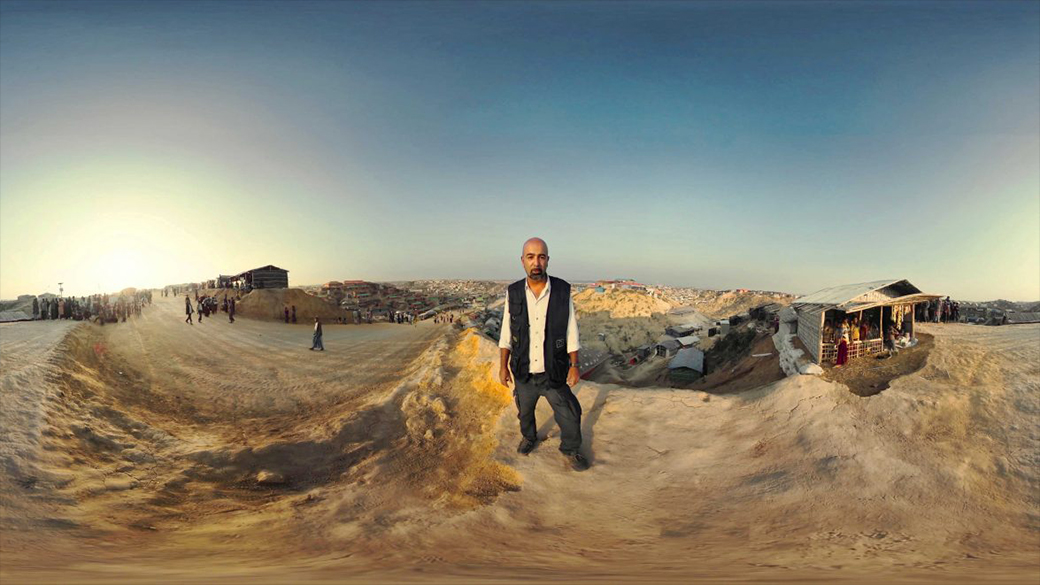
The familiar images from crisis areas play heavily on emotion. That often makes them feel exaggerated and hard to believe. In 360° that hardly works: the whole surroundings stay visible around the viewer, so the picture can’t be staged. It is what it is.
For the sound, that means it has to reach people emotionally without falling back on sad or dramatic music. The naturalness that is otherwise manufactured comes from the original sound here.
Three locations, three sound worlds
In Brussels we were at the ERCC, the Emergency Response Coordination Centre, the EU’s crisis coordination hub. There the sound carries the busy atmosphere and the communication between the response teams. In Denmark we followed an earthquake exercise. And in Bangladesh we were in the refugee camp in Cox’s Bazar, where the Rohingya live.
Bangladesh was the part that affected me most. Much of what we saw there was moving, and not everything could be planned. Once we ended up in a food distribution by accident and could move neither forward nor back. During another recording the muezzin suddenly began the call to prayer. We asked him politely to wait a moment, and he did.
When mixing documentary 360° videos, one rule matters most to me: fewer layers. The audience is already busy enough with the all-round picture. Add voice-over, effects and music at the same time and nothing can be located any more. For the Bangladesh film I therefore started with just the protagonist in the picture, a few footsteps and a light ambience, and only then expanded step by step.
What came of it
The experience ran on the roadshow. The Bangladesh round went down so well that DG ECHO commissioned a second round. That one took us to the Kakuma refugee camp in Kenya: #EUsavesLives 2 in Kenya.
What I take from the project: in a 360° video you observe, but you can’t intervene. That very feeling of helplessness helped create empathy here.
Frequently asked questions about VR experiences for campaigns
Why 360° video instead of a conventional film for humanitarian topics? Because the all-round picture can hardly be staged. The viewer sees the whole surroundings, which makes the reporting credible.
Does a film like this need dramatic music? No. The original sound reaches people emotionally. Too much music also masks spatial localisation.
How many sound layers can a 360° documentary take? Few. Start with what matters most in the picture, such as the main person, footsteps and a light ambience, then add more step by step. Otherwise nothing can be located.
Planning a VR experience for a campaign? Let’s talk.
Original sound that carries the story without pulling at the heartstrings.
Get in touch