TURN ON Interview: Explaining 3D Audio for the Meta Quest 3S
I can close my eyes, but not my ears. That line opens most of the explainer videos I make, and it also opened my appearance on TURN ON, MediaMarkt’s tech show on YouTube. The occasion was the Meta Quest 3S: Meta dropped the 3.5 mm headphone jack on the cheaper Quest model, and the comments filled up fast with people arguing whether that’s progress or a step backward. Host Ilias wanted someone in the studio who could actually explain why sound in VR is its own discipline in the first place. That was my job for the hour.
Why a missing headphone jack turns into a bigger question
On the surface, this is a hardware debate: USB-C instead of a jack, one more adapter in the bag. Underneath, it touches something I talk about constantly and almost nobody thinks about. Everyone discussing VR headsets talks about pixels, resolution, field of view. Sound rides along in the background, even though the whole point is called virtual reality, not visual reality. Inside a headset you only ever see a small cropped window of the world, but you hear the entire space around you the whole time, including whatever is currently outside that window.

That’s exactly why the jack debate made a good hook. It forces an honest answer to what 3D audio actually is. To me it’s an umbrella term for everything that isn’t just left and right like classic stereo, but also in front, behind, above and below you. Most people already know the principle from cinema, when a helicopter seems to fly right over the audience’s heads. In a 360° video or in VR, it becomes something else, because you turn around yourself and the sound has to follow. VR adds one more layer on top: it’s not just direction that matters, it’s distance too. In a competitive game, that distance is what decides whether you hear an opponent sneaking up behind you in time. Anyone who has ever spun the camera around in Call of Duty, Counter-Strike or Battlefield because of footsteps or a gunshot has used 3D audio without ever needing the term for it.
How a studio hour turns into a crash course in 3D audio
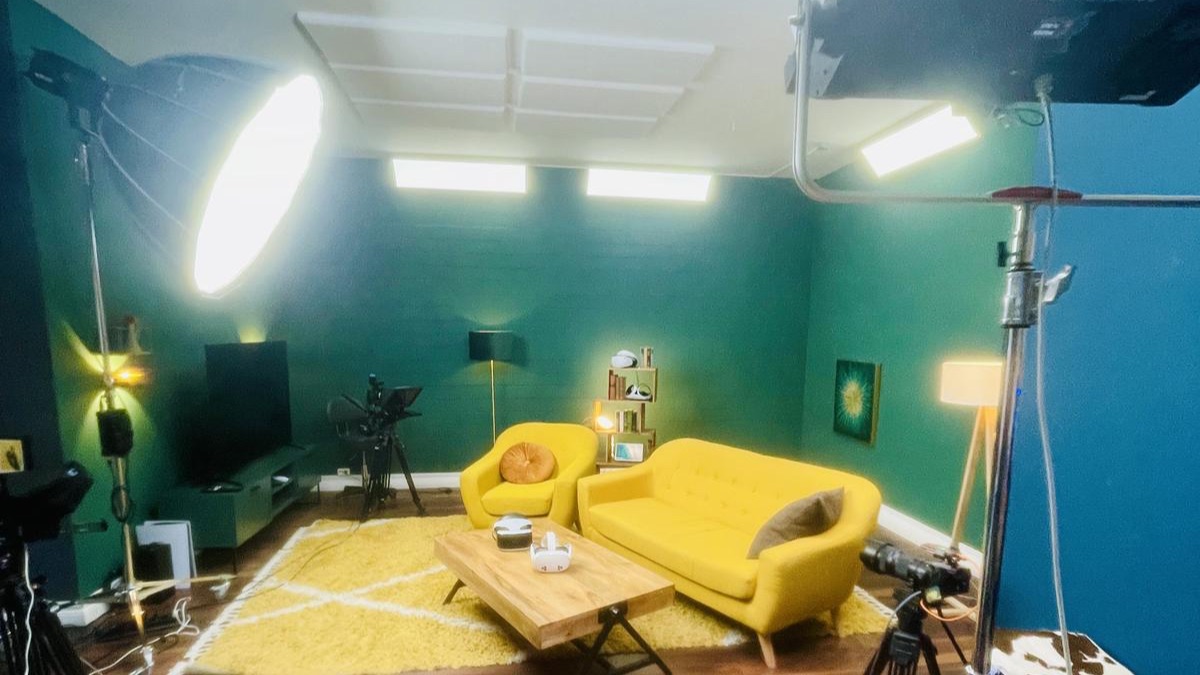
TURN ON shoots in its own studio, built as a living-room set: yellow couch, teleprompter, several cameras running at once. For me that was an unfamiliar seat. I’m usually behind the microphone or in post-production, and this time I sat on the sofa with a lav mic clipped to my shirt, trying to make a technical subject click for a general audience in about an hour, without dumbing it down to the point of being wrong.

On the table sat a PSVR2 and two Meta Quest models for viewers to actually see the hardware being discussed. Before we started, Ilias asked people at home to put on headphones, because the video plays real 3D audio examples. That’s not a minor detail for this topic. Without headphones, you simply cannot hear the difference between stereo and 3D audio, no matter how well someone explains it.
I walked through the two ways 3D audio actually gets made. The first is specialized hardware, above all the dummy head: a microphone capsule placed in each ear of a rebuilt human head, a roughly hundred-year-old principle that still works remarkably well. The best-known one is the Neumann KU100. Its limitation: a dummy head can only face one direction, which is why 360° video needs 360° microphones instead, capturing every direction at once. On playback, the system calculates in real time which slice of that recording matches the direction you’re currently facing. The second way is software: a spatializer that takes an ordinary mono signal and places it inside a virtual room, reflections and materials included. That’s how the viral knocking sound that startled people through their headphones got made.
Then came the actual core question of the episode: does any of this really need a dedicated jack? My answer split in two, and I liked that the split forced a more careful answer than a flat yes or no. With a USB-C-to-jack adapter, you won’t notice a quality difference. The signal stays wired the whole way and only gets converted from digital to analog at the very end. Bluetooth headphones are where it gets tricky. In everyday video watching, a small delay shows up at most as slightly off lip sync. With head tracking in VR, the same delay becomes a real problem: move your head fast, and the sound field lags behind for a moment, so you can no longer tell what’s happening where in the room. The delay itself stays constant, but the faster you turn your head, the more it shows. My practical tip was to tape or velcro the adapter to the headset so it doesn’t dangle and you don’t accidentally rip the port off.
What the audience actually took away
The finished video is cut into four chapters: the basics of 3D audio, the difference between 3D audio and virtual reality, the actual Quest 3S question, and finally how much any of this matters. To me that last chapter was the most important one, even though it’s the shortest. I said it plainly: sound in VR is massively underrated, because every conversation defaults to screens and resolution. That’s exactly the point a general audience gets fastest, the moment you hand them headphones and play one real example.

For VRTONUNG, a job like this sits apart from my brand or museum projects. I’m not delivering a finished mix for a production here. I’m standing in front of a camera as the explainer, for an audience that TURN ON normally reaches through gadgets and tech news, not through spatial audio. That’s where the value sits for me: topics like ambisonics or head tracking otherwise stay inside the industry bubble. A format like this carries them to people who are about to buy a new headset and actually want to know what matters for sound before they spend the money.
What’s left afterward is a compact explainer that uses a hardware controversy as the excuse to correct a bigger misunderstanding: that sound in VR is an afterthought. It isn’t. You only ever see a fraction of the space, but you hear all of it.
Want your product or topic explained to a wider audience?
I’m happy to talk about 3D audio in front of a camera or an audience, whether as a studio guest, a speaker, or a consultant.
Get in touch