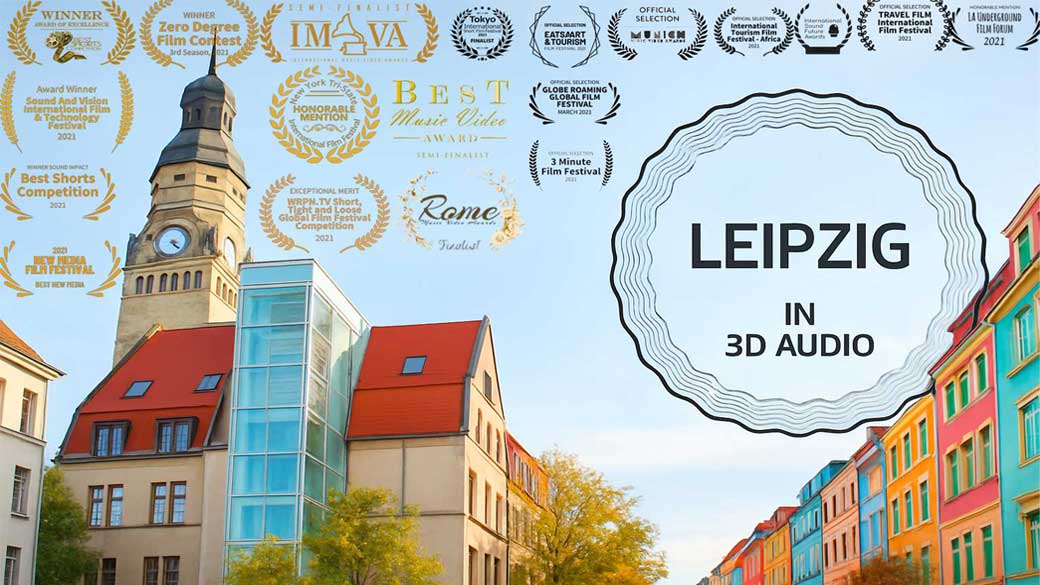
Leipzig in 3D Audio – immersive award winning walking tour video
I think in sound. While others first think about images, camera moves and color looks, the first thing I hear is: What does this place sound like?
When Leipzig Tourismus und Marketing asked me to create two image films about Leipzig as a creative city and a music city, it was immediately clear to me: If a city has so many stories about art, history and music – then it also has to be allowed to sound in 3D.
Walking tour video: Why I wanted to tell Leipzig in 3D
I am interested in everything that goes beyond normal video. A nice edit, good colors, stabilized shots – many people can do that. But too often the sound stays flat, even though our everyday life is actually full of spatial impressions: footsteps behind us, a voice from the left, a door that clearly comes from behind.
I wanted to know: Can a tourist sitting in front of a screen really feel as if they are already in Leipzig – using only image and 3D audio?
Leipzig is a perfect testing ground for this. The city stands for a lively creative scene and a unique musical tradition at the same time – from the Gewandhaus Orchestra to the independent club and concert scene.
The starting point was always the person we wanted to talk to. The goal was to include everyone and to bring all the different sides of Leipzig into the project.
So the task was ideal: two films, one city – one as a creative city, one as a music city, both told through sound.
On top of that came the “Sounds of Germany” campaign for the 250th anniversary of Beethoven. The aim was to make Germany tangible through sound – not just through pretty postcard images.
That is exactly my topic. So it was only logical that I had to throw myself into it.
At the same time, I know my own perfectionism. I constantly question myself: Do I just like this myself – or does it also work for others?
To do this reality check, I sent the second Leipzig clip on a festival tour. The result: several awards, places in the finals, semi-finals – but also a lot of rejections.
And it is exactly this mix that shows me: this is not a niche gimmick, but an approach that really works – even outside my own bubble.
The content of the project is designed to present the collected impressions and the knowledge about 3D audio and Leipzig in a way that makes them understandable and accessible for everyone.
Why immersion is more than a buzzword for me
“Immersive”, “3D”, “spatial audio” – these are now buzzwords that are often used in advertising. But immersion does not happen automatically just because there is a logo of an audio format in the end credits.
For me, immersion means: I forget that I am sitting in front of a screen. I react physically – I turn my head, I startle for a moment, I laugh because something feels real.
The basis of immersion lies in understanding the physical and psychoacoustic effects that make our spatial hearing possible.
That is exactly what I wanted to trigger in the Leipzig movies. When someone hears the stomping of the printing machines, they should briefly think that their own feet are vibrating.
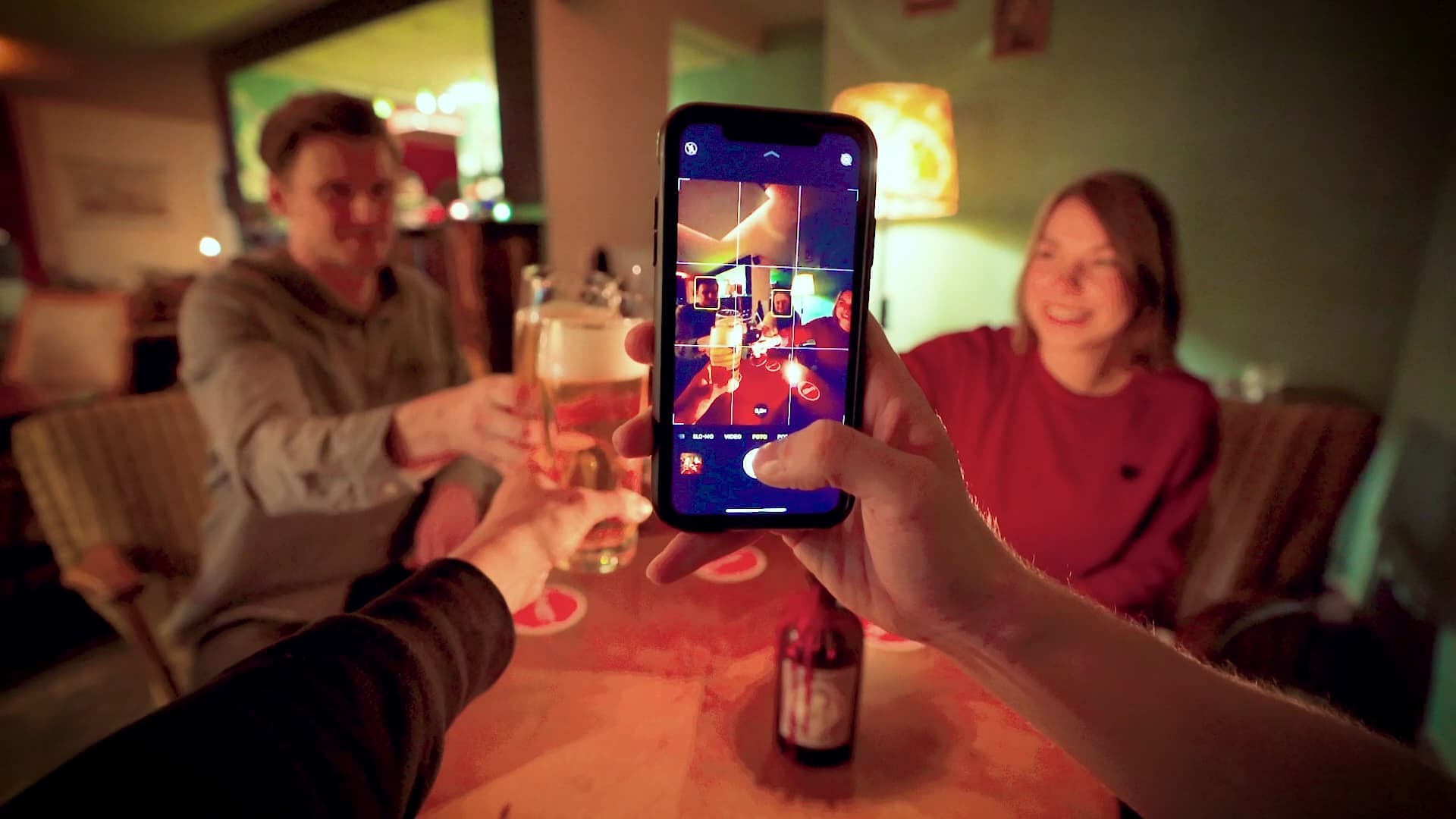
When the Leipzig Ballet dances, the room should really be felt as a room. And when a cocktail is mixed at the bar in the Felsenkeller, that counter should sound as close as your own kitchen table.
My conviction is: Sound can awaken emotions and desire to travel much more strongly than the hundredth beautiful image.
Especially in destination marketing, this is a huge opportunity. The reason for the strong emotional effect of 3D audio lies in the basics of spatial hearing, which stimulate our brain in a particularly intense way.
How I explored Leipzig by listening
The starting point was always the person we wanted to address: the potential visitors. We shoot everything completely from a first-person perspective – the camera is your eyes, my 3D audio setup is your ears.
So I imagined Leipzig as a kind of sound playground. Each place had to deliver two things: an image that works – and a sound that works. To achieve this, I deliberately collected acoustic information in order to capture the special qualities of each place and use them in the best possible way for the later 3D audio production.
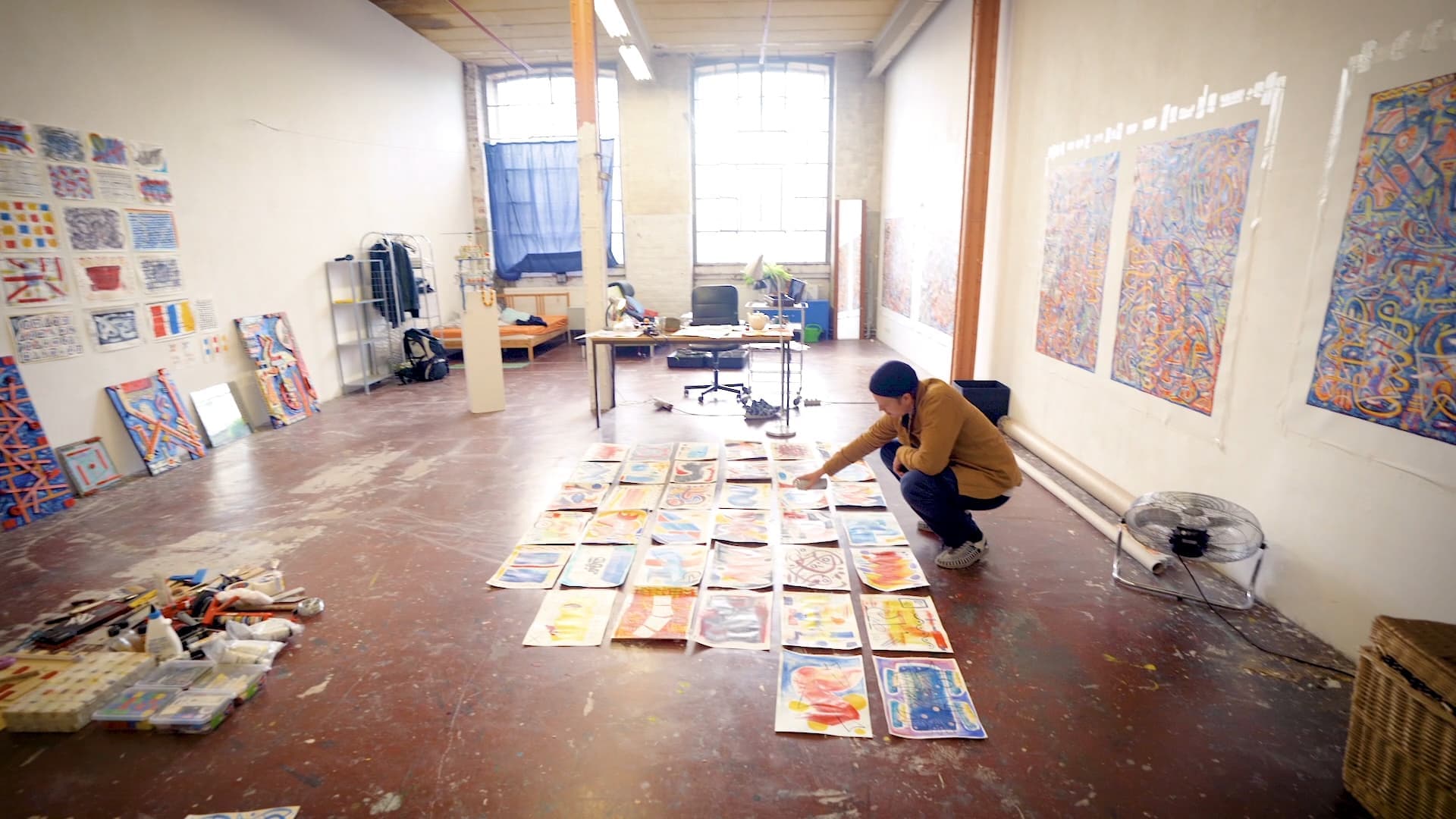
In the creative city clip, for example, we visit the Museum of Fine Arts, the Museum of Printing Arts, the Kunstkraftwerk and the Spinnerei.
There are plenty of images there. It became exciting for me at the moment when I asked myself: What is the “signature sound” here?
In the Museum of Printing Arts, it is clearly the machines. Their stomping and rattling have their own groove. At the Kunstkraftwerk, it was the huge room acoustics, the rustling, the slight echo of footsteps, the projections that sound different from a normal white-cube gallery space.
At the Spinnerei, you hear the subtle work in the background, doors, footsteps, voices – all elements that I collect the way other people collect postcards. Special sound recordings were crucial here to reproduce Leipzig’s soundscape as realistically and immersively as possible.
How everyday sounds become a beat
One basic idea for the music city clip was: what happens if you don’t just add sound to the city, but build your own beat from its noises?
So I started with a simple metronome. Nothing fancy – just a tempo that grooves easily but has enough drive to carry the film. I then cut to this metronome: printing machines, footsteps, glasses, claps – everything was placed so that it fits together rhythmically.
Only then did the music come in. Instead of choosing a track first and adjusting the image to it, I deliberately did it the other way round: the beat of the city was there, and I looked for music that picked up this energy.
Especially in a 3D audio context, music plays a special role, because the spatial placement of sounds and instruments makes the listening experience more intense and opens up new possibilities for staging.
The licensed music we finally used was then adjusted in speed until image, beat and track became one. Certain bands, such as Pink Floyd or Fleetwood Mac, are particularly well suited for 3D audio, because the variety of instruments and the number of band members allow for an exciting spatial distribution in the sound field.
This creates a flow that you feel rather than consciously analyze.
How I use 3D sound for a stereo video
On a technical level, the film looks unspectacular at first glance: Historically, the development of audio technology began with mono sound, before moving on to stereo and surround and finally to modern 3D audio formats.
Binaural audio and binaural recording are special techniques for creating an immersive 3D sound experience. In the end, we deliver a stereo file – the format that any platform can easily play.
The format used is crucial for compatibility with different platforms and devices, such as streaming services or Blu-ray. The “magic” happens before that.
I work with dummy head recordings and additional microphones, which I later position virtually in space. For this I use binaural plug-ins that allow me to move each sound source anywhere in the 360° space around the listener’s head – including height, direction and amount of room reverb.
The timbre of the sound is influenced by the shape of the head and ears and helps to locate sound sources. ILD (interaural level difference) and ITD (interaural time difference) help the hearing system to recognize sound from different directions precisely.
In practice, this means: I ask the camera operator what movement they will make. Then I repeat this movement with the dummy head or a suitable microphone setup.
In this way, picture and sound movement match as naturally as possible. Modern audio formats, through special formats and technologies, provide an immersive experience that goes far beyond classic stereo recordings.
If this does not work perfectly, I can correct the position of the sound source afterwards in the virtual space: a sound a bit more to the left, further forward, higher, lower, with a different amount of room. Reverb is extremely important, because our brain uses reflections to estimate distances and room sizes.
The acoustic properties of the room have a major influence on how we perceive the sound and how authentic it feels.
In the end, the output format is still stereo, but the information about how the sound should arrive at the listener’s head is “baked into” it. The goal is to reproduce the original sound field as authentically as possible.
With headphones, the full 3D effect then unfolds – exactly as in the Leipzig project. 3D headphones play an important role in enabling spatial perception. A smartphone with suitable headphones is already enough to experience 3D audio content.
The growing range of 3D audio content on different platforms is making this technology accessible to more and more people.
Different 3D audio formats pursue the same basic goal: to create a listening experience that is as realistic and immersive as possible. In the simplest case, a binaural recording and a pair of headphones are enough to experience 3D audio.
What came out of it in the end
In the end, there are two films that show very clearly to me what is possible with 3D audio in tourism marketing. The growing range of 3D audio content opens up new ways in tourism marketing to make destinations immersive and emotional.
The variety of audio elements used in these projects plays a major role in creating a unique and intense listening experience.
The creative city clip takes you into museums, studios, project spaces, printing machines and large projections. You hear creativity – you don’t just see it. Leipzig’s west, with its former industrial buildings, becomes an acoustic workshop full of ideas.
The music city clip stretches from Bach, Mendelssohn and the Gewandhaus all the way to clubs and live locations outside the city center.
You move between historical spaces, modern stages and urban nightlife – and the sound tells you where you are before you consciously recognize it in the image.
The films are shown internationally, for example as part of the “Sounds of Germany” campaign and on platforms like Secret Escapes.
At the same time, they work extremely well on social media, because the 3D sound is a real “scroll stopper”: People who are on the go with headphones stop scrolling because it suddenly sounds different from the rest of their feed.
My personal reality check
The festival run was a very honest stress test for me. I did not just want likes and comments, but a neutral external perspective.
The result: Several awards, some places in finals and semi-finals, around a dozen festival screenings – and yes, also rejections. But this exact mix shows me: The concept works without locking me into a tiny niche.
Above all, it proves to me that immersion is not an empty marketing word. When the concept, the client side and creative freedom all fit together, you get content that reaches people emotionally – even through headphones and a small screen.
At this point, a big thank you also goes to Leipzig Tourismus und Marketing GmbH and the German National Tourist Board in London. Without their trust in a relatively new approach to destination marketing, these films would not have been possible.
What I took away from Leipzig
Leipzig has once again shown me why I make 3D audio. The basics of 3D audio technology and the understanding of the physical and psychoacoustic effects are crucial if you want to tell stories that really move people.
It is not about showing off technology. It is about telling stories in such a way that the person in front of the screen briefly forgets that it is “only” a video. Our sense of hearing plays a central role in this, because only through the immersive perception of sound is it possible to truly dive into new worlds.
This button provides you with my contact data