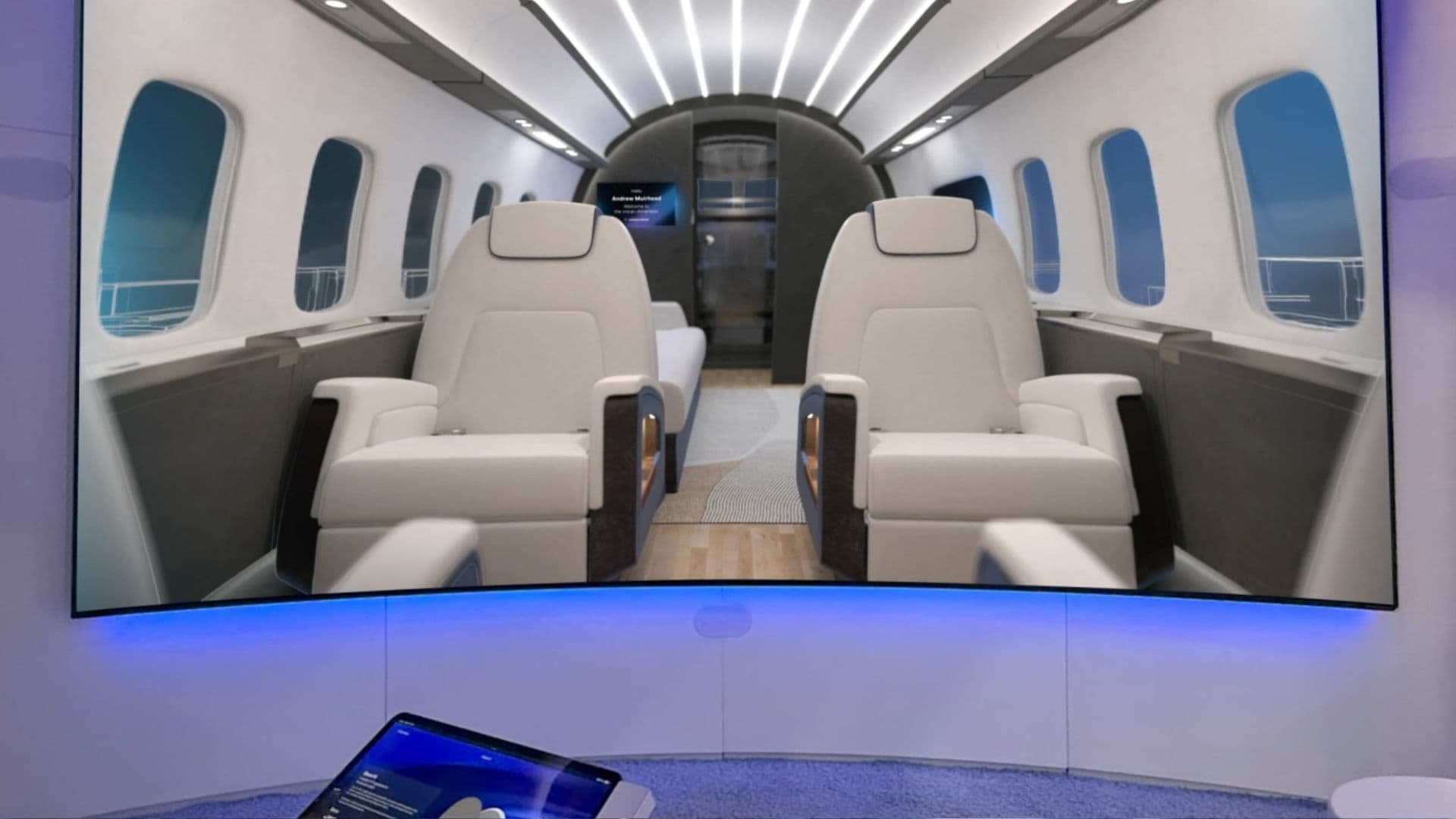
Immersive showroom for Lufthansa Technik in Las Vegas
Imagine me in a huge trade show hall in Las Vegas. Screens blinking everywhere, aircraft parts, a constant murmur of voices, music blasting from neighboring booths. In the middle of all this chaos, something is supposed to be created that does exactly the opposite.
Calm, focus, and a sound that doesn’t shout, but impresses. In front of me are ten extremely flat Omnify speakers, designed for VVIP cabins in private jets. The question is simple and at the same time quite complex: how do you stage these speakers so that people truly experience their quality instead of just talking about it?
The exclusive offering includes a selection of immersive experiences created specifically for the show, inviting visitors to dive into a new, multi-sensory world.
Out of this question, a project emerged that feels more like a boutique cinema than a trade fair booth. An enclosed space, a curated sequence, a multisensory experience.
Right at the center: the attempt to bring together spatial sound, technical know-how, and a very exclusive target group. The highlights of the project include the impressive sound staging, innovative audio technologies, and the special atmosphere that makes the experience unique.
Why
Starting point in a noisy trade show environment
Lufthansa Technik wanted to present its new Omnify speakers at the NBAA in Las Vegas. The target group were clients from the VVIP segment who plan high-end cabin systems for private jets. Expectations were accordingly high.
At the same time, everything took place at a classic aviation trade show. Open halls, tight booth spaces, lots of noise. A single speaker on a pedestal would have been easy, but in that environment no one would have been able to perceive subtle differences in sound quality.
So the core problem was this: how can I showcase a high-end loudspeaker when the environment does everything it can to drown it out? And how can I still create an exclusive atmosphere without blasting the neighboring stands?

Goal: A self-contained world of experience in a showroom instead of a booth
It became clear very quickly that a standard trade show booth wouldn’t be enough. Instead of an open presentation area, we needed a dedicated room. A place that would set itself apart acoustically and atmospherically from the rest of the hall.
My goal was an experience that could be played with, but still clearly guided. Guests shouldn’t just walk through a sequence, but consciously perceive how sound changes, how three-dimensional playback works, and what the system feels like when you’re sitting in a jet.
At the same time, the whole thing shouldn’t feel like a classic product feature video. It should feel more like a short visit to a world of its own. With sound at the center, but supported by light, scent, and tactile details.
How
Room concept – a semi-circular hi-fi listening room
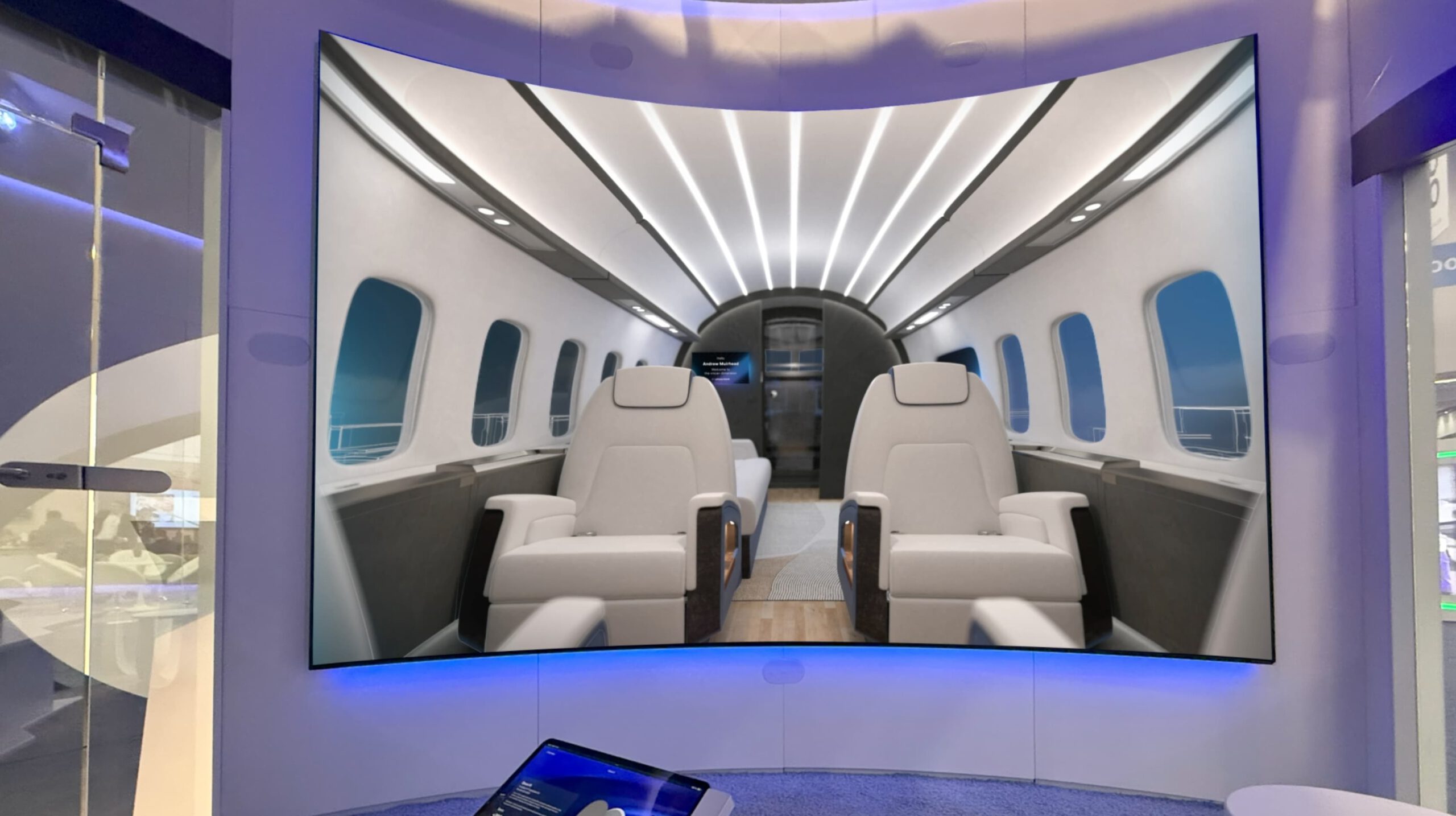
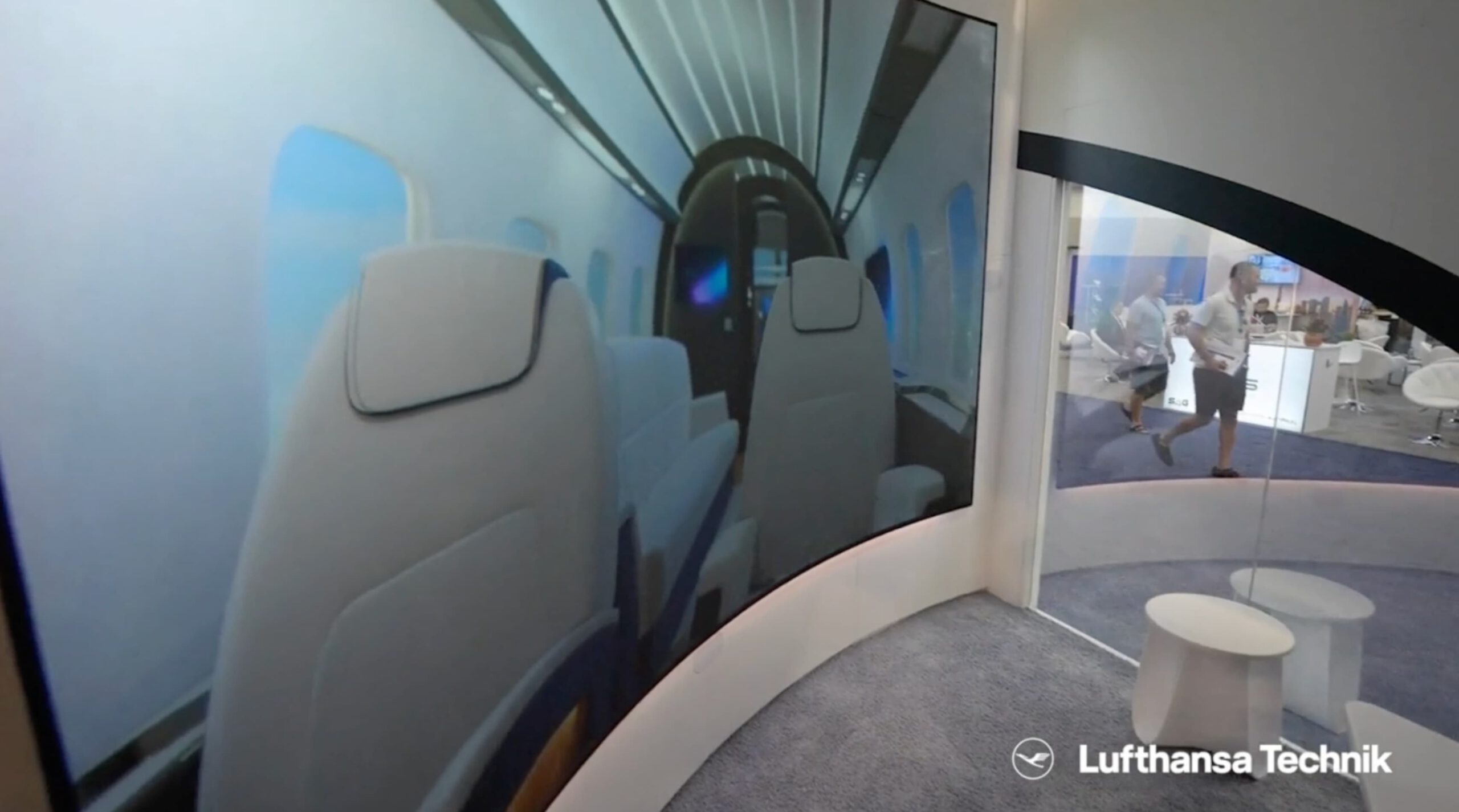
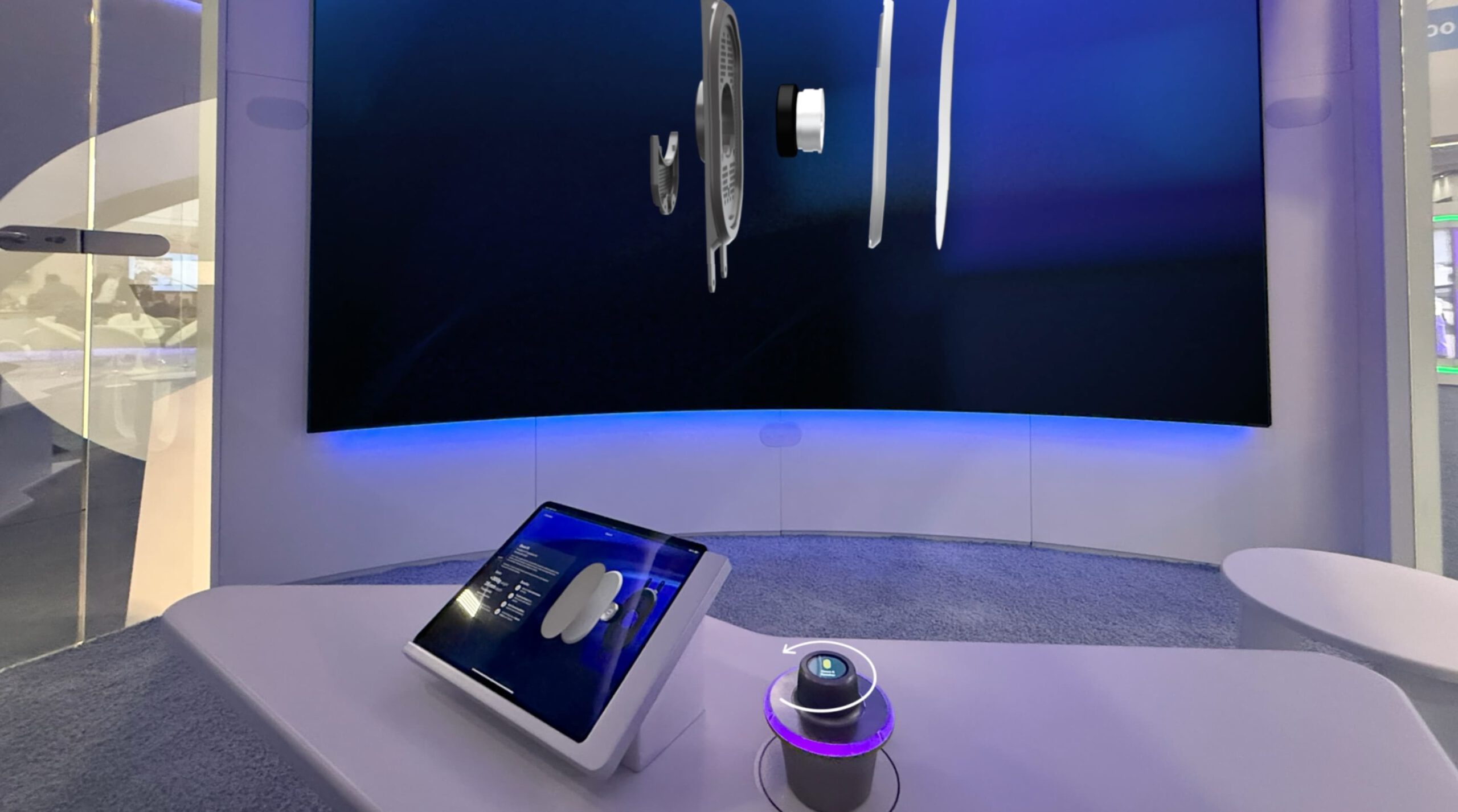
The solution was an enclosed showroom integrated into the booth. Inside, we created a roughly one-hundred-eighty-degree space with a wrap-around projection and ten Omnify speakers integrated into the walls.
The speakers were installed so that they were barely visible. Guests weren’t meant to stare at hardware, but to immerse themselves in a scene.
The technology was fully integrated into the room, not exhibited. Modern tech made it possible to seamlessly integrate the speakers and realize the immersive space. The door dampened sound to the outside and at the same time created a sense of intimacy.
The room itself worked like a small stage. A wide screen at the front, speakers all around, dimmed light, focused accents.
Moving images and visual projections were used together with the sound to create a holistic experience. It should be clear from the moment you stepped in: this is a different kind of brand presentation.
The audio setup was solved using the multichannel interface Audient Oria.
Multisensory – not just listening
It was important to me that the room didn’t only work through the ears. So we engaged several senses.
A particular focus was on sensory feedback: haptic and other multisensory stimuli intensified the immersive experience in the room and allowed visitors to sink into the environment even deeper.
The lighting was tuned to the content and the mood. Warm tones for calmer sequences, cooler accents for more technical passages. On top of that, there was a subtle scent concept that distinguished the room from the trade show hall.
Nothing overpowering – more like a gentle hint that you’ve just stepped into a different environment.
Snacks and drinks were carefully curated and offered in a personalized way. Not as large-scale catering, but as a small gesture that matched the VVIP expectations.
This made the room feel less like a trade show box and more like a lounge where cutting-edge audio technology just happens to be demonstrated.
Content structure – three layers of sound
For the content, I produced three soundscapes, plus a spatial sound demo and explanatory content. The soundscapes were conceived as artistic pieces that showcase the creative potential of immersive audio production.
The soundscapes served as an introduction. One setup was epic, with wide-opening sound fields and slow development. Another was quieter, with a focus on details and textures.
A third leaned more into nature and movement to highlight the spatial potential of the speakers. These soundscapes create different realities that listeners can dive into, experiencing a variety of virtual or artistic worlds.
It was important that these atmospheres didn’t just sound nice, but also provided clearly localizable elements in the room. Sounds audibly moving from front to back. Voices deliberately appearing from the sides. Movements that could be clearly followed along the semicircle.
There were also explainer videos that addressed the system’s technical advantages without slipping into pure marketing talk. These videos were tightly linked to the audio. When a feature was shown on screen, you could simultaneously hear what it sounded like.
The central sound demo used all ten speakers and fully pushed the limits of spatial distribution. The aim here was to show guests what’s possible when you have more than classic stereo positions available in a jet.
Control and personalization
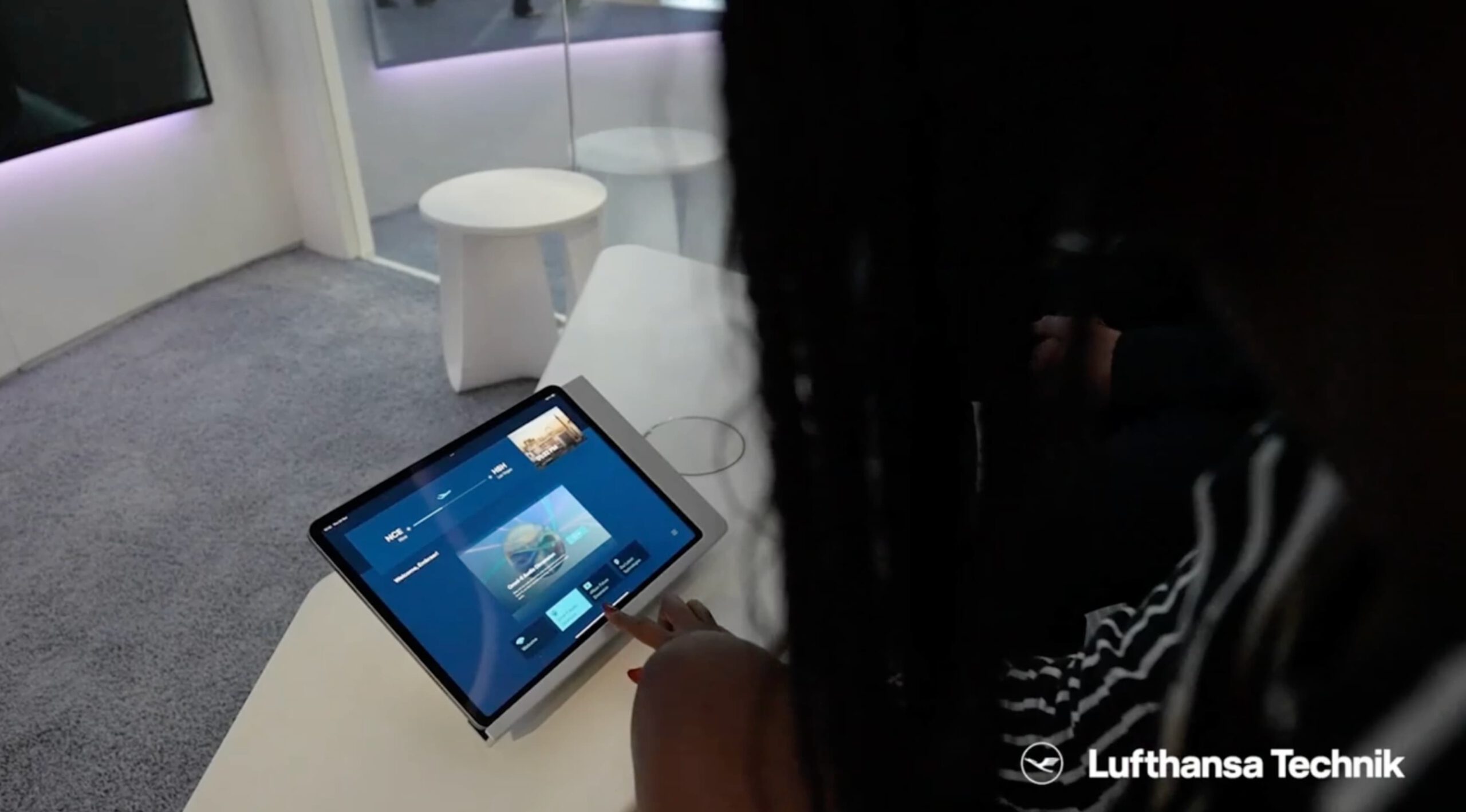
The entire installation was controlled via a touch interface. That made the flow simple and reliable for the booth staff. Different scenarios could be selected directly: welcome, soundscape selection, technical presentation, deep dive.
A key element was the personalized welcome. Guests were greeted by name, which immediately created a private, exclusive atmosphere. In a trade show hall with thousands of visitors, something like that is surprisingly powerful.
The content could be adapted to individual interests. It was possible to tailor the experience to the guests’ specific wishes and needs so that every visitor received a unique, immersive art experience.
Some guests mainly wanted to experience the sound quality. Others were more interested in integration into cabin systems or digital service platforms. Thanks to modular content and a clear structure, both were possible.
What
Sequence and outcomes from the guests’ perspective
For visitors, the experience began even before the door. They were invited to step away from the trade show hustle for a moment and enter an enclosed showroom.
The immersive experience is suitable for both families and friends, offering exciting opportunities to dive into the world of 3D audio together.
Inside, the visit started with a short welcome film and a personal address. The room was calm, the outside world quieter, the voice clearly positioned in the space.
Guests had time to get used to the environment before the speakers showed their full potential. During the experience, guests mastered various challenges together, making the immersive audio even more intense and interactive.
This was followed by a three-dimensional audio demo that deliberately played with movement in the room.
Sounds moved across the semicircle, receded into the distance, then returned. It became very clear why a multichannel solution in a jet can do more than a classic stereo installation.
After that, different product aspects could be explored in more depth. Depending on the conversation, different content was selected.
Sometimes the focus was more on sound, sometimes more on system integration or operation in the cabin context. The setup stayed the same, only the emphasis shifted.
The role of sound design
For me as a sound designer, this project was above all one thing: the opportunity to use spatial sound not as a special effect, but as the central design element of a brand experience.
Every sound in the room had a purpose. Atmospheres created depth and context. The sound design made the life and atmosphere in the room tangible and turned the immersive experience into something visitors could truly feel.
Moving elements demonstrated localization and precision. Spoken content held the dramaturgical arc together.
At the same time, I constantly had to keep the environment in mind. The room couldn’t be too loud on the outside, but not too quiet on the inside. Finding the sweet spot between impressive level and comfortable listening was crucial.
The mix of technology and emotion was also fascinating. It wasn’t about translating a measurement chart into sound. It was about conveying what it feels like to sit in a jet whose acoustics have been carefully thought through.
Impact
The showroom was fully booked for the entire duration of the trade show. Appointments were scheduled tightly, and yet the experience remained calm and focused for each group.
The feedback often boiled down to a single sentence: “I did not expect anything like this here.”
For Lufthansa Technik, the project was more than a product demo. It showed how technical innovation can be translated into a spatial experience that works both rationally and emotionally.
Sound, light, scent, snacks, and interaction concept all interlocked and created a coherent overall picture.
For me personally, the most important learning was that especially in noisy environments, closed, well-curated spaces can have enormous impact. And that spatial sound is most convincing when it’s not staged for its own sake, but serves a clear dramaturgical purpose.
Future developments in immersive shows will, driven by advances in AR and spatial computing, enable even more immersive and individualized experiences.
In the end, what remained was a showroom that made technical solutions for VVIP cabins tangible without simply putting them on display. Instead of a single loudspeaker on a pedestal, a small, self-contained world was created in which sound plays the leading role.
Conclusion
Immersive shows and exhibitions are transforming the way technical innovations and stories can be experienced. They offer new possibilities for interaction, personalization, and emotional connection, setting new standards for presentation across a wide range of industries.
This button links to my contact details