From VR Art to Immersive Experience – Atmos Sphaerae by Tamiko Thiel
A case study: Atmos Sphaerae by Tamiko Thiel — VR origin, immersive projection evolution, spatial audio architecture
Introduction to Immersive Art
Immersive art experiences redefine how audiences interact with digital art, spatial storytelling, and large-scale environments.
An immersive art experience combines visual, auditory, and sensory elements to fully engage visitors in a dynamic and interactive environment, emphasizing emotional impact and multi-sensory engagement.
Projection mapping, LED walls, interactive art systems, and immersive audio turn exhibitions into navigable digital realities.
Museums, galleries, and public art institutions expand their programming with multi-sensory formats that shift perception and place visitors directly inside the artwork.
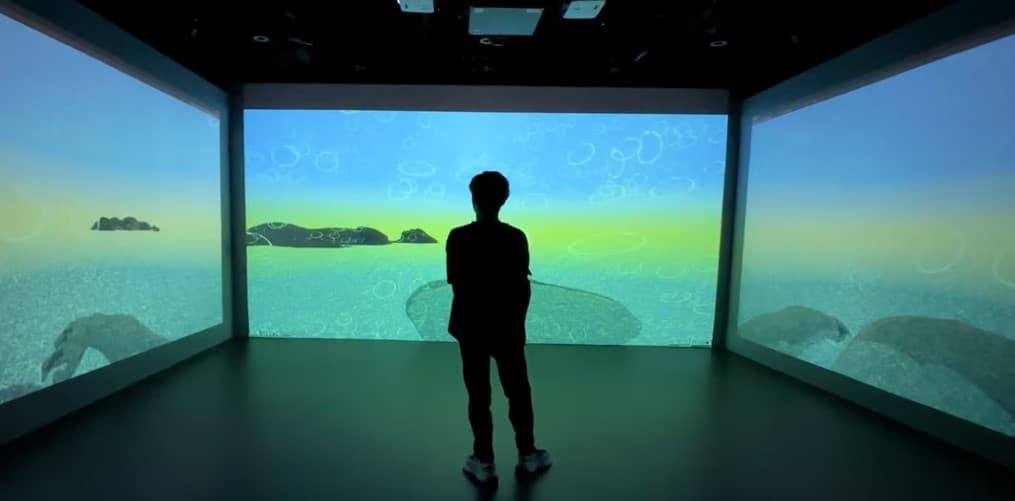
Atmos Sphaerae is a precise example. It started as a VR artwork and later became an immersive art installation using multi-screen projection and edge blending.
This transition demonstrates how immersive art can move between mediums without losing conceptual integrity.
Discover immersive art exhibitions and experiences that transform the way you engage with contemporary art.
WHY — The Purpose Behind Atmos Sphaerae
Atmos Sphaerae examines the history of Earth’s atmosphere across deep time. It treats atmosphere not as an abstract scientific diagram but as a physical and emotional environment. The goal is to expose invisible chemical and planetary processes by turning them into engaging sensory experiences.
The WHY is functional: audiences must feel atmospheric evolution. VR and projection are only delivery systems. The core idea is immersion through sensory alignment—light, motion, and spatial sound forming a coherent environment that stimulates the senses. Immersive audio becomes a primary tool to reveal structure, scale, and transformation.
HOW — Translating Scientific Processes Into Immersive Worlds
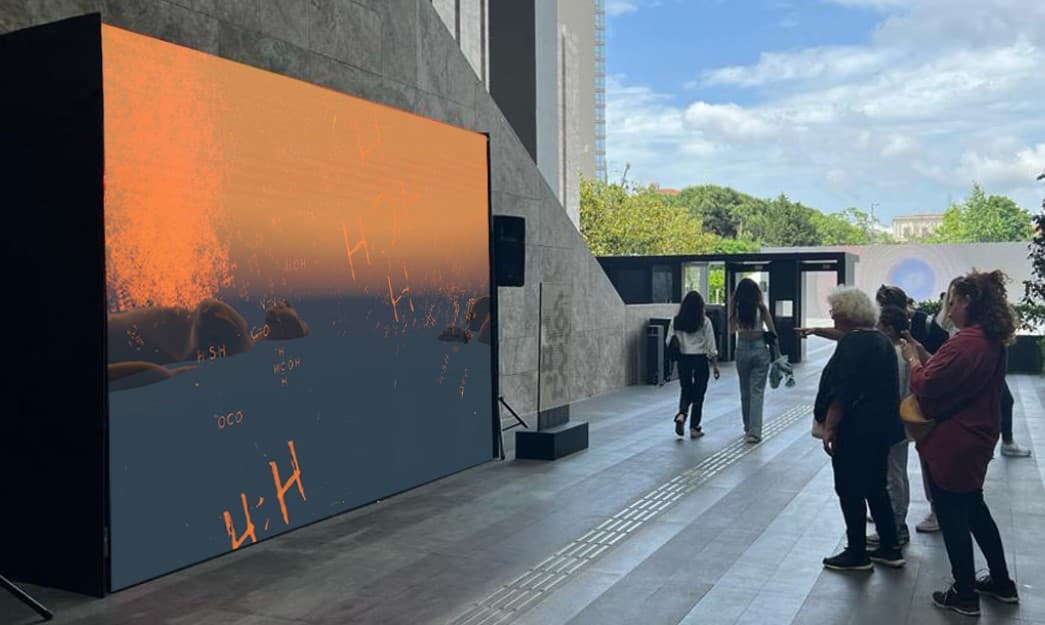
I developed the audio as part of a team together with artist Tamiko Thiel. We defined a creative framework where sound functions as the atmospheric backbone. My role: design and technically implement a spatial audio system that supports the artistic concept across VR and projection formats.
Immersive Audio as Structural Design
The immersive exhibition required audio that is not decorative but structural. Spatial sound marks transitions between planetary eras. Every environmental shift is encoded in the sound field.
Phase Logic of the Soundworld
- Cosmic Void: Minimal density, near-silent gradients, physical emptiness. Immersion built through absence.
- Volcanic Planet: Aggressive low-end, eruptive movement, a physical field of pressure and heat.
- Water World: Fluid transitions, continuous motion, a full immersive space shaped by organic patterns.
- Oxygenatio: Granular detail, micro-movement, molecular behavior translated into spatial motion.
- Runaway Greenhouse: Chaotic density, dissonant overlays, immersive sound used as warning signal.
VR to Immersive Projection — Technical Adaptation
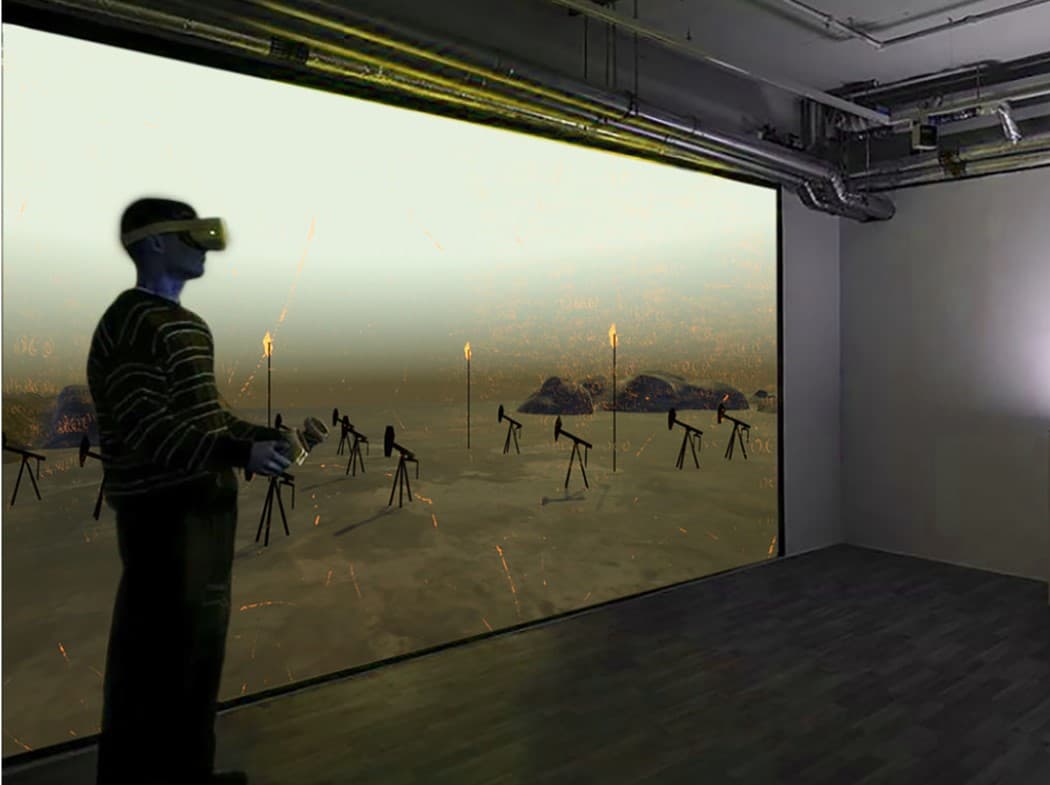
Atmos Sphaerae first premiered as a VR experience (DiMoDA 4.0). Later, it was re-engineered for multi-screen projection installations.
VR uses headtracking and personal immersion. Projection requires spatial stability across a room.
Projection mapping can transform physical objects and surfaces into dynamic visual canvases, turning objects into integral elements of the immersive art experience.
I rebuilt the audio environment with: – Wide atmospheric zones – Defined spatial axes – Loudspeaker alignment for edge-blended projection spaces – Controlled motion fields suitable for free-moving audiences
This turns the work into an immersive space accessible in museums, public art venues, and family-friendly environments.
WHAT — Deliverables and Implementation
I designed the complete spatial audio architecture for both formats:
- 3D-Audio conception and Ambisonics mix for the VR version
- Technical implementation for digital content workflows
- Multi-channel adaptation for LED walls, projectors, and edge-blended installations
- Alignment between visuals, projection mapping, and immersive audio
- Calibration for exhibition spaces in Europe and the USA
The result is an immersive exhibition that operates as both digital art and sensory experience.
Types of Immersive Experiences
Atmos Sphaerae aligns with the broader landscape of immersive art, a realm that encompasses a wide variety of environments and domains—including museums, public installations, interactive exhibitions, and digital realities.
The project demonstrates how scientific storytelling can thrive within formats that use projection, sound, and motion to construct fully immersive environments.
Interactive Art Installations
These large-scale environments integrate projection mapping, LED walls, and immersive audio to transform physical architecture into a dynamic narrative space. Visitors move freely, exploring the artwork as a spatial journey rather than a static display.
Atmos Sphaerae’s projection version belongs to this category, unfolding like a geological and atmospheric timeline made walkable.
Public Art and Corporate Events
Cities, festivals, and organizations increasingly use digital content and projection to create high-impact, sensory-rich environments. These installations communicate ideas through scale and spectacle.
Atmos Sphaerae’s atmospheric story and multi-layered soundworld position it as a strong candidate for such environments, where immersion becomes a tool for education and emotional engagement.
Immersive Spaces for Families and Kids
Children’s museums, science centers, and digital art venues create accessible immersive spaces that do not rely on VR hardware. They use light, motion, and immersive audio to stimulate imagination and curiosity.
Atmos Sphaerae’s projection-based installation supports this format, offering a vivid, understandable journey through Earth’s atmospheric evolution for all ages.
Immersive Art Technologies
Atmos Sphaerae uses the same advanced tools that define leading immersive destinations worldwide. Its transition from VR to projection showcases how digital art can adapt to different environments while maintaining narrative and emotional impact.
Projection Mapping and Edge Blending
Projection mapping transforms walls, ceilings, and architectural surfaces into one continuous digital canvas. Edge blending ensures smooth transitions between overlapping projections, enabling large panoramic displays that are essential for multi-screen installations.
LED Walls and High-Brightness Projectors
These technologies ensure clarity, brightness, and vivid color reproduction, allowing the molecular structures, geological transitions, and atmospheric shifts in Atmos Sphaerae to remain crisp and legible in high-light environments.

Immersive Audio
Spatial sound functions as the emotional and structural backbone of the installation. It guides perception, defines scale, expresses tension, and shapes narrative movement. In Atmos Sphaerae, immersive audio transforms scientific processes into a physical, sensory world.
Digital Content and Interactive Experience Design
The artwork relies on precise alignment between motion graphics, light, and sound. Digital content design gives coherence to the evolving atmospheric scenes, while immersive experience design ensures that transitions feel natural and narratively meaningful.
Virtual and Augmented Reality
Atmos Sphaerae originated as a VR experience and later expanded into projection-based formats. This mirrors a larger trend in immersive art: VR prototypes often evolve into large installations as artists scale their ideas into public space.
Notable Immersive Exhibits — Context and Position
Atmos Sphaerae stands alongside global leaders in immersive art such as the Van Gogh immersive exhibition, which presents Van Gogh’s iconic works in a new way through innovative technology like large-scale projections and virtual reality, the Arte Museum’s Eternal Nature, and Superblue Miami.
These destinations demonstrate how projection mapping, digital art, and immersive audio can create environments that challenge perception. Atmos Sphaerae contributes to this movement with a scientifically grounded, sensory-driven narrative about Earth’s atmospheric history.
Immersive Worlds and Destinations
The immersive art movement has expanded internationally, with cities and institutions dedicating significant space to digital realities.
Locations and Context
- Large-scale installations across the USA
- Immersive art hubs such as Miami
- Digital art museums and contemporary exhibition venues
Atmos Sphaerae’s projection format is compatible with these environments, enabling presentations in galleries, festivals, and public art settings without requiring VR equipment.
Global Immersive Experiences
Across the globe, immersive experiences are taking center stage, transforming how audiences interact with digital art and culture.
From the neon-lit avenues of Tokyo to the historic heart of Europe, cities are embracing immersive art exhibitions that blend projection mapping, interactive exhibits, and digital realities.
These installations invite visitors to step inside the artwork, creating unforgettable moments that linger long after the visit ends.
Destinations like Superblue Miami exemplify this trend, offering a dynamic space where art, technology, and entertainment converge. Here, immersive experiences are not just viewed—they are lived, as visitors interact with digital projections and become part of the creative process.
As the appetite for immersive exhibitions grows, new venues and pop-up installations are emerging in cities worldwide, each pushing the boundaries of what art can be.
Whether you’re exploring a digital rainforest in Seoul or wandering through a projection-mapped cathedral in Paris, the world of immersive art is more accessible—and more exciting—than ever before.
Understanding Immersive Experiences
Immersive experiences depend on the orchestrated interaction of sensory elements—sound, light, motion, and projection. When aligned, these elements build environments that challenge perception and create emotional resonance.
In Atmos Sphaerae, immersion becomes a storytelling device. Instead of reading about atmospheric evolution, visitors navigate it physically: the void, volcanic heat, water formation, oxygenation, and climatic instability become spatial events.
Immersive Art and Culture
Immersive art and culture are redefining the creative landscape, inviting audiences to engage with art in ways that are both interactive and deeply personal. Through immersive art experiences that combine immersive audio, interactive exhibits, and digital realities, artists and curators are crafting environments that challenge traditional boundaries and spark the imagination.
The Arte Museum stands as a beacon of this movement, offering visitors an unforgettable experience where digital art, sound, and interactivity merge to create new worlds. These immersive environments encourage visitors to move, touch, and listen, making each journey through the museum a unique creative adventure.
As artists continue to experiment with digital tools and interactive formats, immersive art is poised to challenge perceptions, inspire dialogue, and foster a deeper connection between art and audience. The result is a vibrant, ever-evolving cultural landscape where creativity knows no limits.
The Power of Immersive Art
Immersive art possesses a unique ability to transport us beyond the ordinary, opening doors to new worlds and fresh perspectives. By harnessing the power of projection mapping, digital art, and interactive exhibits, immersive exhibitions create environments that fully engage the senses and invite visitors to become active participants in the story.
The Van Gogh immersive exhibition is a prime example, using state-of-the-art technology to breathe new life into the artist’s iconic works. Here, visitors don’t just view art—they step inside it, experiencing the swirling skies and vibrant colors as if they were part of Van Gogh’s world.
This ability to create immersive environments that blur the line between observer and participant is what sets immersive art apart. As technology advances, we can expect even more innovative exhibitions that push the boundaries of creativity, offering visitors the ability to experience art, life, and imagination in entirely new ways.
The Future of Immersive Art
Immersive art technologies are moving beyond galleries into education, healthcare, public art, and corporate environments. Projection mapping, immersive audio, interactive exhibitions, and VR/AR storytelling create new possibilities for conveying complex ideas.
Atmos Sphaerae reflects this shift by using immersive tools to communicate scientific knowledge through sensory experience.
Immersive Experience Examples
Atmos Sphaerae follows the experiential design principles used in leading immersive destinations such as the Arte Museum’s Eternal Nature, Superblue Miami, and the Van Gogh immersive exhibition.
These spaces prioritize sensory clarity, multi-channel projection, interactive environments, and spatial sound. Atmos Sphaerae adds scientific depth, transforming atmospheric history into an immersive world.
The Benefits of Immersive Experiences
Immersive exhibitions offer:
- Increased engagement through multi-sensory design
- Enhanced learning through embodied experience
- Strong emotional resonance and memorable encounters
- The ability to communicate complex topics through spatial storytelling
Atmos Sphaerae leverages projection and spatial sound to create a direct, physical encounter with planetary processes—turning Earth’s atmospheric evolution into a vivid, unforgettable experience.

Preservation and Education
As immersive art continues to evolve, preserving its legacy and harnessing its educational potential become increasingly important. Interactive exhibits and digital realities are not only captivating for visitors—they also serve as powerful tools for teaching art, history, and culture in engaging, memorable ways.
Museums and educational institutions are integrating immersive and interactive experiences into their programs, allowing students and visitors to explore complex topics through hands-on digital environments. This approach brings history and creativity to life, making learning both accessible and inspiring.
At the same time, efforts to document and preserve digital and immersive art ensure that future generations of artists, curators, and visitors can continue to learn from and build upon these groundbreaking works. By prioritizing preservation and education, the art world safeguards its innovative spirit and ensures that the magic of immersive experiences endures for years to come.
Contact me!